Iran's Khamenei Is Dead. The Real Contest Is Just Beginning.
With Ayatollah Khamenei confirmed dead and the country's three-branch leadership paying its respects, the question is no longer who leads Iran — but which faction writes the rules for whoever does.
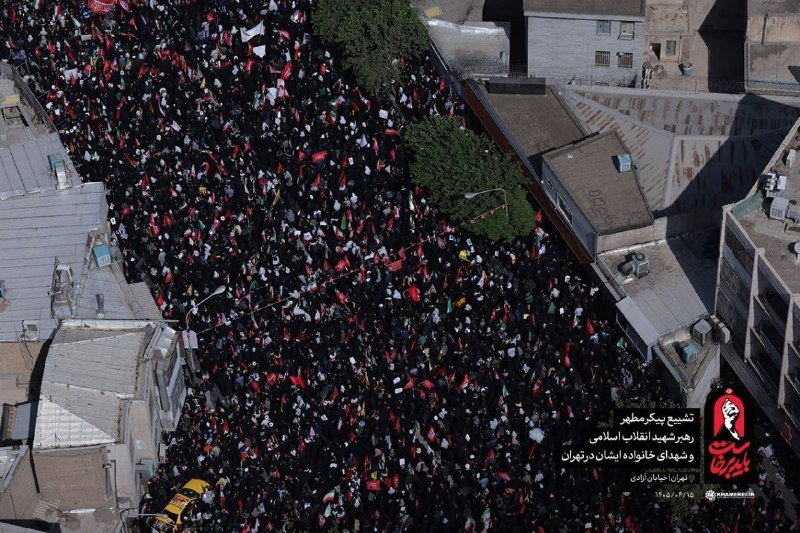
The family of Ayatollah Ruhollah Khomeini paid their final respects on Friday to the body of Ayatollah Seyyed Ali Hosseini Khamenei, the Supreme Leader of the Islamic Republic since 1989. Iran's heads of the three branches of government, the First Vice President, Foreign Minister Abbas Araghchi, and Major General Mohsen Rezaei — secretary of the Expediency Discernment Council — were among the senior figures who followed. The two Telegram channels operated in Khamenei's name carried the same footage within minutes of each other, a choreography of state-media coverage that Iran-watchers will recognise as the visual signature of a managed transition.
The death, framed by Iranian outlets as martyrdom, ends nearly four decades of personal rule and opens the most consequential succession contest the Islamic Republic has ever staged. The question is no longer who formally occupies the office. It is which faction defines the boundaries of the office for the next occupant — and whether those boundaries are narrower or wider than the ones Khamenei himself enforced.
The choreography of succession
The footage matters as much as the fact. The Khomeini family's presence at the bier signals legitimacy flowing from the revolution's founding lineage. The attendance of the heads of the executive, judiciary and legislature demonstrates intra-branch coordination. The presence of Rezaei, a former Revolutionary Guards commander turned institutional elder, ties the moment to the security establishment that has become Iran's de facto praetorian guard.
What is conspicuously absent from these dispatches is any public name for a successor. Iran's constitution provides for an interim council of clerics, headed by the president and including the head of the judiciary and a member of the Guardian Council, to manage a 50-day transition. But the actual selection of a new Supreme Leader has always been a factional negotiation inside the Assembly of Experts, not a constitutional procedure. The choreography on display is the choreography of buying time.
What the factions actually want
Three tendencies will fight for the chair. The traditionalist clerical faction, anchored in Qom and the seminary network, wants a quiet, scholarly, ageing figure who will defer to the Council of Guardians on social and doctrinal questions. The principlist security faction, anchored in the IRGC and the bonyads, wants a pliable jurist who will sign whatever the security apparatus drafts. And a third current — younger, technocratic, more comfortable with the language of managed re-engagement with the outside world — wants a leader who will allow Iran's damaged economy to breathe without conceding the regime's monopoly on power.
Each faction's preferred candidate is less important than what each candidate would allow. The traditionalists will tolerate a tighter ideological perimeter because that is how they retain clerical authority. The security faction will tolerate economic liberalisation because they control the licenses. The technocratic current will tolerate neither doctrinal micromanagement nor security dominance, because both choke the economic space they need.
Why this matters beyond Tehran
The succession is not a domestic Iranian story. Khamenei was the central node in an axis of resistance that runs from Tehran through Baghdad, Damascus and Beirut to Sanaa. Every militia commander in that chain calibrated behaviour against his known preferences. A new Supreme Leader, whoever they are, will inherit a network that has been visibly weakened over the past two years — and a regional environment in which the United States, Israel and the Gulf states are all reading the same internal Iranian moment and adjusting accordingly.
There is a counter-narrative worth taking seriously: that the Islamic Republic's institutional depth makes succession a formality, not a crisis. The constitutional machinery exists. The factional players are known. The IRGC has managed plenty of internal turbulence since 1979. Under this read, the regional architecture adjusts slowly, the network recalibrates, and the regime endures.
The structural counter to that read is that no succession in the history of the Republic has happened under these conditions — a degraded Hezbollah, a fractured Syrian corridor, a Houthi movement under sustained air campaign, and a sanctions architecture that has become a permanent feature of Iran's external operating environment. The factions will not be choosing a leader for an Iran at peace. They will be choosing one for an Iran in siege.
Stakes over the next 50 days
Inside Iran, the practical stakes are immediate. Currency stability, fuel pricing, subsidy allocation and the regulatory treatment of the private sector will all signal which faction has captured the relevant portfolio. The appointment of an interim council head, the sequencing of the Assembly of Experts vote, and the language of the official eulogies — martyrdom language, as already deployed, versus more measured formulations — will telegraph direction.
Outside Iran, the practical stakes are sharper. Oil markets will price in uncertainty. The Gulf states will probe Iran's perimeter to test whether the new leadership has the bandwidth to retaliate. The United States and Israel will weigh whether a transition window opens space for diplomacy, or whether the security faction's instinct to demonstrate continuity through action closes that window. The corridor from Tehran to Beirut is, for the moment, the single most consequential piece of geography in Middle Eastern geopolitics.
What remains uncertain — and the public sources available do not resolve it — is whether the Assembly of Experts will be permitted to act as a genuine deliberative body or whether the security faction will pre-empt the process with a fait accompli. The footage released so far shows unity. The next fifty days will show whether the unity was real or staged.
This publication has reported on Iranian succession politics since the 2009 Green Movement. The framing here draws on Iranian state-media coverage as primary source material, with the structural context inferred from two decades of reporting on the Islamic Republic's factional architecture.
Wire provenance
This editorial synthesis draws on the following public wire/social posts:
- https://t.me/Khamenei_it
- https://t.me/Khamenei_it
- https://t.me/tr_khamenei_ir
- https://t.me/tr_khamenei_ir