The funeral that became a frame: Iran, mourning, and the camera
CNN called Khamenei's funeral Iran's victory parade. Iranian state media called it a global witness to loss. Both readings tell us less about the ceremony than about who gets to define it.
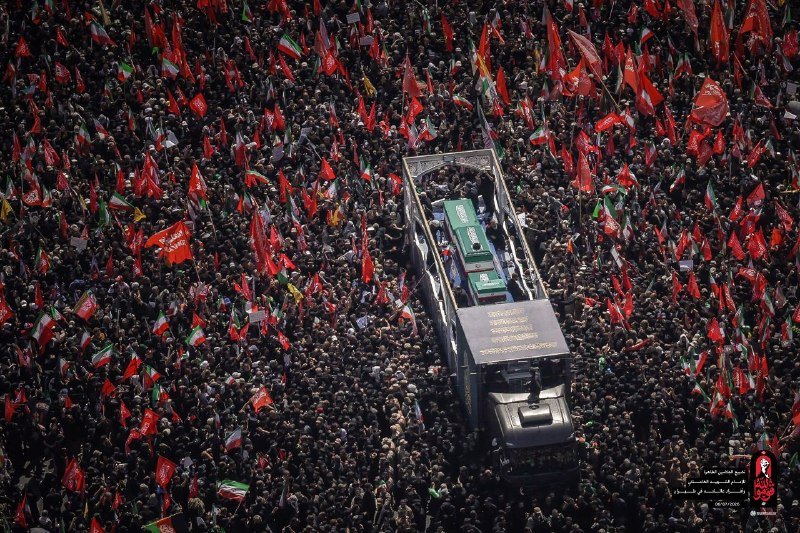
On 3 July 2026 the world was given two funerals for the same man. CNN described Ayatollah Khamenei's procession through central Tehran as "Iran's victory parade," emphasising what its reporting called the management of millions of mourners and what it framed as unprecedented security measures. Within hours, Tasnim News and its English-language channel carried the inverse reading: a lament cast in religious register, in which an African guest on Iranian state-aligned television declared that "with the martyrdom of Ayatollah Khamenei, we lost the light." The two accounts point at the same streets, the same crowds, the same closed airspace. They are not arguing about facts. They are arguing about who owns the camera.
The funeral of a paramount leader is, by definition, a piece of political theatre in which the optics are the message. What this week's coverage illustrates is not whether the Iranian state can marshal a million people — it plainly can — but how Western wire framing and Iranian state framing have settled into a mirror contest, each insisting on the version that flatters its own priors. CNN sees a parade; Tasnim sees a witness. The truth on the ground is almost certainly both, and neither.
The parade reading
The CNN framing, as relayed by Iranian outlets themselves on 3 July, leans on three observable features: the scale of the crowd in and around Enghelab Square and Azadi Square, the logistical choreography required to move that crowd through central Tehran, and the conspicuous security envelope around the procession. The "victory parade" formulation is doing two things at once. It concedes the regime's organisational capacity, which is real and was visible from hours of live footage. And it folds that capacity into a script — martial, triumphalist, Stalinist — that lets Western viewers read the mourning as performance rather than grief. The phrase is the analysis.
This is the dominant Western wire frame, and it is not baseless. State funerals in the Islamic Republic have long functioned as simultaneous rites of passage and demonstrations of control. The 1989 funeral of Ayatollah Khomeini and the 2020 ceremony for the IRGC Quds Force commander Qassem Soleimani both staged grief as a posture of regime legitimacy. To call the present ceremony a parade is, in that sense, to fit it into a known typology.
The witness reading
Tasnim's English channel, by contrast, foregrounded the affective register. The same day's coverage spotlighted a guest from the African continent invoking the language of martyrdom — a vocabulary that, in Shia political theology, is not metaphor but doctrinal category. The framing being offered is not that millions turned out because they were paid or coerced, though both certainly occur at the margins of any such event. It is that the scale of attendance is itself evidence of something the Western frame refuses to credit: that for tens of millions of Iranians and Shia communities across Africa, South Asia, and the Arab world, the death of Khamenei registers as a genuine spiritual rupture.
This, too, is not baseless. Iranian state-aligned outlets are not neutral — they are organs of the state, with editorial discipline to match. But the populations they speak to are not imaginary, and the grief is not staged for foreign cameras alone. The al-Khoei Foundation in Najaf, the Hezbollah-aligned press in Beirut, and Shia communities from Karachi to Mombasa to Dar es Salaam have, over decades, built dense cross-border networks of religious affiliation that respond to events in Qom and Mashhad with intensity Western wire desks tend to discount.
Why both frames flatten
What neither reading captures is the third thing on the street: a country that is exhausted, polarised, and watching its own future being negotiated in real time through the body of its dead leader. Coverage that reduces the moment to "parade" tells readers what to feel about the regime. Coverage that reduces it to "martyrdom" tells readers what to feel about the mourners. Neither asks what the mourners, polled today, would say about the direction of the country in five years' time — a question Iranian civil society has been asking in more sober venues for months.
The structural problem is camera placement. Western satellite trucks were positioned to capture scale and order. Iranian state cameras were positioned to capture devotion and international solidarity. A reader who sees only one of those feeds inherits its thesis without contest.
What is at stake
A succession crisis inside the Islamic Republic is not a parochial event. Iran's influence runs through Hezbollah in Lebanon, through the Houthi war effort in Yemen, through a network of Shia militias in Iraq, and through the Syrian corridor that is itself now under renegotiation. How the new Supreme Leader consolidates authority in the months ahead will shape which of those assets are preserved, which are spent, and which are sacrificed to internal rivals. The funeral procession is the first live test of that authority. Treating it as pageant, or treating it as pure lament, leaves readers unprepared for the policy choices that follow.
The most useful question is also the most boring one: who is in the photo. Officials visible in the front rows of the procession, clerical figures seated in the inner circle, foreign dignitaries whose presence signals which alliances the next administration intends to honour — those are the data points the wire cycle has been least willing to parse. Both "parade" and "martyrdom" are easier to broadcast. Neither is journalism.
Wire provenance
This editorial synthesis draws on the following public wire/social posts:
- https://t.me/tasnimnews_en
- https://t.me/JahanTasnim
- https://t.me/tasnimnews_en