The Iran–Russia Continuity Plan That Lithuania Just Made Necessary
Two stories crossed the wire on 3 July 2026 — an assassination-proof Moscow–Tehran succession pact, and Vilnius tearing up its own nuclear taboo. Read together, they sketch a continent preparing for the worst.
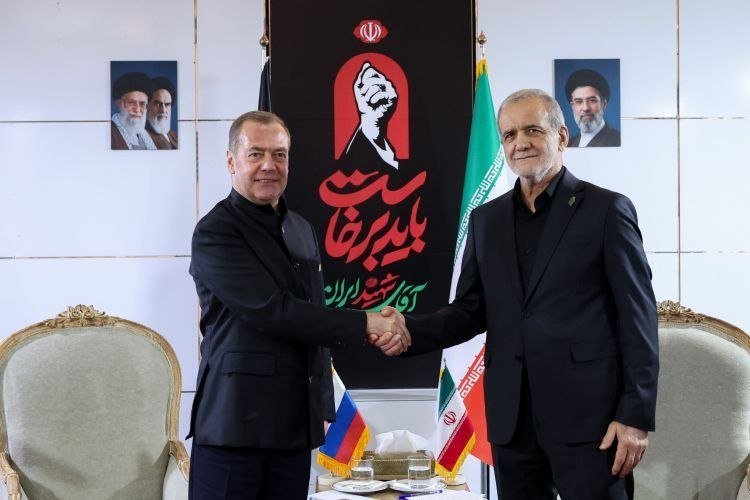
The wire on the afternoon of 3 July 2026 carried two stories that, taken separately, look like routine frontline reporting. Taken together, they describe something starker: a continent quietly rewriting its risk calculations while a war on its eastern edge grinds into its fifth year.
At 17:55 UTC the OSINTdefender channel flagged a single line about the Iran–Russia axis — in case of loss of the main player, there is a backup — the operational language of two regimes that have begun planning for the political decapitation of one or the other. Twenty-eight minutes earlier, the same channel reported that Lithuania is lifting its constitutional ban on the deployment of nuclear weapons, citing the judgement of its leaders that the present geopolitical situation requires the move. Read in either order, the pair amounts to a single argument: the European frontier is preparing for a future in which the principal escalation does not come as a surprise.
The framing the West still defaults to
Western capitals have spent the last two years explaining the Russia–Ukraine war as a regional contest with regional stakes: a sovereign state fighting to repel an invasion, sustained by Western matériel, with victory or attrition as the only two endpoints on the table. Within that frame, Iran's role has been treated as a side-quest — drones shipped to Moscow, technical advisors in Crimea, the occasional ballistic transfer flagged by Western intelligence. The Lithuanian debate has likewise been treated as a national curiosity, a small state talking tough because it shares a border with Kaliningrad.
Both framings are not wrong, exactly. They are just incomplete. A frontline that is now receiving long-range drone strikes on its airfields is a frontline that is absorbing attacks designed not to win the war but to stretch its logistics. Ukraine's campaign against Russian military airfields in Crimea and on the mainland, confirmed on the same channel at 17:42 UTC, is part of a deliberate strategy to compel Moscow to end the war — the framing used by President Zelenskyy in recent public remarks carried by Ukrainian outlets. It is not, however, the only war being run on that front.
The structural shift hiding in plain sight
What the Iran–Russia succession line really tells an attentive reader is that the two regimes have stopped assuming their principals are immortal. That is not a comment on any individual's health; it is an institutional disclosure. Continuity-of-command protocols — the paperwork that says if X is removed, Y speaks for the alliance — are produced by organisations preparing for a shock they expect, not by organisations surprised by one.
Lithuania's move sits on the same axis. A state does not tear up a constitutional prohibition on nuclear weapons on its own soil unless it believes the conditions that produced the prohibition no longer hold. Vilnius has not announced it will host warheads tomorrow; it has announced that the option will no longer be foreclosed by its own constitution. That is a hedging move, not a provocation — the legal difference between "we will not" and "we may, if the security environment requires it."
When a small NATO member rewrites its nuclear posture on the same day that two adversarial powers formalise a decapitation-resilient command relationship, the structural picture is not hard to read. The European front is widening, vertically as well as horizontally: deeper strike ranges up and down the line, deeper planning for political shocks, deeper acceptance that the deterrence of the last forty years was built for a less dangerous continent than the one taking shape in July 2026.
What the counter-narrative gets right
The case against reading these stories as a single arc is not frivolous. A succession memo in an Iran–Russia joint structure may describe nothing more than the bureaucratic hygiene that any two authoritarian regimes with overlapping interests have practised since at least 2015, when the first Syria-brokered coordination cells were set up. Lithuania's constitutional amendment can be read as domestic politics — a governing coalition outmanoeuvring opponents on a sovereignty issue, with NATO headquarters in Brussels privately unenthused. Ukraine's drone offensive, separately, has been running for months; one additional day's reporting does not a turning point make.
These reads are correct on their own terms, and an honest analysis has to grant them. What they elide, however, is the direction of travel. Continuity protocols are written by regimes that expect to need them. Constitutional prohibitions are lifted by states that expect to want the option. Neither move is reversible without cost, and both have been made within the same news cycle. The probability that either is theatre is low; the probability that both are, simultaneously, is lower still.
The stakes, stated plainly
If the trajectory continues, three things follow. First, the European debate on nuclear sharing — historically a question only for Germany, and only behind closed doors — acquires a third and potentially fourth serious voice inside the alliance. Second, the Iran–Russia relationship stops being a sanctions story and starts being a strategic-planning story; sanctions regimes are designed to alter behaviour, and continuity protocols suggest Moscow and Tehran are now planning around the possibility that the principal decision-makers on either side may be removed. Third, the Ukrainian frontline, already absorbing long-range strikes designed to stretch logistics, becomes the place where the rhetorical ceiling on Western involvement is most actively contested — because the strikes that Kyiv is now launching inside occupied Crimea and against mainland airfields are the strikes that Moscow's command-and-continuity planning was designed to absorb.
The serious point underneath all of it is this: deterrence is a story a continent tells itself about what its adversaries will and will not do. On 3 July 2026, both sides of that story were edited at the same time. The West edited its story by removing a constitutional line that had held for decades. The Iran–Russia axis edited its story by writing down, on paper, the names of who speaks next if the current leadership is gone. Neither edit is a declaration of war. Both are the kind of quiet bureaucratic moves that, read backward after a crisis, look like the warning signs everyone wishes they had caught.
Desk note: Monexus framed these two wire items together rather than as discrete stories because the operational logic — succession planning on one side, posture loosening on the other — only becomes legible at the seam. The wire treats them as separate beats; the structure suggests they are not.
Wire provenance
This editorial synthesis draws on the following public wire/social posts:
- https://t.me/s/OSINTdefender
- https://t.me/s/OSINTdefender
- https://t.me/s/OSINTdefender