The farewell that wasn't: reading the Khamenei succession through who came to mourn
Delegations from Amal, the Persian Gulf, India, and Germany's Shia communities are filing past a body in a Tehran ceremonial hall. The list of mourners is itself the document.
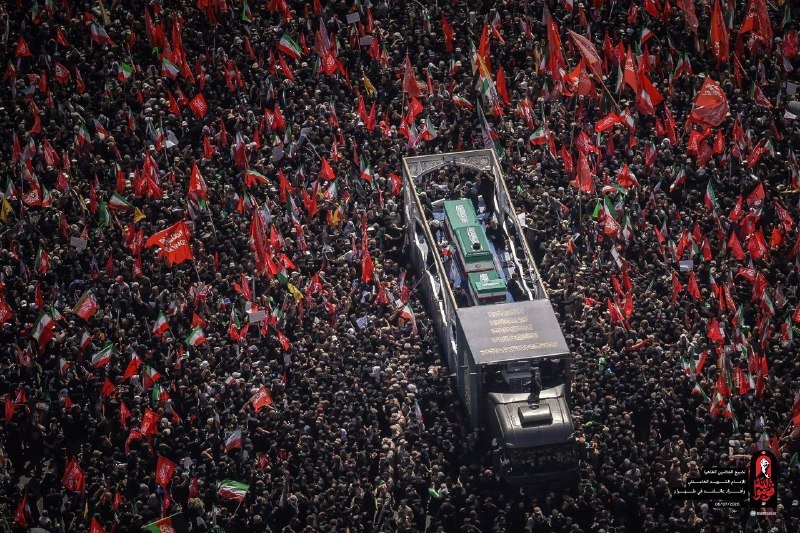
On the afternoon of 3 July 2026, a delegation of the Amal Movement of Lebanon filed through a ceremonial hall in Tehran to pay its respects at the bier of Ayatollah Seyed Ali Khamenei, the supreme leader of the Islamic Republic of Iran, whose death the state has framed as martyrdom. The Amal procession was one of at least four foreign tribute delegations documented by the office's official Telegram channel on the same day: a contingent of Shia faithful from the Persian Gulf states at 14:18 UTC, the Amal Movement at 14:08 UTC, a wider "Resistance Front" delegation of personalities and elites at 13:58 UTC, and an earlier group of Indian community leaders alongside Shia worshippers from Thailand and Germany at 15:18 UTC. The official framing in each Telegram caption uses the honorific "the martyred Leader of the Islamic Revolution" and the formulation "purified body," a register reserved for the highest figures of the Republic.
The delegations are themselves the document. Khamenei's death does not so much produce a foreign-policy realignment as expose one that has been running, in slow motion, since 1989. The question the next seventy-two hours will answer is not who grieves loudest, but who is invited to grieve at all, and what that list signals about Tehran's assessment of its own margin.
Reading the guest list
A mourner list, like a board meeting, reveals priorities. The most operationally telling name on the day's roster is the Amal Movement: the Lebanese Shia party co-founded by Musa al-Sadr in 1974, led in its current form by Nabih Berri, the long-serving speaker of the Lebanese parliament. Amal is not Hezbollah. It is older, larger among Lebanon's Shia, and considerably more cautious in its public liturgy. That Berri's movement has dispatched a senior delegation to pay tribute in person in Tehran, in a format the official channel recorded, is a public signal of political alignment in a moment when Lebanese Shia movements have reason to triangulate.
The "Resistance Front" delegation is the wider category. Telegram posts at 13:58 UTC reference a group of "personalities and elites of the Resistance Front," the formal Arabic term Iran uses for the network it has spent four decades financing, arming, training, and sheltering. The Persian Gulf contingent and the India-Germany-Thailand visitors are softer signals: clerical-diaspora solidarity, not military pact, and a reminder that the Republic's religious constituency extends well beyond the borders that Western coverage of Iran usually draws.
The counter-read
The default Western framing of an Iranian leadership transition is a hard-edged balance-of-power story: who inherits the Revolutionary Guard portfolio, who controls the foreign-ministry files, whether the next supreme leader is a cleric or a general, what happens to the nuclear file. Telegram footage of a cleric with a turban and a wreath fits that frame and disappears inside it. The counter-read, more common in Arab and wider Global-South commentary, is that the ceremonial choreography itself is the policy. A state that has spent thirty-seven years building a foreign constituency in the language of martyrdom does not abandon that vocabulary in the first week of a succession. It doubles down on it, because the audience that responds to that vocabulary is the same audience the next leader will need to keep.
That is also why the Amal visit matters more than its size suggests. A transition in Tehran is, for Beirut, a transition in patronage as well as in principle, and Amal's presence in the hall is a quiet statement to the Lebanese Shia public that the older, state-aligned pole of Lebanese Shia politics still has standing in the new capital.
Structural frame
What is being choreographed here is not a funeral but a continuity demonstration. Iran has not, in its official communications, used the word death without the word martyrdom. It has not presented the body without the word purified. The delegations are arranged so that the camera reads them in a fixed order: the Lebanese Shia political class, the wider Resistance Front, the Gulf Shia community, the Indian subcontinent. The message to each audience is calibrated — to the Lebanese, that Amal is still the political interlocutor of first resort; to the wider Resistance, that the new order is their order; to the Gulf Shia, that Tehran remains a pole of authority for the Shia across the Gulf monarchies; to South Asia, that the seminary system in Qom and Mashhad still serves the global Shia umma.
Inside Iran, the absence of comparable Telegram coverage of any senior Western or Gulf-state-Arab official visit is the equally telling half of the same message. The next leader's first foreign audience is being defined in advance as the audience Iran already has.
Stakes
If the choreography holds, the next administration in Tehran inherits a foreign-relations architecture that is less Western-facing and more confessional, less state-to-state and more movement-to-movement, than the one Khamenei inherited in 1989. The risk of that trajectory is not, on the evidence of the day's posts, an abrupt rupture with any state, but a steady re-weighting of Iran's diplomatic bandwidth toward the networks that the mourner list names.
What remains genuinely uncertain is the leadership question itself. The Telegram posts do not name a successor or a presumptive acting authority, and the office's captions continue to refer to Khamenei in the present-tense vocabulary of martyrdom rather than in the past tense of biography. That is consistent with a state still managing its own transition out loud, and a press room still catching up.
This publication read the day's official Telegram captions as a single text, and read the order of delegations as a policy signal in its own right. The wire services have largely led with the personnel question; the more durable story this week is the audience question.
Wire provenance
This editorial synthesis draws on the following public wire/social posts:
- https://t.me/Khamenei_es/0
- https://t.me/Khamenei_es/0
- https://t.me/Khamenei_es/0
- https://t.me/Khamenei_es/0