The Optics of a Funeral: Why the Mourners at Khamenei's Coffin Matter
A row of dignified visitors at the Supreme Leader's coffin is meant to project an unbreakable front. The list of who shows up — and who doesn't — tells the more honest story.
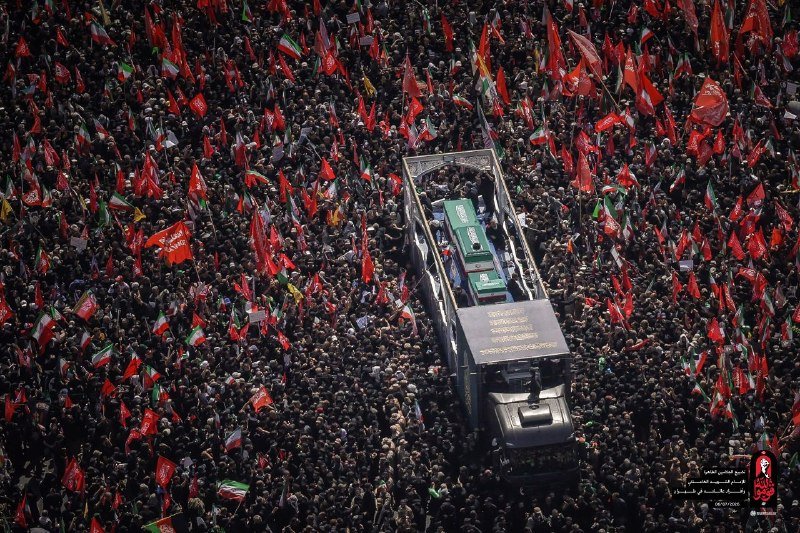
In the courtyard outside the Iranian parliament on Friday afternoon, the mourners file past the coffin's edge with the choreography of a regime rehearsing its own continuity. The visitors' book is the story. A Turkish vice president on Friday 3 July 2026, Cevdet Yılmaz, the Vice President of Türkiye, paid his respects to the body of Grand Ayatollah Ali Khamenei, according to the official channel of the Supreme Leader's office on Telegram. So did Mohammad Qomati, deputy chairman of Hezbollah's Political Council, and a Hamas delegation led by the movement's senior figures. Ziyad al-Nakhalah, secretary-general of Palestinian Islamic Jihad, was there too, per the same house feed. The point of the photograph, in a region where the cameras belong to the powerful, is to project an unbreakable front at a moment when the front has, by definition, lost its linchpin.
The framing matters because the question of what Iran actually is — after the man who was its policy — has not been settled by the procession alone. Funeral imagery in this part of the world is governance. It tells the public who is still at the table, who has travelled at the cost of looking, and which of Iran's many clients can be relied on in the months of unclarity that follow. Read for what it actually contains rather than for what it is meant to signal, the registry reads less like a list than like a balance sheet.
The lineup reflects a hierarchy, not a coalition
The presence of a senior Turkish government figure is the single most consequential item. Turkey is a NATO member, an aspirant EU partner in places, and the most populous state in the Muslim world. A Turkish vice president's attendance does not, by itself, constitute an endorsement — Ankara's relations with Tehran have been transactional for decades — but it is a piece of diplomatic furniture that almost no Sunni-majority regional government would supply without internal debate. The Iranian readout will, of course, present it as proof of brotherhood. The honest reading is more modest: the calculus of alignments has nudged, at the level of a vice-presidential plane ride, in a measurable direction.
The Hezbollah and Hamas delegations are obligatory. They have been clients of the Islamic Republic for longer than most of Iran's current cabinet have held portfolios. Their presence confirms the maintenance of an existing arrangement rather than its expansion. The arrival of Islamic Jihad, the smaller and more militant of the two Palestinian armed factions, is consistent with the same pattern: low-cost symbolic solidarity in exchange for the continued expectation of support that is more often promised than delivered.
The thing the photograph does not contain is more revealing than what it does. There is no visible senior figure from Gulf Arab monarchies. No Egyptian delegation. No senior Western envoy. No Russian ministerial presence in the official channel. Each of those absences is itself a kind of statement — and a useful reminder that the Axis of Resistance of the last two decades was always a partial alignment, dependent on the degree to which its members' immediate interests overlapped with Tehran's.
What the wire was told to see
The Telegram channel distributing these photographs is the house channel of the office being mourned. It is not a neutral outlet. The captions across the four items use the same liturgical register — "the martyred Leader of the Islamic Ummah, Grand Ayatollah Imam Sayyid Ali Hosseini Khamenei (may God sanctify his pure soul)" — and they are sequenced to read as a continuous global tribute that no one outside the headline channels is replicating. Western and Gulf wire services are running their own, narrower version of the funeral: confirmation of the death, description of the succession process, market and oil-price reaction. None of them mention Yılmaz by name. None of them are currently framing the mourners as a story in their own right.
This is the editorial question of the week. A reader in Beirut or Baghdad who watches the Iranian house channel will see a wall of solidarity. A reader in London or Riyadh who watches the BBC or Al Arabiya will see a transitional power structure under stress. The same coffin, two opposite narratives, and almost no overlap between them.
The structural frame, in plain terms
What we are watching is not a funeral but a moment of imperial succession in which the new emperor is not yet chosen. The Islamic Republic is a clerical order wrapped in a state. Its external alliances — the armed factions in Lebanon, the Palestinian territories, the militia networks in Iraq, the Houthi project in Yemen, the surviving links to Syrian remnants of an older order — were built and maintained under a single signatory authority. The succession process is opaque by design. Until it resolves, every client on the list at the coffin is being asked, in effect, to make a low-cost public statement that the arrangement continues.
The thing about low-cost statements is that they are easily revoked. The Turkish vice president's attendance is reversible within the week by a single ministerial schedule rewrite. The Hamas and Islamic Jihad delegations will be hostage to whatever the next Supreme Leader considers the appropriate foreign-policy posture — and his selection is itself the subject of an internal struggle the Iranian state has spent forty years insisting it does not have.
Stakes for the weeks ahead
Three concrete things follow from the optics. First, the speed and tone of the succession process itself will become the test: an internal council that produces a new Supreme Leader in days rather than months will buy continuity of the present posture. A protracted contest will leak uncertainty into every regional front where Iran has a stake. Second, the regional answer to the funeral line-up matters more than the lineup. Visits by senior Gulf, Egyptian, or Western figures — none of which appear in the official channel — would in fact be the deciding signal of a genuine realignment. Their absence, at least so far, is the news. Third, the armed clients in the room now face a quieter test. They are being measured on whether they continue behaving as if the next Supreme Leader, whoever he or she turns out to be, will deliver on the inherited contracts. The coffin is the moment that question becomes polite to ask.
What remains uncertain
The sources available to this publication today do not specify which version of the Iranian succession procedure will be invoked, nor when a formal announcement is expected. They do not disclose the full visitor roster at the coffin, only the names published by the office being mourned. They do not record a public statement from any of the delegations on what the succession means for their own posture. Each of those gaps is a story that will develop over the next seventy-two hours, and each is worth watching before the procession moves off-camera.
This piece is part of Monexus's continuing coverage of the regional rebalancing around the Islamic Republic during its succession period.
Wire provenance
This editorial synthesis draws on the following public wire/social posts:
- https://t.me/Khamenei_en/
- https://t.me/Khamenei_en/
- https://t.me/Khamenei_en/
- https://t.me/Khamenei_en/