A succession in Tehran, and a queue forming in the mausoleum
Six delegations in a single hour of Telegram posts — Sanaa, Beijing, the D-8, Bangkok, the SCO, Hezbollah — converged on a Tehran mourning site, a choreography that says more about the post-2026 Middle East than any summit communiqué.
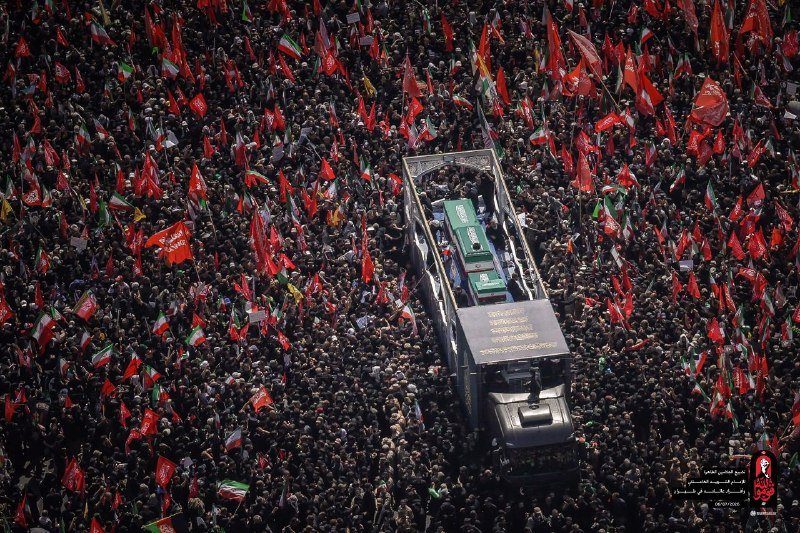
The line forms outside a mausoleum in southern Tehran, and it is no longer drawn only from the Islamic Republic's own cloisters. Between 14:30 and 15:28 UTC on 3 July 2026, six separate delegations filed past the body of the martyred Supreme Leader in a window of less than an hour: a Hezbollah Political Council delegation led by its deputy chairman; the Secretary-General of the Shanghai Cooperation Organisation; the Secretary-General of the D-8 Organisation for Economic Cooperation; a Thai government envoy carrying the personal regards of the Deputy Prime Minister; a deputy chairman of Yemen's Houthi-aligned Supreme Political Council; and He Wei, Vice Chairman of the Standing Committee of China's National People's Congress [Khamenei_en Telegram channel, 14:30–15:28 UTC, 3 July 2026]. Each post carries the same reverent vocabulary — pure body, lofty station, Leader of the Islamic Ummah — and the same choreography. The framing is religious; the substance is geopolitical.
The point is not who came to mourn. The point is who bothered to be seen mourning, and in what company. A line that runs from Sanaa through the southern suburbs of Beirut to Bangkok and on to Beijing is no longer a regional pilgrimage; it is a coalition announcing itself, in real time, through the only public vocabulary available in Tehran this week.
The choreography, decoded
Diplomatic condolence calls are a normalised ritual. In most capitals they produce a paragraph in a foreign-ministry readout and little else. What is unusual about the 3 July queue is its composition. The Houthi envoy and the Hezbollah deputy chairman carry the armed-resistance axis. The Chinese parliamentary vice-chairman carries a permanent UN Security Council seat. The SCO and D-8 secretaries-general carry two of the principal multilateral vehicles for a non-Western order. The Thai envoy, unusual as the visit is, completes a Southeast Asian reach. Read together, these are the spokes of an architecture that, two decades ago, would have sent separate delegations with separate messages to separate offices in Qom and Mashhad, not a single condolence line past the Supreme Leader's body.
That consolidation matters more than any single name. A coalition is most legible at its rites of passage.
What Beijing is signalling, and what it is not
He Wei's appearance is the load-bearing entry of the morning. China does not send senior National People's Congress figures to foreign funerals for theatrical effect. The visit carries three implicit messages. First, continuity: Beijing is treating the post-Khamenei settlement in Tehran as a relationship it intends to manage rather than weather. Second, balance: by appearing in the same queue as Hezbollah's Mohammad Qomati and Mohammed Saleh Al-Nuaimi of Yemen's Supreme Political Council, Beijing is signalling that its Middle East posture has room for the resistance axis without rupture. Third, precedent: a Chinese parliamentary vice-chairman at a Supreme Leader's bier is a photograph that will appear in Iranian textbooks; it cannot be retracted.
The Western wire read will be that Beijing is opportunistically filling a vacuum. The Chinese counter — and it is a serious one — is that the Islamic Republic has been a stable Chinese partner through three US administrations and a sanctions regime of unprecedented extraterritorial reach, and that paying respects to a fallen partner is what durable partnerships look like. Both readings have evidence behind them. The honest version is that they are not mutually exclusive: Beijing is doing what great powers do, which is show up.
Multilateralism with a Tehran address
The SCO and D-8 visits deserve more attention than they will receive in the Western press. The Shanghai Cooperation Organisation has, since its 2001 founding, been read in Western commentary primarily as a Central Asian security body. That framing is increasingly anachronistic. With Iran a full member since 2023 and the organisation's secretary-general now paying respects in Tehran in person, the SCO is functioning, in this moment, as a framework for diplomatic representation that the Western multilateral system does not perform at this scale for Islamic Republic principals. The D-8, the eight-member developing-country bloc anchored in Istanbul, performs the same function for the Global South's economic diplomacy that the SCO performs for its security and energy diplomacy. The two visits, sequenced within sixteen minutes of one another on the Telegram feed, are not redundant. They are layered.
This is not a sentimental story. It is a story about who shows up when an institutionally significant figure dies, and the queue is, in effect, a seating chart for the post-2026 Middle East.
The limits of the frame
There are reasons for caution. The Telegram channel from which most of this morning's reporting flows is the office of the late Supreme Leader itself; it is a primary source for what was said, not for what was meant. The Houthi political council's institutional weight inside Yemen is contested even among its allies; a deputy chairman's appearance is not the same as a head-of-state appearance. The Thai envoy's title — chairman of an advisory council to a deputy prime minister — is one rung below cabinet, and Bangkok's posture toward the Islamic Republic has historically been calibrated, not committed. The Hezbollah delegation, for its part, is led by the deputy chairman of its political council rather than the secretary-general, and the organisation's own room for manoeuvre in a post-Khamenei Tehran is, by the same logic, narrower than a photograph suggests.
What remains, after those caveats, is the photograph. And the photograph is of a queue.
What is at stake
A coalition that can produce six senior delegations across multilateral, parliamentary, and resistance institutions in a single hour is not announcing itself to Tehran. It is announcing itself to the next Iranian administration. The late Supreme Leader's succession is not a private Iranian matter; it never has been. It is a hinge event for every actor that has invested in the Islamic Republic as a node of an alternative international order. The morning's line is the first visible map of who intends to keep investing, and in what company. The stakes, plainly: if the post-Khamenei settlement in Tehran preserves the coalition's geometry, the Middle East's diplomatic architecture for the next decade has already been sketched; if it fractures, the same six delegations will be the first creditors at the door.
Monexus framed this as a coalition-announcement story rather than a succession story, on the reading that the succession itself is a private Iranian political event whose outcome is not yet in the public record, while the condolence queue is a public, dated, and externally documented act.
Wire provenance
This editorial synthesis draws on the following public wire/social posts:
- https://t.me/Khamenei_en
- https://t.me/Khamenei_en
- https://t.me/Khamenei_en
- https://t.me/Khamenei_en
- https://t.me/Khamenei_en
- https://t.me/Khamenei_en