Foreign delegations file past Khamenei's body in Tehran as Iran stages farewell to its supreme leader
The speakers of the Pakistani and Sri Lankan parliaments were among the first foreign delegations to pay respects in Tehran, signalling the breadth of condolence diplomacy surrounding the supreme leader's death.
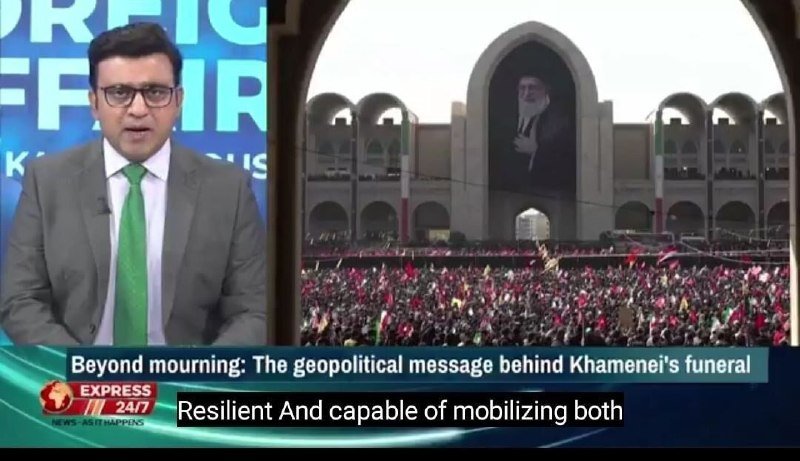
The first foreign dignitaries began filing past the body of Ayatollah Ali Khamenei in Tehran on 3 July 2026, with the speakers of the Pakistani and Sri Lankan parliaments among the earliest arrivals at the state farewell ceremony, according to Iranian state outlets Tasnim and Al-Alam Arabic. The dispatch from Al-Alam Arabic, sent at 13:32 UTC, named the Pakistani parliamentary speaker and an accompanying delegation paying respects to "the martyr leader of the revolution." Less than fifteen minutes earlier, Tasnim's English service and Al-Alam Arabic both confirmed that the speaker of Sri Lanka's parliament had performed the same rite, framing the act as tribute to the "holy body of the Martyr Imam."
The choreography of a leader's funeral is rarely incidental. The order in which foreign delegations arrive, the titles carried by their envoys, and the framing offered by host broadcasters all telegraph priorities: which relationships the Islamic Republic most wants to honour, and which it most wants to display. Pakistan — the only nuclear-armed Muslim-majority state and Iran's eastern neighbour — appearing alongside Sri Lanka, a South Asian democracy far closer to India's orbit, suggests the regime is reaching broadly across the Muslim-majority and South Asian worlds to populate the front ranks of the condolence register.
The first delegations
Al-Alam Arabic's Urdu-facing channel reported the Pakistani parliamentary speaker's participation at 13:32 UTC on 3 July, describing the visitor as heading "the Pakistani Parliament and his accompanying delegation" and framing the visit as participation in the "farewell ceremony for the body of the martyr leader of the revolution, Imam Khamenei." The phrasing — "martyr," "leader of the revolution," "Imam" — is the canonical Iranian clerical vocabulary for Khamenei and is reproduced verbatim across Iranian state outlets, indicating a coordinated framing directive from Tehran rather than independent phrasing by each correspondent.
Tasnim, the outlet most closely aligned with the Islamic Revolutionary Guard Corps, posted its English-language confirmation at 13:19 UTC that the Sri Lankan speaker of parliament had paid tribute, using the hashtag #Badarqa_Aghai_Shahid_Iran. Al-Alam Arabic's Arabic service followed within a minute at 13:20 UTC, and Tasnim's Persian service corroborated at 13:21 UTC. The near-simultaneity across three language services — Arabic, English, Persian — is itself a signal: the Iranian state wants the South Asian condolence diplomacy visible to Arab, Western, and domestic audiences simultaneously.
Why these two visitors, why now
Pakistan's presence carries weight beyond protocol. Islamabad and Tehran have deepened cooperation over the past two years in the face of shared border pressure and a common front against the Taliban government in Kabul, and the Pakistani prime minister has previously visited Tehran for high-level consultations. Sending the speaker of parliament — rather than a lower-ranking envoy — to lead the delegation is a deliberate elevation, signalling that Pakistan wishes to be seen as a first-tier interlocutor in the transition now underway in Iran.
Sri Lanka's appearance is a different kind of signal. Colombo is not a routine partner of the Islamic Republic; it sits inside India's strategic periphery, and its economy has cycled through acute distress in recent years. A parliamentary speaker's visit to Tehran during a leadership transition is an unusually visible diplomatic gesture for a South Asian government that does not normally court Iran. Whether it reflects warming trade ties, an attempt to diversify creditors, or simple protocol cannot be determined from the Iranian state dispatches alone — those briefings say only that the delegation came, paid respects, and departed.
What the framing tells us
Iranian state broadcasters are using a deliberate vocabulary in their English- and Arabic-language services: "Martyr Imam," "leader of the revolution," "holy body." These are not journalistic choices but ideological ones, and they are aimed simultaneously at a domestic audience that will read the coverage and at foreign observers measuring whether the Islamic Republic's script has shifted. It has not. The use of "martyr" — a title reserved for those killed in the cause — applied to a head of state who died in office, is a doctrinal claim: that Khamenei's life and rule were a form of continuing struggle against foreign powers. The decision to open the foreign condolence book with Muslim-majority and South Asian parliamentary speakers, rather than with the Chinese, Russian, or Venezuelan heads of state who might have been expected to lead, is the other half of the same message: Iran's diplomatic gravity runs south and east.
The counter-framing, visible in Western coverage that has begun to ask who succeeds Khamenei and what happens to the network of regional allies — Hezbollah, the Houthis, Iraqi militias — that the Islamic Republic cultivated over four decades, treats the funeral primarily as the opening scene of a succession drama. Iranian state framing treats it as a continuation. Both can be true: succession is a process, not an event, and the choreography of the funeral is precisely where one registers which reading the regime wishes the outside world to absorb.
What remains uncertain
The thread dispatches do not name the successors to Khamenei who will receive the visiting delegations, do not specify the duration of the public mourning period, and do not disclose whether foreign heads of state — as distinct from parliamentary speakers — have begun to arrive. They also do not record the presence, or absence, of any Western delegation. The Iranian state outlets that have published so far are those closest to the security establishment; broader coverage from the presidency or foreign ministry has not yet appeared in the materials available to this publication. Readers weighting the significance of the condolence register should therefore treat the first day of arrivals as an early signal, not as a final map of who stands with the Islamic Republic at this moment.
The funeral of a supreme leader is a state act whose meaning is decided less by what is said than by who shows up, in what order, and under what banner. On 3 July 2026, the order so far is South Asia first, the security-services' framing dominant, and the succession question still to be answered.
Desk note: this piece is built on the Iranian state dispatches that arrived in real time via Al-Alam Arabic and Tasnim on 3 July 2026. Where independent confirmation of the visitor list or the official mourning schedule is not yet available, that gap is flagged in the final section rather than papered over.
Wire provenance
This editorial synthesis draws on the following public wire/social posts:
- https://t.me/alalamarabic
- https://t.me/JahanTasnim
- https://t.me/alalamarabic
- https://t.me/tasnimnews_en
- https://t.me/alalamarabic/1