Tehran's farewell and the choreography of an Axis
A four-day state farewell for Iran's late Supreme Leader has turned into a diplomatic set-piece, with Hamas, Palestinian Islamic Jihad, and a senior Russian envoy converging on Tehran within hours of one another.
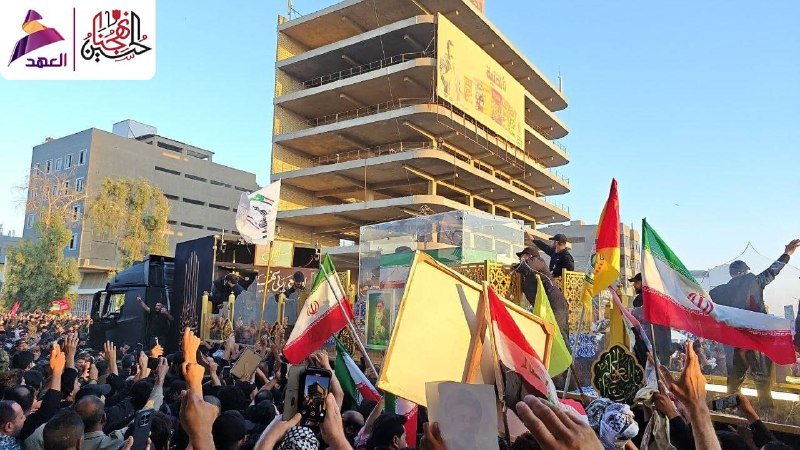
Tehran on Friday opened a four-day state farewell for its late Supreme Leader, and the guest list read less like a memorial and more like a map of the alliances the Islamic Republic has spent four decades building. By 13:26 UTC on 3 July 2026, a Hamas political-bureau delegation and a separate Palestinian Islamic Jihad delegation — led by PIJ Secretary-General Ziad Al-Nakhalah — had both arrived in the Iranian capital, according to a Telegram post by the geopolitical monitor GeoPWatch. Less than ten minutes earlier, Russian Security Council Deputy Chairman Dmitry Medvedev had landed for the same ceremonies, an arrival confirmed independently by Iranian state broadcaster PressTV at 13:10 UTC. The choreography is not incidental. Funerals in the Iranian system function as statecraft: the camera frames the mourners, and the mourners frame the doctrine of the next era.
The read-through is straightforward. The so-called Axis of Resistance — Iran's network of partners and proxies stretching from the Levant to the Gulf — is performing continuity at a moment of acute leadership transition in Tehran. So is Moscow, whose deputy head of the Security Council is the highest-ranking Russian visitor publicly identified at the ceremonies so far. The optics are calibrated for two audiences at once: domestic Iranians, who need to see the next generation of the Islamic Republic's alliances intact, and the foreign ministries in Washington, Tel Aviv, and the Gulf, who need to see them visibly.
What the arrivals actually signal
Hamas's political wing travelling to Tehran at the same moment as PIJ's secretary-general is unusual only in its timing, not in its substance. The relationship between the Palestinian factions and the Islamic Republic is long-standing, predating the October 2023 war and the killing of senior Hamas figures in Tehran that complicated it. The fact that a formal Hamas delegation is again receiving a public Iranian welcome — alongside Al-Nakhalah, who has been the most visible PIJ figure for years — is the news. It signals that, even amid the disruption of the war in Gaza and the wider regional realignment since 2023, the political channel between Tehran and the Palestinian armed factions remains operational at the leadership level.
Medvedev's presence, reported by both PressTV and GeoPWatch within minutes of each other, is the more analytically interesting datum. Russia is not a patron of Hamas or PIJ in the way Iran is, but it has spent the post-2022 period rebuilding its position in the Middle East — military coordination with Iran, deepened ties with the Gulf states, an explicit stake in Syria's post-Assad reconstruction. A serving deputy chairman of Russia's Security Council at an Iranian supreme-leadership funeral is not a routine condolence call. It is the sort of presence intended to be read as endorsement of the successor order in Tehran, whoever that successor turns out to be.
The counter-read
The sceptical take is that all of this is theatre. Four-day state funerals are designed for exactly this kind of imagery, and dignitaries attend them the way they attend UN General Assembly week — out of obligation as much as conviction. The presence of a Hamas delegation in Tehran says little about the operational depth of the relationship; the presence of Medvedev says little about how Russia would behave in a crisis involving Iran or its partners. There is also a question Tehran-watchers will be asking privately: who, exactly, is hosting these delegations? A transition in the Supreme Leader's office is, by definition, a transition in who receives foreign guests and on whose authority. Until the succession is settled, the symbolism of the arrivals outruns the substance of any new commitments.
A second counter-read is more uncomfortable. Coverage that treats this guest list as a simple continuity story may be missing the more interesting shift: the Axis of Resistance is now visibly meeting in Tehran, in public, on Iranian state television. The diplomatic register has changed. What was once conducted through intermediaries in Beirut, Damascus, or Doha is now being staged in the Iranian capital under the eyes of Russian security officials. Whether that reflects confidence or compensating display is the question the next week of Iranian politics will answer.
The structural frame
The larger pattern here is the consolidation of a non-Western diplomatic circuit that runs Tehran–Moscow–Gaza–Beirut, with side branches into Ankara and Beijing. It is not a bloc in the Cold War sense — there is no charter, no mutual-defence clause, no joint command — but it is a recognisable alignment of interests: a shared scepticism of US-led security architecture, overlapping sanctions exposure, and complementary energy and weapons relationships. Funerals, like summits, are where such alignments are made visible. The four days of mourning in Tehran are functioning, in effect, as the first post-succession summit of that alignment, even if no one is calling it that.
Stakes
For Israel and the United States, the practical question is whether the post-Khamenei order inherits not only the alliance network but also the doctrine that has sustained it — the armed-proxy deterrence posture, the nuclear-latency strategy, the regional ambition. For the Gulf states, the question is whether a stable succession produces a more predictable partner or a more embattled one. For Moscow, the question is whether Iran remains a useful junior partner in a Middle East policy that is otherwise overstretched. For the Palestinian factions, the question is whether Tehran's chequebook survives the transition at the same altitude it occupied before. The guest list at a funeral cannot answer any of these. It can only confirm that the parties intend to keep talking.
What remains uncertain
The sources available do not specify who within Hamas travelled with the delegation, which senior Iranian officials received the visitors, or whether Medvedev carried a message from President Putin beyond the standard condolence register. PressTV framed Medvedev's arrival as participation in "the funeral procession of the martyred Leader of the Islamic Revolution," a translation of an Iranian theological term that is itself contested outside the Republic. GeoPWatch, the channel surfacing the PIJ and Hamas arrivals, is an aggregator without the editorial standing of a wire service. The picture it paints is consistent across two independent Telegram channels, but it is still a picture drawn from open-source social media rather than from a Reuters or AP bureau in Tehran. Treat the choreography as confirmed; treat the doctrinal meaning as suggestive, not settled.
This publication frames the Tehran ceremonies as an exercise in alliance maintenance under succession stress — the optics deliberate, the doctrinal content still to be written.
Wire provenance
This editorial synthesis draws on the following public wire/social posts:
- https://t.me/presstv/
- https://t.me/GeoPWatch
- https://t.me/GeoPWatch
- https://t.me/GeoPWatch