Tehran's Farewell Ceremony Doubles as a Coalition Photograph
Foreign dignitaries arriving in Tehran for the funeral of the Islamic Republic's late 'martyred leader' are producing an unflattering optics problem for Western ministries that prefer a quieter story line.
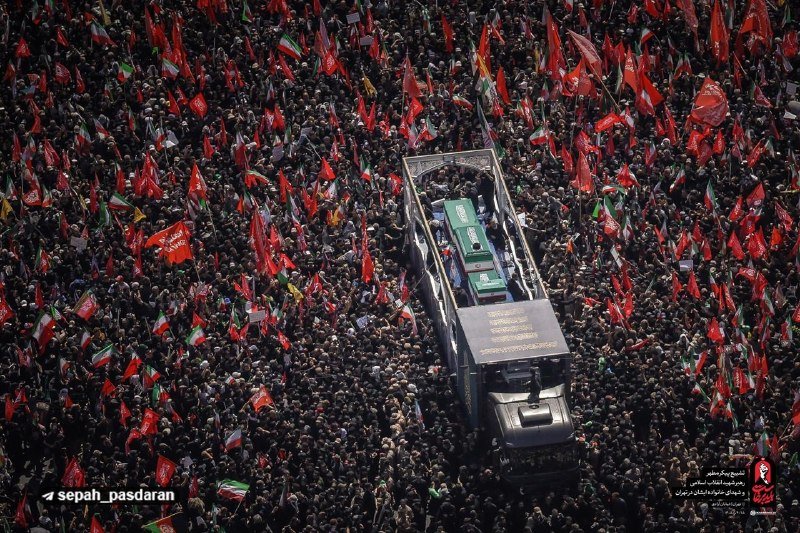
Three Gulf airlines have rerouted around Iranian airspace this month. A European foreign ministry has warned its citizens against non-essential travel to the Islamic Republic. And yet the delegations keep walking through the door at Tehran Mosalla. On 3 July 2026, Algeria's Supreme Mufti and a Tunisian Republic representative were received for the funeral of the man Iranian state media uniformly describes as the "martyred leader of the Islamic Revolution," according to posts from Al-Alam carried on Telegram at 14:42 UTC and corroborated at 15:34 UTC by an X account affiliated with the Iranian press. Hours earlier, the special envoy and governor of Bihar, Seyyed Atta Hasnain, arrived with an Indian delegation for the same ceremony, per an Al-Alam Telegram dispatch at 14:40 UTC. The pattern is the story.
The headline out of Western capitals this month has been one of isolation: snap sanctions packages, airspace advisories, a quiet downgrading of chargé d'affaires contacts. That framing, while factually defensible on a number of metrics, has a curious blind spot. It assumes that diplomatic gravity moves on a Western axis. The queue forming at the Mosalla suggests otherwise. The arrivals are not choreographed as provocations. They are choreographed as obligations — the kind that a contested leadership in Tehran can convert into a coalition photograph, and that coalition photograph can in turn be repackaged into legitimacy at home.
The optics problem for Western ministries
There is a particular kind of awkwardness when the headlines say "isolated" and the doorstep says otherwise. The two are not strictly contradictory — a state can be economically sanctioned and diplomatically courted by the same set of non-Western partners — but in public-affairs terms they puncture each other. Every cleric who walks past a bank of cameras from Al-Alam adds a frame to an emerging montage: a multipolar audience for an event the West prefers to render as a domestic crisis. Coverage that has spent weeks cataloguing the Islamic Republic's dwindling list of friendly exchanges now has to share front pages with Grand Muftis and Indian state governors.
What the coalition photograph actually confers
The lift here is not economic. Sanctions regime architecture is not unwound by a funeral cortège. The lift is reputational and procedural. A Grand Mufti standing beside the casket tells audiences from Tunis to Jakarta that the clerical establishment in Tehran retains standing inside a wider Islamic consensus. An Indian state governor in the same frame tells a different audience — the South Asian diplomatic corps, the BRICS-adjacent middle powers — that institutional Iran still travels. For a leadership attempting to consolidate at a moment of acute internal pressure, those signals are not decorative. They are load-bearing.
The counter-frame the delegations carry
The Western line and the arriving delegations are not actually arguing about the same event. The wire services that have spent the month tracking sanctions enforcement and airspace risk are reporting on a security ledger. The delegations are reporting on a ledger of religious and post-colonial solidarity. Neither is wrong. The reading depends on which columns of the spreadsheet a reader privileges. Treat the funeral as a security event and you see a hole in the Western coalition. Treat it as a religious-summit event and you see a long-standing network of clerical-to-clerical relationships behaving exactly as designed. Both readings are internally consistent; the friction between them is the actual news.
Stakes, and what remains unverified
If the pattern continues past the funeral — if subsequent weeks bring not a thinning but a thickening of the receiving line — then the Western framing will need recalibration rather than reinforcement. The plausible alternative is that the photograph crowds front pages for a single news cycle and the substance of the underlying pressure regime is unchanged. The sources do not specify which trajectory holds; the next ten days of arrivals, or the absence of them, will. The Monexus desk treated this as an optics-and-coalition story rather than a personality-cult story, on the view that the durable question is what a queue of foreign dignitaries concedes, not what the rituals themselves mean.
Wire provenance
This editorial synthesis draws on the following public wire/social posts:
- https://t.me/s/sprinterpress
- https://t.me/alalamfa
- https://t.me/alalamfa