Even in mourning, Tehran is stage-managing the optics of solidarity
A line of foreign dignitaries is arriving at a farewell hall in Tehran. The choreography matters more than the names.
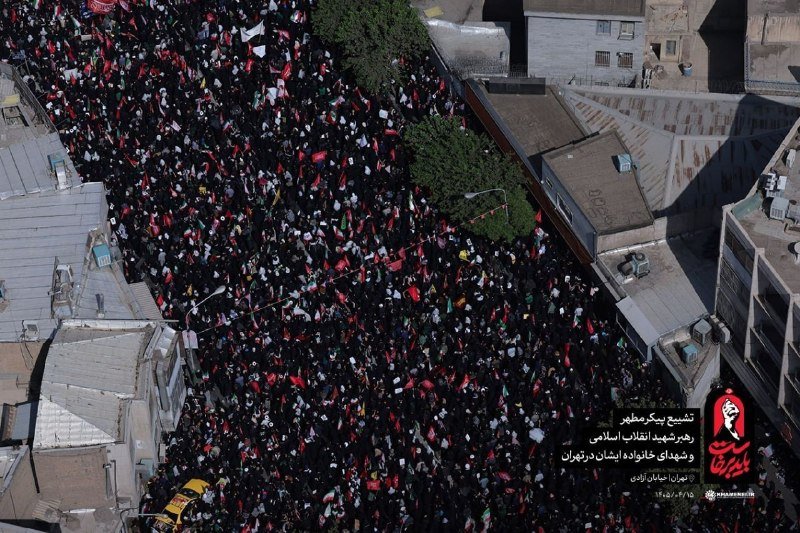
A steady stream of parliamentary delegations is filing through a Tehran farewell hall. On the morning of 3 July 2026, within the space of a few minutes, three separate arrivals were recorded: the President of the Egyptian Senate, Essam El-Din Ahmed Mohamed Farid, and the Speaker of the Kyrgyz Parliament, Marlin Abdurakhmanovich Mamataliev, each photographed and broadcast through official Iranian channels as they paid their respects at the catafalque of the country's late Supreme Leader. Theatrical as the choreography is, the image-sheets the regime is releasing — dignitaries of varying ideological hue standing in identical postures of veneration — are themselves the news.
Mourning, in the Islamic Republic, is rarely allowed to look like mourning alone. It is reframed as a moment of international endorsement, a way of converting grief into diplomatic inventory. Foreign visitors sign no communiqué, no treaty, no joint statement. They stand, they bow, they are filmed. That photograph is then redistributed through Iranian-aligned outlets and the Iranian diaspora's Western-covering press as evidence that the post-Khamenei order is broadly accepted, broadly mourned, broadly endorsed. To read those images uncritically is to mistake stagecraft for statecraft.
What the arrivals actually tell us
Two arrivals are documented in the same Tehran window on 3 July: a senior Egyptian parliamentary leader and his Kyrgyz counterpart. Cairo's seat at the bier is the more politically loaded of the two. Egypt and Iran restored full diplomatic relations in 2023 after a seven-year freeze; the presidential visit earlier that year broke logistically what the funeral visit is now documenting politically. A Senate speaker laying a wreath is not a head of state, but in a region where parliamentary shuttles do quiet lifting that presidential visits cannot, it is significant. Kyrgyzstan, the second guest, signals the Eurasian pull. Bishkek votes with neither bloc cleanly and tends to follow Beijing's diplomatic accents; an arrival here is read in Moscow and Astana as a nudge, in Tehran as warmth.
The two governments are not aligned with one another, and that is precisely the point. A diverse guest list is the product being marketed.
The counter-reading
Iran's external enemies have an obvious interest in portraying the funeral as an awkward shrunken affair — token delegations from states one step from Russian or Chinese dependency. Iran's external allies have an interest in the opposite frame. The reality is somewhere in the middle, and the live-sourced wire of images coming out of Tehran is genuinely ambiguous: it shows arrivals, not their weight; it shows faces, not their mandate. Senior Egyptian parliamentary visits and Central Asian speaker-level visits are not nothing — they are the active diplomatic register most states use when they want to be present without pledging — but they are also not a G7 funeral. The narrow evidentiary base in the live wire does not yet let us rank these signals against the comparative scale of past Iranian state funerals.
The structural pattern
A hegemonic transition — whether you call it a succession, a realignment, or a rebalancing — runs on two parallel tracks: the announced track of treaties, sanctions, and arms transfers, and the unannounced track of stage-managed optics. The Islamic Republic has long specialised in the second. Funeral diplomacy, summit choreography, the careful seating of foreigners at UN general debate, the well-orchestrated pilgrimage of Iranian foreign minister to Jeddah, Damascus, and Ankara in single tours: each is a small inventory entry in the broader ledger of who recognises whom, and on what terms.
The pattern cuts both ways. Western governments that refuse to send even a low-level representative to a state funeral are also making an inventory entry. So are Gulf monarchies, Russian figures, African Union chairs. The quiet arithmetic of presence and absence is what reshapes alignments far more durably than communiqués ever do. Read these photographs carefully and they tell you the bracket of states willing to be photographed grieving with Tehran — and the larger bracket unwilling.
What it means going forward
The days around a Supreme Leader's funeral are when any faction inside the Islamic Republic with a competent foreign-affairs desk gets a free run at producing international legitimacy for whatever leadership proposition it is putting forward. The arrival sheets are receipts. If, in the weeks that follow, the new executive structure ratifies a defence agreement with one of the states whose flag-bearer stood at the bier on 3 July, this morning's arrivals will look less like courtesy and more like commitment. If nothing materialises, the visitors will be reclassified as atmospheric.
The honest position is that the live wire tells us who turned up, and when. It does not yet tell us what they were promised, or what they will receive. That ledger will be settled in coming months — in trade memoranda, in parliamentary friendship groups, in votes at the UN General Assembly. Until then, the photograph is the story. But it is the photograph of a story, not the story itself.
Wire provenance
This editorial synthesis draws on the following public wire/social posts:
- https://t.me/Khamenei_arabi
- https://t.me/Khamenei_arabi
- https://t.me/Khamenei_en