Tehran's Farewell Hall Reads as a Coalition Map: What the Dignitaries at Khamenei's Memorial Actually Signal
The list of foreign mourners paying respects in Tehran — Sunni scholars, an Omani state-council chair, a Pakistani speaker, and a senior Chinese legislator — sketches a coalition geometry that the Western wire cycle has barely paused to read.
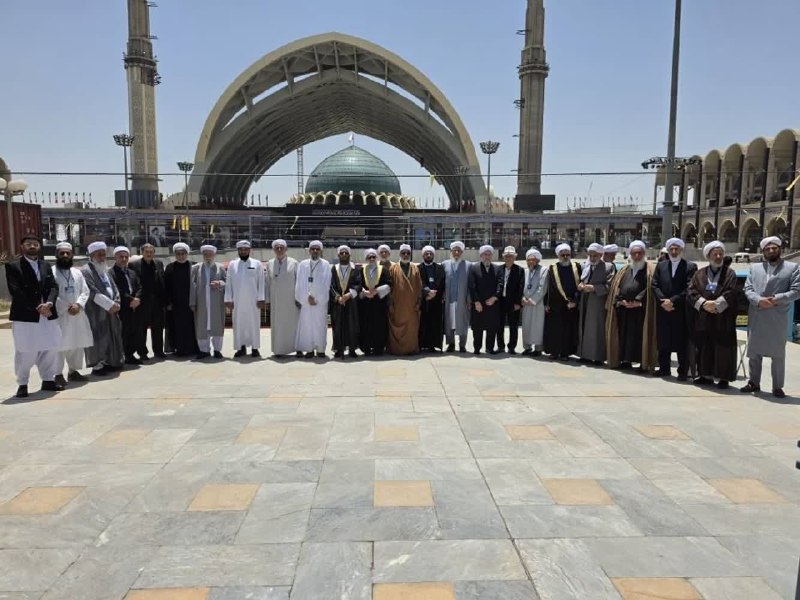
By the afternoon of 3 July 2026, the procession of foreign mourners passing through Tehran's farewell hall had already mapped, more honestly than any communique, the architecture of Iran's external relationships in the post-Khamenei moment. Within a roughly fifty-minute window, an official Telegram channel associated with the Khamenei office documented four distinct categories of visitor: a delegation of Sunni scholars from across the Islamic world arriving to honour the late leader; He Wei, Vice Chairman of the Standing Committee of the National People's Congress; Abd al-Malik bin Abdullah Al-Khalili, Chairman of the State Council of the Sultanate of Oman; and Iyaz Sadiq, Speaker of the Islamic Republic of Pakistan's National Assembly. Each arrival was treated as news. Taken together, they sketch a coalition geometry the Western wire cycle has barely paused to read.
The argument this publication advances is straightforward: in moments of leadership transition, the choreography of condolence is itself a foreign-policy document. Who sends whom, who shows up in person, who stays away — these are signals as legible as any signed memorandum. Iran's farewell hall, in the hours captured by the Khamenei office's own channels, was broadcasting a four-part message about the post-Khamenei order.
The Sunni-scholar delegation and the sectarian frame
The arrival of a Sunni scholarly delegation, recorded on the Khamenei office's Arabic-language Telegram at 14:58 UTC on 3 July 2026, is the most ideologically loaded of the day's signals. Iran is a Shia-majority republic whose constitutional identity rests on the doctrine of Wilayat al-Faqih, and the public presence of senior Sunni clerics paying respects to the Supreme Leader is not a routine diplomatic courtesy. It is, rather, an act of intra-ummah bridge-building whose weight is calibrated for two audiences: Sunni publics in the wider Islamic world who may have heard of Khamenei only as a Shia pole, and the Iranian state's regional interlocutors — Ankara, Doha, Riyadh, Islamabad — for whom sectarian vocabulary has long been an obstacle to cooperation. That a delegation was received and photographed at all is the news; the composition of the delegation, which the official channel does not enumerate, would matter more still.
Beijing's ranking, and what it implies about the China file
The 14:40 UTC Telegram item records the presence of He Wei, Vice Chairman of the Standing Committee of the National People's Congress, in the farewell hall. The choice of messenger is itself the signal. Beijing did not dispatch a foreign-ministry official of ministerial rank, nor a working-level chargé; it sent a vice-chairman of the NPC Standing Committee — a figure senior enough to require a Politburo-level sign-off and junior enough to leave the next move available. That calibration is consistent with a longer pattern documented across the China-Iran relationship over the past decade: a strategic partnership that Beijing has consistently preferred to formalise incrementally rather than spectacularly, preserving room to deepen economic cooperation under the 25-year framework while declining the sort of mutual-defence language that would foreclose flexibility. In plain terms, China has chosen to read Iran as a high-value partner and a useful counterweight in the Gulf, without paying the rhetorical price of an alliance.
The Gulf and the South Asian rim
The 14:26 UTC item places Abd al-Malik bin Abdullah Al-Khalili, Chairman of Oman's State Council, in the farewell hall. Oman is the Gulf monarchy with the longest uninterrupted track record of quiet mediation between Tehran and Washington — the Sultanate hosted the early rounds of talks that produced the 2015 nuclear framework and has retained a back-channel role in every subsequent round. Al-Khalili's physical presence in Tehran, recorded on an Iranian state channel and not on a Gulf one, is best read as Muscat signalling continuity: that the late leader's passing will not interrupt the Oman-Iran mediation corridor, and that the Sultanate intends to remain useful to whichever successor configuration emerges.
At 14:07 UTC, the channel logged the arrival of Iyaz Sadiq, Speaker of Pakistan's National Assembly. Pakistan is, demographically, the Sunni-majority neighbour whose Shia minority is politically significant and historically vulnerable, and whose state relationship with Tehran runs through a combination of energy-import dependence, border management, and the shared pressure of operating under sustained Western sanctions scrutiny. A parliamentary speaker is a senior but not head-of-state-tier visitor — consistent, again, with the message that Islamabad intends to honour the moment without pre-committing to a particular line on succession.
What the Western wire is under-reading
The dominant framing in Western coverage of leadership transitions in the Islamic Republic tends to run on a single track: who succeeds, how hard, and how the United States should position itself. That framing is not wrong; it is just incomplete. The condolence choreography on 3 July is evidence of at least four other tracks — Sunni-Shia intra-ummah reconciliation, the China-Iran partnership's incremental deepening, Gulf mediation continuity, and South Asian energy-and-border pragmatism — running in parallel. A reader who took only the Washington-track coverage away from the day would miss most of what the farewell hall was actually saying.
The serious point, and what remains uncertain
The honest caveat: a Telegram feed curated by the office of the deceased leader is, by definition, a managed document. The arrivals it chooses to publicise, and the order in which it publicises them, reflect an editorial decision about which signals matter. The composition of the Sunni delegation is not specified; the full list of foreign mourners is not provided; the duration of each dignitary's stay is not stated. A coalition map drawn from these four items is suggestive rather than conclusive. What it does establish, beyond reasonable doubt, is that the Islamic Republic's external partners chose 3 July 2026 to be visible in Tehran — and that the diversity of those partners is itself the story the day was telling.
This article uses Telegram dispatches from the Khamenei office's official channels. Where Western wires have framed the transition as a succession question, the publication reads the condolence choreography as a foreign-policy document in its own right.
Wire provenance
This editorial synthesis draws on the following public wire/social posts:
- https://t.me/Khamenei_arabi
- https://t.me/Khamenei_arabi
- https://t.me/Khamenei_en
- https://t.me/Khamenei_arabi