Tehran Stages a Farewell: What the Procession Order Tells Us About Power After Khomeini's Heir
State-aligned wires broadcast six hours of crowd footage outside a shuttered mosque. The choreography matters more than the funeral.
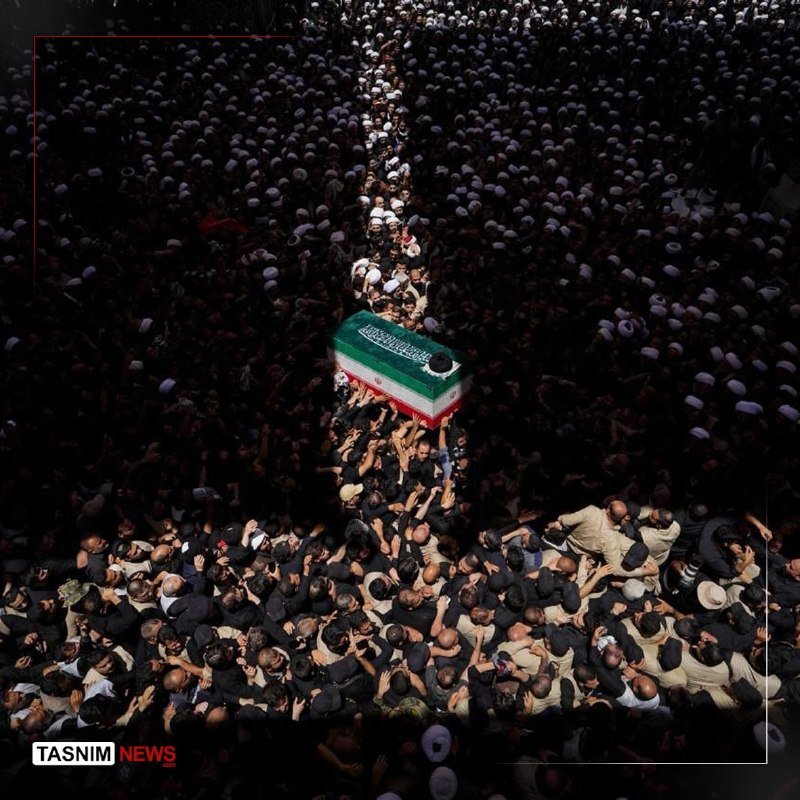
At 18:27 UTC on 3 July 2026, the Iranian state-aligned wire Tasnim News English began publishing a continuous, curated stream of footage from central Tehran: the preparation of Beheshti Street, a wide shot of Imam Khomeini's Hussainiya six hours before the doors opened, and the patient queue assembling at door number one. The images are quiet, almost domestic — street-sweepers in orange, scaffolding going up, a line forming in the dark. The story they are designed to tell is not quiet at all. Iran is rehearsing a farewell, and the rehearsal is the news.
The procession, framed as the closing rite for a senior figure in the Islamic Republic's clerical hierarchy, is being managed the way these moments always are: doors staged, gates opened at a fixed hour, and the state-aligned media apparatus humming in lockstep. Tasnim's English-language Telegram channel has effectively become the editorial brain of the event outside Iran's borders, deciding which frames cross the border and at what timestamp. That is itself a fact worth naming. Coverage of Iranian leadership rituals inside Western outlets tends to read them as a single block; the underlying choreography is a sequenced broadcast, and it is broadcast by Tasnim first.
The ritual, step by step
Tasnim's running thread, posted between 18:27 and 20:54 UTC, follows a fixed template. First, the preparation imagery: Beheshti Street dressed to host the pilgrims, the long axis of central Tehran remade as a processional corridor. Second, the exterior of the Hussainiya in wide angle, hours before the doors open, with a hashtag pinned to the footage — #Badarqa_Aghai_Shahid_Iran — and the network's handle reattached to every post. Third, the close-up: the crowd at door number one, and the operational note that the north and east doors would open at 06:00 local time for the entry of mourners. Each frame is timestamped, captioned, and tagged. The cadence is closer to a state-issued programme than to journalism.
For a non-Iranian reader, three things follow from the structure. The event is being staged in a specific architectural sequence: a courtyard mosque designed for mass assembly, surrounded by streets engineered for controlled foot traffic, in a capital whose grid was reshaped after 1979 partly to make exactly this kind of procession legible. The opening hour is fixed and published in advance, which converts a funeral into a scheduled broadcast. And the media distribution is centralised: Tasnim English, sitting inside the state-aligned media ecosystem, is the only source carrying continuous live imagery in the language the global wire will inherit.
What the Western wire will and won't see
The Western press will pick up the event at the moment the doors open. Reuters, AFP and the BBC will move their own frames, sourced from stringers inside the courtyard or from Iranian state media's pool feed; those frames will be the ones that travel. The two-hour build-up Tasnim is now publishing in English — the sweepers, the scaffolding, the queue, the empty courtyard under floodlights — will mostly be read as colour, if it is read at all. The institutional choice of Tasnim English as the lead wire for diaspora and global audiences is the story; the procession is the canvas it is being painted onto.
This is not a small editorial point. When a single state-aligned outlet controls the running visual record of a leadership transition, the available counter-frame inside Western coverage is the one that outlet chooses to release. Independent verification of crowd size, of who is and is not in the courtyard, of which clerics are visible and at what rank, is constrained to the frames Tasnim decides to publish. The same constraint has applied in reverse during Iranian state funerals since 1989; the tooling has simply moved from domestic television to a Telegram channel with global reach.
A succession framed before the cameras arrive
The political context is the unnamed subtext of the entire broadcast. The Islamic Republic has, for the better part of a decade, been navigating the question of what comes after the generation that founded it. A funeral at the Hussainiya is not a neutral event: it is one of the few public spaces in the country where the clerical establishment is visible as a corporate body, where rank is read in seating, and where the order of speakers — and the order in which the cameras are allowed to film them — is itself a statement about who is ascending. By publishing six hours of preparation footage in English, Tasnim is extending the optic of that statement to a non-Persian audience that will not read the seating chart but will absorb the visual claim: an orderly institution, a devotional public, a managed transition.
The counter-reading is straightforward and should be stated. State-aligned media has an institutional interest in presenting Iranian leadership rituals as seamless and devotional; the same courtyard, on a different day, has hosted protests that the same wire framed as foreign-instigated unrest. The crowd footage Tasnim is releasing is real — there is a queue at door number one, the north and east doors did open at 06:00 — but its selection is editorial. The pictures are chosen to make one argument. A reader who sees only the Tasnim thread will not see the women detained in Evin in the same week, the strikers in the petrochemical towns, or the family members of the dead standing outside with their own cameras. Those frames exist; they simply are not the ones being exported in real time.
What is actually new
The technical change is small and significant. Twenty years ago, a state-aligned outlet would have held this footage for its evening news bulletin. Today, the English-language channel of a state-aligned agency is publishing timestamped, hashtagged, geolocatable stills and short videos to a platform that distributes them, unmediated, to aggregators and to the diaspora. The Iranian state has, in effect, built its own running wire service for its own leadership moments, and that wire now competes with Reuters and AFP on arrival time inside non-Iranian newsrooms that lack a Tehran bureau. The result is that the visual grammar of an Iranian state ritual — the courtyard, the door, the queue, the sweepers, the hashtag — is being set, in English, by an outlet that is not a neutral observer of the event it is covering.
The stakes are not symbolic. The orderly procession being broadcast tonight is the public face of an institution preparing for a generational handover. If the next decade of Iranian politics is decided in courtyards like this one, then the frames Tasnim is sending out now are the frames the global reader will remember, and the editorial choices being made at 18:27 and 20:54 UTC will have done their work long before any analyst publishes a verdict. The ceremony begins at 06:00 local time. By then, the world will already have seen the queue.
This publication notes that Western wire copy of Iranian state rituals tends to inherit state-aligned frames wholesale because independent stringer access in central Tehran is constrained. The pool footage travels; the counter-frames mostly do not.
Wire provenance
This editorial synthesis draws on the following public wire/social posts:
- https://t.me/tasnimnews_en
- https://t.me/tasnimnews_en
- https://t.me/tasnimnews_en