Iran buries its 'martyred leader' as a political signal, not a funeral
Tehran is staging a farewell ceremony for the late Supreme Leader at scale. The political message is the headline — and it travels well beyond the prayer hall.
Lead
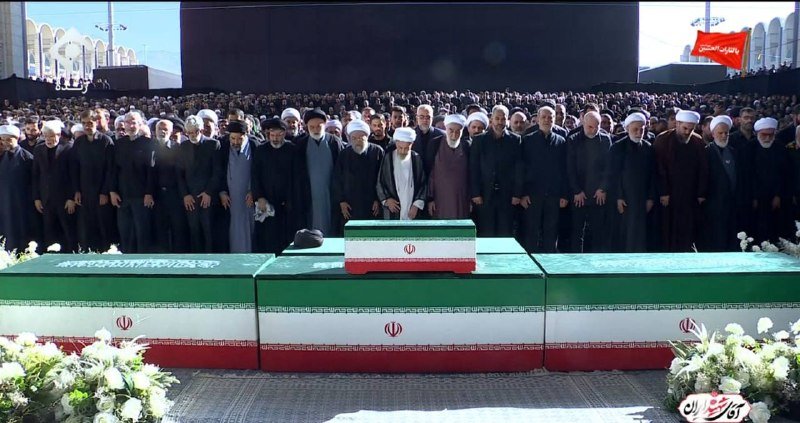
At 03:55 UTC on 4 July 2026, waves of mourners were still pouring into central Tehran from the surrounding streets even though the Imam Khomeini prayer hall was already full, according to the Beirut-based, pro-Iran channel Al-Alam Arabic. Within minutes, the national anthem had been played at the start of the farewell ceremony for the "martyred leader" — the framing the Iranian state has consistently used since his killing — and by 04:58 UTC, the prayer hall was ringing with a single word repeated in unison: revenge.
Nut graf
This is not a private grief airing itself in public. It is a state-organised political signal, performed in front of the cameras, and the choreography is the message. When the official government spokeswoman tells her audience that this funeral "cannot be viewed as a mere funeral ceremony," she is admitting, on the record, what anyone watching already knows: every chant, every hymn, and every overflow crowd is being staged to set the terms of what comes next — at home, in the region, and in Iran's confrontation with the United States and Israel.
The staging
Al-Alam Arabic is a satellite channel aligned with Iran's state broadcasting apparatus, and its choice of words matters as much as its footage. Calling the late leader "the martyred leader" rather than "the late leader" is a deliberate classification. A martyr, in the Islamic Republic's lexicon, is not merely a person who has died; it is a person whose death acquires meaning only in the pursuit of unfinished political business. The national anthem, sung at the head of the ceremony, transforms a ritual of mourning into a ritual of mobilisation. The overflow crowds flowing from side streets into the prayer hall's precinct are not incidental — they are the visual argument: that the Iranian street is one body, that the loss is shared, that the demand for retaliation is national.
The counter-frame
None of this changes the fact that a head of state is dead, that families are grieving, and that an Iranian death on Iranian soil is, first, a human event. To read the ceremony only as performance is reductive in its own way; performative grief and real grief are not mutually exclusive in any large-state funeral, and Iranian televising is doing both at once. What is distinct is that the Iranian state has used the body's display to convert private sorrow into a public commitment of action. That commitment narrows the room for any successor regime — or any negotiation with external powers — to back away from a retaliation cycle without paying a domestic cost. Coverage that focuses only on the solemnity misses the politics. Coverage that focuses only on the politics misses why the streets are full.
The structure underneath
Look past the prayer hall and the same pattern is being reproduced across the region. Funeral rites for fallen heads of state are routinely drafted by the surviving government as the opening paragraph of their own legitimacy story. The prayer-hall choreography — anthem, martyrdom framing, overflow crowds, unanimous chants — sits inside a familiar regional grammar in which grief and mobilisation are deliberately fused. The novelty here is less the ritual than the audience the ritual is being staged for: a Saudi-, Emirati-, Iraqi-, and Lebanese-aligned readership, an Israeli intelligence community that watches Iranian state media for actionable signal, and a Western wire system that receives the same frames through the same satellite feed. When the Iranian official line says "this is not a funeral," the relevant listeners across the Persian Gulf and the Levant know exactly which sentence in that briefing they have to respond to. The information value of the broadcast, for that audience, is not what happened. It is what is being promised.
Stakes
The risk for Tehran is that a funeral staged as mobilisation forecloses the diplomatic space it claims to be defending. A leadership that has publicly bound its own grief to retaliation cannot cheaply de-escalate later; the chants will be replayed. The risk for the United States, Israel, and Iran's Gulf neighbours is that they treat the broadcast only as theatre and miss the binding function it performs inside Iran — and so misread what is actually being constrained. The risk for the Iranian street itself is the one it rarely gets to comment on: that the mourning of the Imam Khomeini prayer hall is being read aloud in the names of people who were never asked whether they wanted their grief scripted.
What remains uncertain
The sources here are state-aligned and cease-fire-minded observers will reasonably note that Al-Alam Arabic's framing cannot be verified against independent ground reporting inside the prayer hall. The footage tells us the hall was full and the chants were audible. It does not tell us who attended under compulsion, who attended out of conviction, or how the streets outside the immediate camera arc were configured. It also does not name the deceased leader by full title on the record — a notable silence that may itself be a signal about succession timing. Until independent journalism inside Iran confirms the choreography's perimeter, the broadcast remains exactly what it was designed to be: a one-sided statement of intent, dressed as a farewell.
Desk note
Monexus frames this as a political signal first and a funeral second, because the Iranian government's own spokesperson told journalists the ceremony should be read that way — and because the structural stakes of the broadcast sit in regional mobilisation, not domestic grief. Wire coverage that leads with the crowds alone will misread the event.
Wire provenance
This editorial synthesis draws on the following public wire/social posts:
- https://t.me/s/alalamarabic
- https://t.me/s/alalamarabic
- https://t.me/s/alalamarabic
- https://t.me/s/alalamarabic