Iran's farewell to a martyred cleric and the camera it keeps
At a state funeral in Tehran for the cleric widely referred to as Iran's 'Mr. Martyr,' the performance was religious, the politics were kinetic, and the cameras were almost entirely domestic.
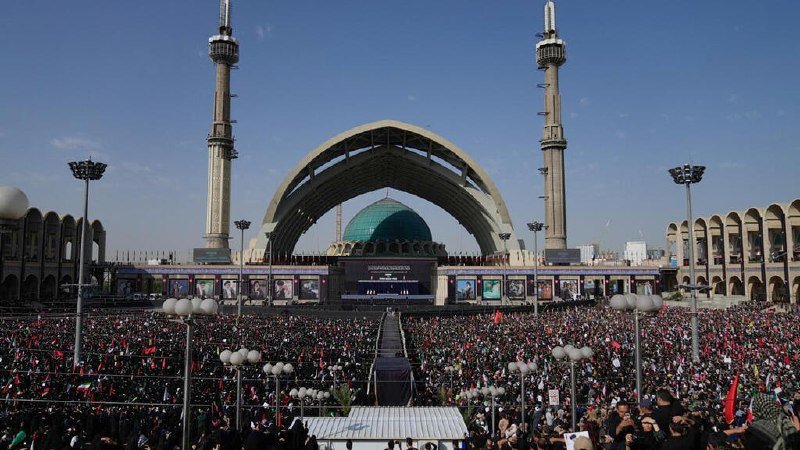
At 04:06 UTC on 4 July 2026, state broadcaster footage published through Mehr News showed the Iranian national anthem ringing through the mosque of Imam Khomeini in central Tehran. By 04:28 UTC the same feed was carrying a poetry recitation by Haj Mehdi Rasouli. By 05:15 UTC, mourners' lamentation, performed in the Karbala tradition by Nariman Panahi, was being streamed out of the same hall. The mourners, according to Iranian state outlets, had gathered to take leave of a figure honoured in official discourse as "Mr. Martyr of Iran."
The political choreography of a clerical funeral in Tehran is rarely incidental. The choice of venue (the mosque named for the founder of the Islamic Republic), the choice of performers (figures whose Karbala-style lamentation carries a codified anti-oppressor register) and the choice of camera (state-aligned Mehr and Tasnim reporting in real time to Telegram audiences) together amount to a message as much as a mourning. The visible message is grief. The structural one is that the apparatus that lost the cleric knows exactly how to package the loss.
The visible ceremony
The frame on every Telegram dispatch is the same: an interior of the mosque, banners in Persian, a congregation in black, the national anthem giving way to religious lamentation. Mehr's 04:06 UTC clip carries the anthem and its caption names the venue; Tasnim's 04:28 UTC clip carries Rasouli's recitation as part of the same farewell sequence; the 05:15 UTC clip from Mehr records Panahi's elegy at what the same caption again calls the mosque of Imam Khomeini in Tehran. The tempo is unusual even by Iranian state-funeral standards: anthem, formal poetry, classical Karbala lamentation, all within roughly seventy minutes of broadcast footage.
What the clips do not show is anything so basic as a processional route or a casualty figure; the source material surfaced this morning is a tightly edited triptych from inside the mosque. Iranian state media has, in the past, used exactly this arrangement — formal, devotional, venue-anchored — to communicate that a death at the heart of the establishment has been absorbed into the establishment's own symbolic vocabulary.
The camera's politics
The feeds are state-aligned by self-identification: Mehr News and Tasnim are Iranian state and quasi-state outlets, both publishing in English through Telegram channels that target a domestic audience first and a diaspora audience second. That matters because the loud foreign-language coverage of any senior Iranian cleric's death tends to concentrate on the geopolitics (whose death, when, by whom, at whose hand). The Iranian-state angle tends to concentrate on the liturgy, on the symbolic continuity, on the body of the cleric as martyr.
In other words, the same event is narrated two ways. The Western wire tends to lead on who the cleric was, what he did, who loses influence, and what the succession geometry looks like inside the Islamic Republic. The Iranian-state feed tends to lead on the lamentation, the poetry, the venue, the anthem. Both reads are partial. The clerical funeral is not only a personnel story; it is also a cohesion ritual. Reporting it as only one or the other flattens the event.
The structural frame
Looked at cold, this is the operating logic of an ideologically articulate state: when the body fails, the symbolism holds. The martyr frame, the Karbala vocabulary, the mosque of Imam Khomeini, the Persian-language poetry, the national anthem as prologue — none of it is improvised for one cleric. It is a reusable template, designed to convert individual loss into collective position-taking. That it appears in real time on Telegram, lightly edited, with captions prepared, points less to spontaneity than to a state media system that has had a long time to rehearse this exact genre.
This is also why a foreign desk's instinct to summarise the cleric's career and stop there tends to misread the event. The structural read is not "Iran lost a senior figure." It is that the apparatus of public mourning is itself a piece of statecraft, and it has just been deployed on schedule, under lights, with the cameras it wants.
What remains uncertain
The source material from Mehr and Tasnim carried in this morning's thread identifies the mourners, the reciters, the venue, and the genre. It does not, in the clips circulated so far, name the cleric's title, office, or manner of death in any detail, nor does it link this farewell ceremony to a confirmed broader public funeral procession. Standard practice in such cases is for Iranian state media to release additional material in stages, and the foreign-language wire is likely to follow later in the day. For now, the only verifiable specifics are the venue, the reciters named by Mehr and Tasnim, the running order of the broadcast clips, and the official framing inside Iran as "Mr. Martyr of Iran" — a phrase that elevates the cleric beyond a single office and into a civic-symbolic register.
What the camera in the mosque showed on Saturday morning was a liturgy in working order. What the camera showed outside the mosque, and what the cleric's specific portfolio was, will determine whether this is mourned as an assassination, a strategic loss, or a passing — but those frames, in this morning's sources, are not on camera.
Desk note: Monexus is reading the Iranian-state framing at face value where Mehr and Tasnim are the named source, and is flagging the absence of foreign-wire specifics rather than substituting them.
Wire provenance
This editorial synthesis draws on the following public wire/social posts:
- https://t.me/mehrnews/
- https://t.me/tasnimnews_en/
- https://t.me/mehrnews/