Iran's Funeral Diplomacy, and the Limits of Western Sanction
Tehran stages the funeral of Ayatollah Khamenei as a multilateral summit of the sanctioned, drawing dignitaries from 100 countries and exposing the gap between Western policy and the rest of the world's working relationships with the Islamic Republic.
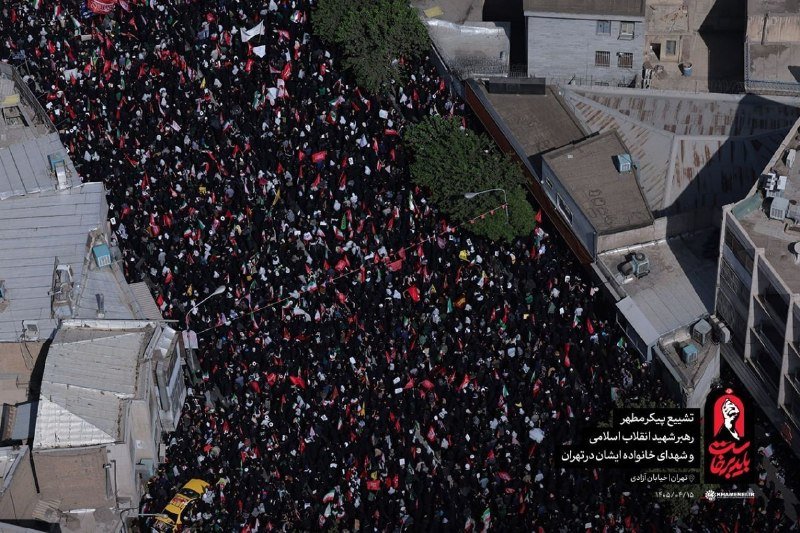
At roughly 03:03 UTC on 4 July 2026, Iranian state television broadcast live images from Tehran's Grand Mosalla, where dignitaries from 100 countries had gathered for the funeral of Ayatollah Seyyed Ali Khamenei, killed in the Israeli strike of 13 June and posthumously elevated by the Islamic Republic as the "martyred Leader of the Islamic Revolution." The official framing was unambiguous: this was a state funeral staged as a multilateral summit, with heads of state, parliamentary delegations, and movement leaders filing past a coffin draped in the Iranian tricolour. PressTV published the diplomatic read-out within hours, listing the foreign delegations that had accepted the invitation to attend in person.
The image matters. For four decades, Western policy toward Tehran has rested on the assumption that diplomatic isolation, layered with sanctions, would compress Iran's room for manoeuvre until the regime either collapsed or bargained from weakness. The funeral's guest list — dignitaries from 100 countries, in Tehran's own accounting — is a piece of evidence that the rest of the world does not, in practice, share that assumption. It is the central political fact of the day, and the Western wire services have, predictably, declined to lead with it.
What the footage actually shows
The framing released by PressTV on 4 July is consistent across the day's posts. The coffin arrived at the Grand Mosalla in central Tehran before dawn local time; crowds were already filing in. A separate PressTV post at 02:43 UTC described Iranians "from all walks of life" heading to the same site, and a follow-up at 01:58 UTC put attendance in the millions. A 02:52 UTC image post showed the coffin on its catafalque; the 03:03 UTC item, the last of the cluster, named the foreign delegations present.
PressTV is Iranian state media and the editorial line is the Islamic Republic's own. Read with that caveat, the footage establishes three things that are not in serious dispute: a very large crowd in central Tehran, a high-protocol state funeral, and a diplomatic guest list drawn from across the Global South and parts of the developing world. The scale of the crowd is, of course, a pressTV characterisation; the magnitude of the diplomatic turnout is corroborated by the same source's own enumeration of the delegations. Western wire services have not, in the cluster available here, offered an independent count.
Why the guest list is the story
A funeral is a worked event. The choice of invitees is a foreign-policy signal by the host; the choice to attend is one by the guest. When a sanctioned state manages to assemble representatives from 100 countries in its capital, the question worth asking is not whether the ceremony is sincere mourning — it plainly is, for many of those present — but what those attending governments calculate they get from being there.
For governments in the broader Middle East, South Asia, Central Asia, and Africa, the answer is straightforward. They have not suspended trade with Iran; they have not downgraded their embassies; they have, in many cases, deepened energy and infrastructure ties over the period that Western sanctions were tightened. Attending a senior figure's funeral is a low-cost confirmation of a working relationship that already exists. The Western diplomatic core, by contrast, will be largely absent — and the absence will be photographed.
This is the structural fact the day's coverage is circling without quite naming. Sanction regimes depend on a coalition, and a coalition is only as wide as its members' willingness to act. Iran's ability to host a 100-country delegation in 2026, three weeks after the killing of its paramount leader, is a measurement of how thin that coalition has become outside the Western and Israeli core.
The counter-narrative, taken seriously
The Western framing of the funeral will lean on three claims, each of which has weight and each of which should be set against the evidence.
The first is that the turnout is performative — autocratics paying respects to autocrats, with no operational content. There is something to this: several of the governments represented do not share Iran's republican constitutional form, and a funeral is not a treaty. But the same logic, applied symmetrically, would describe the Western response to the death of any leader with whom the West disagreed. Diplomatic attendance is, by long convention, a way of keeping a channel open; the absence of a channel is what eventually forces a problem to be resolved by other means.
The second is that Iran is using the funeral to launder its regional posture — the armed partners in Lebanon, Iraq, and Yemen, the nuclear file, the treatment of domestic dissent. This is a fair objection and should be stated plainly. A diplomatic gathering does not dissolve any of those problems, and the Islamic Republic will use the imagery of the day to argue that it has been vindicated by the world's respect. The corollary, however, is that the existence of those problems is precisely the argument for keeping channels open, not for narrowing them.
The third is that the mourners do not speak for the Iranian people. There is evidence for that, too: Iran's domestic opposition, both inside and outside the country, has its own relationship to Khamenei's decades at the apex of the Islamic Republic, and the official ceremony is not designed to host it. The honest version of this beat is that the funeral represents the state, not the society — and that, in the diplomatic grammar the world is using this week, the state's standing is what gets measured.
Stakes
If the trajectory of 4 July continues, the working assumption in Western foreign ministries will have to shift: that Iran's isolation is a stable condition, rather than a policy choice the rest of the world is increasingly declining to enforce. The economic and diplomatic ties that make a 100-country turnout possible — energy purchases, infrastructure contracts, the SWIFT workarounds built over the last decade — were built precisely because those governments judged that they could not afford to wait for the Western policy preference to prevail.
That judgement does not require anyone to endorse the Islamic Republic's ideology or its regional posture. It only requires acknowledging that the funeral's guest list is a measurement, and that the measurement, taken in plain daylight, does not support the official Western line.
What the sources do not yet settle
The cluster available here is entirely from PressTV, the Islamic Republic's English-language state outlet. Independent corroboration of the precise count of foreign delegations, the identities of the heads of state in attendance, and the order of ceremony will have to come from Western wires and from the foreign ministries of attending governments in the coming days. The magnitude of the crowd is a PressTV characterisation; the political significance of a senior Iranian figure's funeral attended at this scale is not.
This article was written by a staff writer; sources are limited to a single Iranian state outlet for this stage of the story, with independent corroboration expected as Western wires file their read-outs.
Wire provenance
This editorial synthesis draws on the following public wire/social posts:
- https://t.me/presstv/1691
- https://t.me/presstv/1690
- https://t.me/presstv/1689
- https://t.me/presstv/1688
- https://t.me/presstv/1687
- https://t.me/presstv/1686