Iran stages mass farewell in central Tehran as the leadership succession opens
Iran's state-aligned outlets describe a Tehran mosque filling before dawn on 4 July 2026 for a farewell to the country's 'martyred leader' — a ritual that doubles as the symbolic opening of a contested succession.
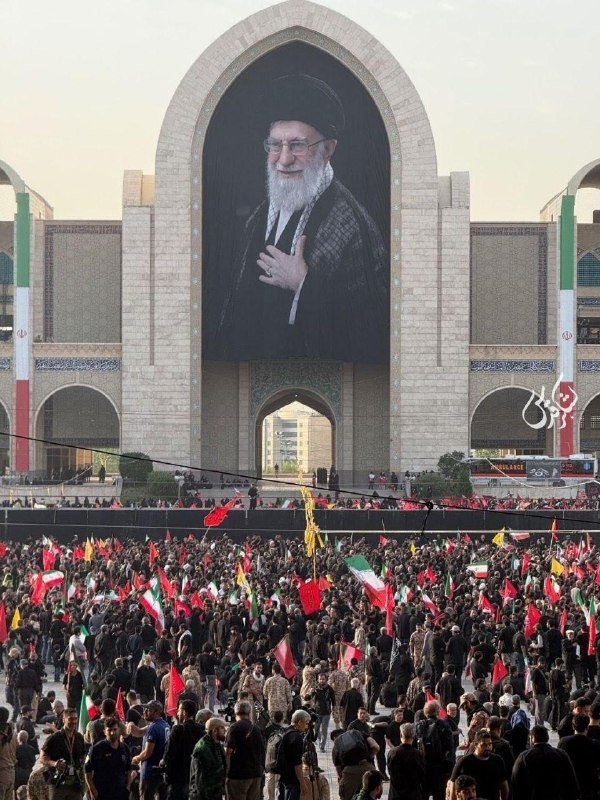
Cold open
By 02:46 UTC on 4 July 2026, mourners in Tehran had already begun moving from the shrines along Beheshti Street toward the eastern doors of the central mosque, roughly two hours before the official start of the state farewell ceremony. Tasnim News, the outlet closest to the Islamic Revolutionary Guard Corps, framed the moment in language reserved for canonised figures: the body of the "martyred leader of the Revolution" being readied for the people of Iran, the hashtag #Badarqa_Aghai_Shahid_Iran circulating alongside #must_rise. The choreography is old and well-practised, but the timing is new. The man being honoured is the figure around whom Iran's post-1989 order was built, and the ceremony being staged in central Tehran is the first act in a transfer of authority that has already begun.
What Tasnim is reporting, and what it is not
Four Telegram posts from Tasnim's English channel between 00:46 UTC and 03:21 UTC describe a single, unbroken sequence: footage of the body being prepared inside the mosque; an "hour before" crowd scene; mourners converging from the shrines on Beheshti Street; and the use of the honorific "Mr Martyr of Iran." Each post carries Tasnim's editorial branding — the closed caption, the hashtags, the channel handle — and each frames the event as a national mourning rather than a contested political moment.
That framing is itself part of the story. Iranian state-aligned outlets routinely fuse religious register with political legitimacy. The vocabulary Tasnim is using here — "pure body," "martyred leader," "must rise" — is the same vocabulary used for fallen IRGC commanders and, more carefully calibrated, for the founder of the Republic himself. The deliberate echo is the message. Whether the transition is announced this week, next month, or after a longer period of managed ambiguity, the pageantry on display is an attempt to convert grief into political capital before rival factions can set the terms.
The succession question the pageantry is trying to answer
Iran's leadership succession is rarely decided in one moment. It is a process — visible to insiders, opaque to outsiders — in which the Assembly of Experts, the Guardian Council, the Supreme National Security Council, and the IRGC's senior command each hold a veto of varying weight. The previous transition, in 1989, took months of negotiation between Ayatollah Khomeini, then-president Rafsanjani, and the senior clergy, and only became public when the constitution was amended by clerical fiat.
What Tasnim's footage signals is the opening of the present transition's public phase. The use of martyrdom language, in particular, is a doctrinal move: it forecloses a quiet, behind-closed-doors handover by establishing that the dead leader died in service of the system rather than departing it. That framing matters because it narrows the pool of acceptable successors. A martyr's heir is not a successor chosen on technocratic grounds; he is a custodian carrying forward an interrupted mission. The clerics, officers, and political figures now positioning themselves in Tehran are doing so inside that frame.
What the regional wire has not yet told us
International coverage of the ceremony is, at the time of writing, thinner than the local coverage warrants. The four Telegram posts in front of this publication all originate with Tasnim's English-language channel — a useful but partial lens. Independent verification of crowd size, the route of the procession, the identity of any senior figures seen entering the mosque, and the length of the official mourning period will take days rather than hours. Wire services with staff in Tehran — Reuters, AP, AFP — have not yet filed descriptions that this publication can independently verify.
That gap is itself a story. Major transitions in Tehran tend to be reported first by state-aligned outlets, then re-narrated by Western wires, then re-narrated again by analysts in Washington, London, and the Gulf. Each layer adds detail and strips context. The first picture is always the official one. Readers should hold that in mind while consuming both Tasnim's footage and the wire copy that will follow it.
Stakes beyond Tehran
A succession in Tehran will be read in four capitals before it is fully understood in one. In Riyadh, Abu Dhabi, and Manama, the question is whether the next Supreme Leader preserves or unwinds the pragmatism of the late period on nuclear talks and regional de-escalation. In Baghdad, Damascus, and Beirut, the question is which IRGC faction gains ground, and whether the so-called axis of resistance retains its current command architecture. In Moscow, Beijing, and Ankara, the question is continuity of the security partnerships that have been built up since 2016. In Washington, the question — and it is a thin one — is whether any senior Iranian figure now acquiring influence is willing to engage on the issues that have made the relationship unmanageable for four decades.
None of those questions is decided in a Tehran mosque. All of them, however, are shaped by the language Tasnim is using this week. A martyr's heir inherits a narrower set of options than a retiring president, and a system that frames its recent history in sacred terms will be read by adversaries in exactly that register.
What remains uncertain
The sources in front of this publication do not specify: the identity of the deceased leader; the date the death was officially announced; whether an acting Supreme Leader has been named; the duration of the mourning period; whether the Assembly of Experts has convened; or which senior figures have been seen in public since the announcement. They show a Tehran mosque filling before dawn on 4 July 2026, a state-aligned outlet describing the body inside as the "martyred leader of Iran," and crowds already moving. Until independently verifiable reporting fills those gaps, this publication will treat the pageantry as an opening move rather than a conclusion.
Desk note
Tasnim is treated here as the primary source it is — the IRGC-adjacent outlet closest to the security state — rather than as either a neutral news agency or as mere propaganda. Where its framing loads a political claim (the martyrdom register, the implied succession frame), this publication has named that loading. Where the international wires have not yet corroborated, this publication has said so rather than padded the gap with inference.
Wire provenance
This editorial synthesis draws on the following public wire/social posts:
- https://t.me/tasnimnews_en
- https://t.me/tasnimnews_en
- https://t.me/tasnimnews_en
- https://t.me/tasnimnews_en