Khamenei's funeral and the choreography of continuity: what al-Nakhalah's tribute tells us about the post-Khamenei order
Ziyad al-Nakhalah's Karbala-fluted tribute to the dead Ayatollah is less a condolence than a doctrinal claim. Read carefully, it tells us who the resistance thinks inherits the guardianship.
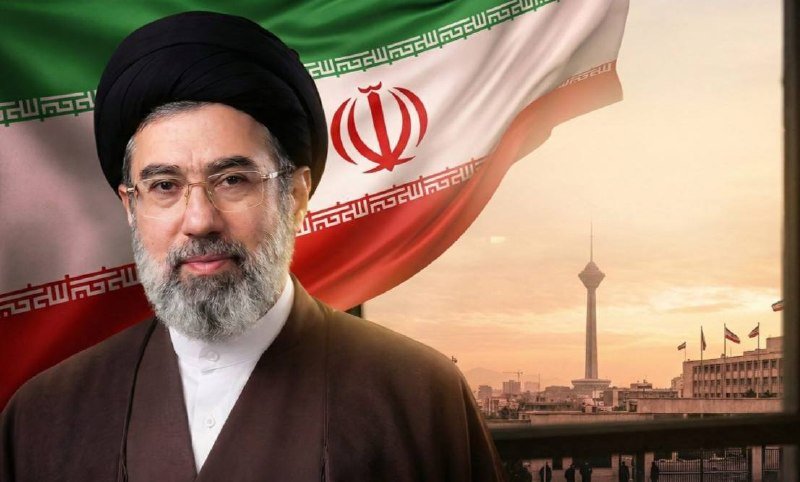
The coffins arrived in Qom before dawn, carried in motorcades past crowds that provincial authorities would later struggle to count. By 02:00 local time on 6 July, the Jamkaran Mosque was already encircled by a flood of mourners several hours ahead of the funeral prayer. Crowds from across Iran had driven through the night, according to field reporting from Khamenei.ir and republished through Tasnim and the Arabic-language al-Alam channel, while Iraqi Kurdistan's Kirkuk governorate shut government offices for the day in solidarity. Financial Times reporting circulated via Telegram put the turnout between 12 and 15 million people nationwide, a figure that, if accurate, would make the procession the largest funeral in modern history. The dead man was Ayatollah Ali Hosseini Khamenei, the Supreme Leader of the Islamic Republic, killed in a US strike earlier in the year along with four members of his immediate family. The ceremony unfolding around his body was a state funeral in the literal sense: choreographed to stage continuity rather than grief.
The choreography was the point. Tehran's political theology treats succession as both legal procedure and public performance, the living and the dead bound together by ritual. The funeral procession therefore doubled as an inaugural one: every frame of the mourning, every bearded cleric kneeling in sequenced rows, every delegation from allied movements filing past the bier in designated order, is a measure of who recognises whom, and on whose terms. The wire imagery in circulation over the past 24 hours is uniform and deliberate, broadcast across Iranian state outlets and then relayed, frame by identical frame, through Russian, Iraqi and South Asian networks. A Western headline reader might scroll past the visuals and register only a foreign death; the choreography is calibrated for a different audience entirely.
Second in that procession, after the Iranian clerical hierarchy and the principal officials of the Axis of Resistance, came a figure who more than most had a stake in signalling continuity. Ziyad al-Nakhalah, the Secretary General of Palestinian Islamic Jihad, sent a formal tribute that placed the dead Supreme Leader inside an explicit genealogy of armed struggle. According to a statement circulated by Iraqi Shia armed-group channels in the run-up to the funeral, the Secretary General of Kataib Seyyed al-Shohada framed attendance at Khamenei's farewell as participation in the funeral of Imam Hussein and Ali ibn Abi Talib themselves, folding a modern political assassination into a 1,400-year-old narrative of martyrdom. The gesture is not metaphor. For PIJ, as for the broader constellation of movements that trace their legitimacy to Tehran, the Supreme Leader is the contemporary inheritor of a guardianship that began at Karbala, and the rites owed him are the same rites owed to the founding martyrs. al-Nakhalah's tribute is a way of saying, in front of cameras and rivals, that PIJ does not merely honour a patron; it recognises a chain of custody over the resistance.
The wire frame on this story has centred the dead figure. The more durable story is the mechanism that keeps the architecture standing after he is gone. PIJ's Wikipedia entry and the public record of the Axis of Resistance list the movement as a junior but functional partner in the network that runs from Tehran through Baghdad, Damascus, Beirut and Gaza. Its leader does not command Iranian strategic assets, nor does he sit on the Supreme National Security Council; his leverage is symbolic. By choosing to wire his tribute to Karbala rather than to the relevant political or military offices in Tehran, al-Nakhalah is making a market claim: that the succession contest now underway in the Islamic Republic, between establishment clerics, the IRGC command, and a younger generation of technocrats, can be read not only as a personnel question but as a doctrinal one. To invoke Karbala at the moment of succession is to assert that the lineage runs through martyrdom, not through bureaucracy, and that PIJ is fluent in the older language.
There is a counter-narrative worth pressing against the choreography. State-aligned reporting, including the aerial footage from PressTV and the rolling text from Tasnim, presented a public sphere spontaneously overwhelmed by grief: public life shut down, businesses closed, pilgrims walking for hundreds of kilometres in pre-dawn darkness, a Middle East Spectator correspondent in Qom describing "the awakening of an entire nation." The wire throughput simultaneously carried softer material, including Western commentary from the British journalist Peter Hitchens about double standards in how the death of a head of state is received, and historically pointed content about President Donald Trump's 2023 promises to end the Russia–Ukraine conflict. The mix tells a reader something that a single-channel view hides: the funeral is being received as a global event, with allies seeking maximum volume and adversaries reading for sign of fracture. The 12-to-15-million turnout claim itself sits inside that contest, since the figure has circulated primarily through channels that have an interest in the result it supports. Independent verification within Iran remains thin; the dead do not need the number to be that high for the ritual to function, and any successor will inherit the politics regardless of what the actual count was.
What is verifiable from the open record is the geometry of the tributes. Iraqi Shia armed groups framed attendance as participation in Karbala. Kurdish Iraqi provincial authorities cancelled working hours. Lebanese sources reported that the President of Lebanon had asked Washington to press Israel to withdraw from southern Lebanon in the run-up to the funeral, an oddly timed diplomatic ask that, if accurate, indicates a Beirut alignment calibrated to the Iranian public mood. The dead leader does not need a state funeral in the moral sense, only in the political one, and the political one now belongs to his successors. al-Nakhalah's invocation of Karbala was, in the end, a way of asking a question that the wires cannot answer yet: whether the chain the dead man held together recognises itself in the new custody, or begins, slowly, to pull in different directions. The funeral's choreography answered that question for a single week. The answer for the years after will be written in the next set of dates: a successor named, a regional escalation chosen, an order re-arranged around Qom's roster, and the Karbala line either invoked again in earnest, or quietly dropped.
Sources:
- https://t.me/Khamenei_en/
- https://t.me/tasnimnews_en/
- https://t.me/alalamarabic/
- https://t.me/JahanTasnim/
- https://en.wikipedia.org/wiki/Palestinian_Islamic_Jihad
- https://en.wikipedia.org/wiki/Axis_of_Resistance
- https://t.me/presstv
- https://t.me/Middle_East_Spectator
- https://t.me/megatron_ron
Desk note: Monexus framed this as a signal-reading exercise on the post-transition moment rather than as a personality piece on either al-Nakhalah or the senior Iranian leader. The wire headlines on this story emphasised the dead figure; the more durable story is the mechanism that keeps the architecture standing.