Tehran buries its 'martyr': the farewell ceremony as a foreign-policy statement
A state funeral on 4 July 2026 is being staged as a doctrine lesson: independence, non-interference, and the 'active support' of armed allies — read against the region’s accelerating crisis.
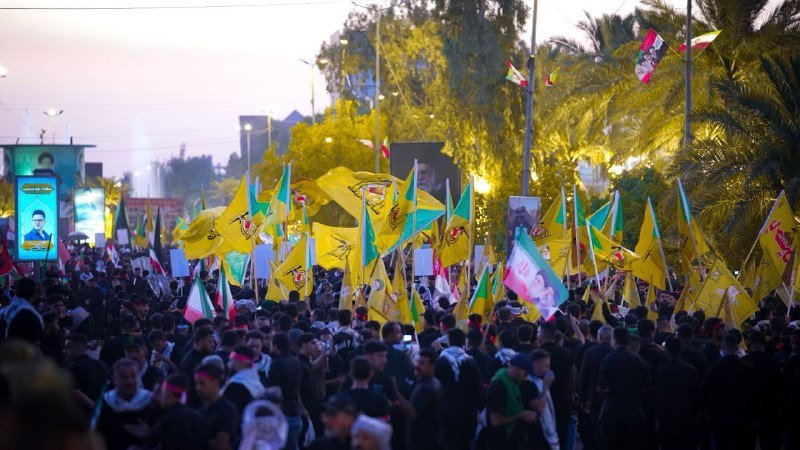
On the morning of 4 July 2026, a farewell ceremony opened in Tehran under banners quoting the Qur'an — "Stand up for God in pairs and individually" — and the slogan's familiar refrain, Far from us is humiliation. Within thirty minutes of the doors opening, crowds were still streaming in, according to the Lebanese outlet Al-Alam Arabic, the Beirut-based, Iran-aligned broadcaster that has carried the event's running coverage from its first hours. The principal being mourned is not named in the wire material, but the framing — the martyr Imam, the martyred leader of the nation — and the presence of senior officials place this squarely inside the architecture of state ritual that Iran reserves for figures whose deaths are treated as doctrine, not just loss.
The reason to watch a funeral is not the grief. It is the doctrine the grief is asked to carry. Foreign Minister Abbas Araqchi used the platform to lay out what he called the late leader's "legacy in foreign policy" with unusual plainness. Independence, he said, was the spine: an "active, influential and independent presence in the international arena," distinct from alignment with any single power bloc. The corollary, delivered in the same remarks, was the "active role based on supporting resistance movements" pursued "in parallel with a commitment to the principle of non-interference." Read together, that is not a contradiction; it is a carefully phrased equilibrium. Iran claims sovereign decision-making at the diplomatic tier and active backing for armed partners it regards as defensive — a posture the outside world usually labels sponsorship, and which Tehran frames as solidarity with occupied or besieged populations.
What the ceremony is designed to do
Iranian state funerals are stage-managed for an audience that goes well beyond the grieving family and the diplomats on the dais. The slogans are chosen. The speakers are sequenced. The cleric who delivers the Qur'anic verse sets the theological frame; the foreign minister converts that frame into policy. Araqchi's two-track formulation — independent diplomacy plus armed allied support — is the line Iran has held since at least the early 1980s, but it has seldom been stated so explicitly at a funeral. The implicit message to the armed allies is that the supply line and the political cover remain. The implicit message to Washington and the Gulf states is that the diplomatic posture will not collapse into accommodation under stress.
Al-Alam's running ticker emphasised scale: a national turnout, dignitaries present, the choreography of a farewell extended over hours rather than the compressed minutes of a news bulletin. That scale matters, because Iran is asking its own public to read the ceremony as legitimacy — the leader's biography ratified, the resistance axis confirmed, the diplomatic doctrine renewed. It is also asking regional audiences, who watch such rituals closely, to read the ceremony as continuity rather than rupture. In a week when ceasefire negotiations, sanctions debates, and proxy frontlines are all in motion, that signal is the point of the exercise.
The counter-narrative — and why it does not quite hold
The standard Western-wire read on a ceremony like this treats it as theatre: a managed display that papers over domestic strain and international isolation. There is real evidence behind that read — Iran's economy remains under heavy sanctions, its currency volatile, and its regional partners have absorbed punishing blows over the past two years. It is fair to ask whether the slogan's confident register reflects material weight or whether the state is borrowing against it.
But that read can flatten what is actually being said. Araqchi's insistence on independence and non-interference is not just rhetoric; it is a negotiating posture that has, in recent months, allowed Tehran to talk to Washington without surrendering the language of armed support, and to talk to Gulf neighbours without conceding the framing of regional security. The funeral staging that language as inheritance rather than improvisation. Whether that is durable depends on outcomes the ceremony itself cannot control: the trajectory of the Gaza front, the Lebanon-Israel line, the question of whether Iran's enriched-material programme crosses an Israeli or American red line in the months ahead. The ceremony does not settle those. It tells you what Iran intends to say when those questions land.
Structural frame — why a funeral is foreign policy
What we are watching is the conversion of a death into a doctrinal deposit. The late leader's biography is being rewritten, in real time, as a foreign-policy inheritance: independence at the diplomatic tier, armed allies in the field, non-interference as a guardrail against entangling alliances. That posture is not new, but it is being restated at a moment when Iran's room for diplomatic manoeuvre has narrowed and the cost of armed support has risen. The state is signalling, to multiple audiences at once, that the line will not be redrawn under pressure.
The broader pattern here is the way states under sanctions convert ritual into currency. A ceremony is cheaper than a weapons test, less reversible than a negotiating position, and reaches audiences that cables do not. For audiences inside the country, it ratifies a leadership transition; for armed allies, it confirms the supply line; for adversaries, it is a reminder that the negotiating posture has not been hollowed out. None of that is proof of capability on the ground. It is, however, the clearest signal Tehran has issued in months about how it intends to enter the next round of regional crisis.
Stakes — who wins and who loses if the doctrine holds
If the doctrine holds, Iran's armed partners in the regional theatre retain political cover and material support, the diplomatic channel with Washington survives without doctrinal concessions, and Tehran preserves the language of independence against both Western pressure and the lure of full alignment with Beijing or Moscow. If it fractures — under sanctions stress, a kinetic shock, or a leadership contest that reorders the security apparatus — the armed partners face a harder environment, and the diplomatic channel becomes harder to defend at home. The ceremony on 4 July is the state betting that it can keep both halves of Araqchi's formulation alive at once. The wager is visible. The outcome is not.
Desk note: Monexus has led this piece with Al-Alam Arabic, an Iran-aligned outlet, because the ceremony's choreography and the doctrine statements are best read at source; we have flagged that framing explicitly rather than transcribing it through Western-wire language.
Wire provenance
This editorial synthesis draws on the following public wire/social posts:
- https://t.me/s/alalamarabic
- https://t.me/s/alalamarabic
- https://t.me/s/alalamarabic
- https://t.me/s/alalamarabic
- https://t.me/s/alalamarabic