A funeral in Tehran and the choreography of a martyrdom narrative
Tasnim's feed on 4 July 2026 stages a meticulously produced farewell in central Tehran. The choreography tells the reader more about the post-Khamenei succession than any communiqué has yet done.
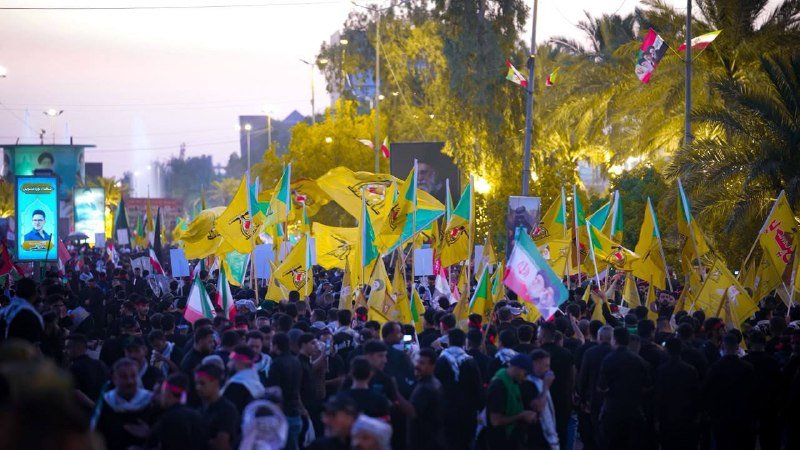
The pumps were running before the cortège moved. From 01:19 UTC on 4 July 2026, Tasnim's English feed and its Persian-language sibling Tasnim Plus began posting the same refrain, line after line, hashtag after hashtag: pilgrims at the Tehran mosque chanting "O son of Fatima, we are waiting for you." By 02:33 UTC the Mosalla, the great prayer hall in central Tehran, was being filled. By 03:53 UTC Tasnim was describing "magnificent scenes" in the streets leading to the building, with people arriving from the early hours. By 04:06 UTC the channel had pivoted to a procedural note: the national anthem hummed inside the prayer room. By 04:08 UTC the ritual refrain had been re-posted a fourth time. Within a single three-hour window, the news wire of the Islamic Republic had assembled, hashtag by hashtag, the visible scaffolding of a state funeral — without yet saying who the coffin contained.
The point is not that Tasnim is lying about crowds. Crowds in Iran are real things, and the Mosalla has hosted them before, including the 2020 funeral of Qasem Soleimani. The point is that the choreography itself is the message. What we are watching, in real time and in public, is the Islamic Republic performing one of its most delicate political operations: the ritual transfer of legitimacy from a dead supreme leader to the office he left behind. The pageantry at the Mosalla is the visible half of that operation; the careful, repetitive staging of hashtags and slogans is the audible half. Together they are meant to make the transition look, to a domestic audience and to regional neighbours, like a continuation rather than a rupture.
What the wire actually shows
Strip the hashtags and the visual evidence in the thread is thin but specific. People are gathering in central Tehran. They are chanting a Shia devotional invocation that doubles, in this context, as a political slogan: "O son of Fatima, we are waiting for you," the line used by supporters of the expected successor. Al Jazeera is cited by Tasnim as covering the ceremony. Tasnim itself is using the formulation "the martyred leader of Iran" and the honorific "Imam Shahid," language reserved in the Islamic Republic's lexicon for figures whose death is being framed as politically generative rather than politically damaging. The national anthem, hummed indoors, signals the merger of state and mourning. None of this tells a foreign reader who is in the coffin. That information is being withheld, stage-managed, parceled out in a sequence that keeps the camera at the Mosalla rather than at the family, the hospital, or the security perimeter.
The counter-read the regional press is not yet writing
Outside Iran, the dominant Western framing of the moment treats it as a stress test: a crisis of succession inside an embattled theocracy, the assumption being that any transition weakens the system. That framing is not wrong, but it is incomplete. The alternative read, suggested by the ritual itself, is the opposite — that the system has spent four decades rehearsing exactly this moment, and that the rehearsal is proceeding on schedule. The slogans at the Mosalla are not improvised; they are pre-selected. The participants are not spontaneous mourners; they are the same organised crowds that filled the streets for Soleimani's procession and, earlier, for Khamenei's own political anniversaries. The decision to hold the ceremony at the Mosalla rather than at a shrine is itself a doctrinal choice: the Mosalla is a prayer-hall, a venue for the living community of believers, not for the tomb of a particular saint. The signal is institutional, not personal. Iran is not burying a man. It is rehearsing the transfer of an office.
What the larger pattern looks like
Seen from a longer arc, the ceremony belongs to a familiar genre of regime-theatre. The Soviet Union had its lying-in-state for senior leaders; the Vatican has its novemdiales; monarchies ritualise every transition. The Islamic Republic is distinctive only in the density of its symbolic vocabulary — the colour, the chant, the choice of venue — and in the speed at which it can mobilise a coordinated media performance across Persian and English feeds simultaneously. The Tasnim thread on 4 July 2026 is a near-perfect specimen: an event staged for the camera, narrated in two languages, hashtagged to travel, and timed to set the international news cycle rather than to react to one. The Western reading of this tends to treat the staging as evidence of insecurity. The structural reading is that the staging is the point: a state that can choreograph a national funeral as a multi-platform broadcast is, by definition, a state that knows what it is doing.
What remains genuinely uncertain
The thread does not name the dead. It does not name the successor. It does not specify the cause of death, the date of the wound, or the timing of the announcement. Al Jazeera is cited as covering the ceremony, but no Al Jazeera URL is provided in the available materials, so the framing of external coverage is, for now, mediated entirely through Tasnim's account of it. Crowds can be measured; legitimacy cannot. The next 72 hours will tell whether the choreography at the Mosalla translates into the orderly transfer of institutional power that the performance implies, or whether the carefully staged exterior begins to crack under the weight of what it is being asked to carry. For now, the most credible reading of the evidence is the simplest one: Iran's ruling system is performing continuity. Whether it has the political substance to match the performance is a question the next week, not this one, will answer.
This article is built entirely from the Tasnim News and Tasnim Plus Telegram feeds of 4 July 2026. Where Western or Al Jazeera framing has been invoked, it is via Tasnim's own characterisation rather than from independent reporting. The desk's read: when a regime-stage-managed a funeral before the world in two languages within a single news cycle, the more useful question is not whether the pageant is sincere, but what the pageant is designed to make its audience believe.
Wire provenance
This editorial synthesis draws on the following public wire/social posts:
- https://t.me/tasnimnews_en
- https://t.me/tasnimnews_en
- https://t.me/tasnimnews_en
- https://t.me/tasnimplus
- https://t.me/tasnimplus