A farewell in Tehran, and the framing fight it will provoke
Crowds gathered in central Tehran overnight for the funeral of Iran's supreme leader. The next 48 hours will be defined less by who fills the post than by which camera lens the world watches it through.
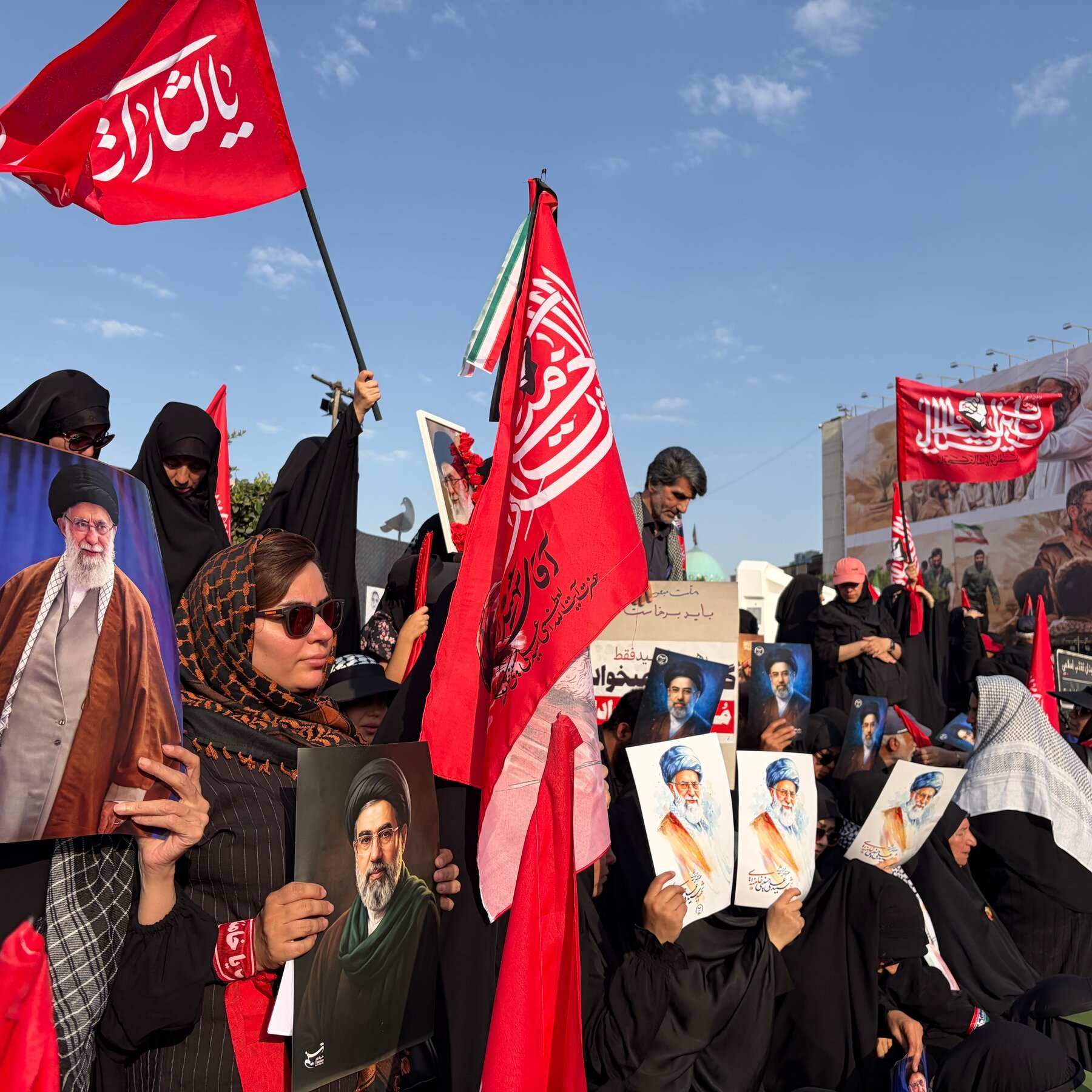
By 00:40 UTC on 4 July 2026, the courtyards of central Tehran's Musalla were already filling. Aerial footage circulated by Tasnim News showed a slow, deliberate swell of black-clad mourners converging on the prayer hall where the body of Iran's supreme leader had been brought to lie in state. Within the hour, Tasnim's English service reported processions beginning from the shrines along Beheshti Street, two hours before the official ceremony was due to begin. By 02:33 UTC, Tasnim Plus was broadcasting the first arrivals in real time. The choreography was unmistakable: a state preparing to be seen, by its own people and by every foreign camera pointed at it, on the day that the Islamic Republic's most powerful office changes hands.
This publication does not yet know who will succeed the deceased leader, and the source material available to us does not say. What the material does say — what the next forty-eight hours will visibly say — is that Iran is staging a grief narrative at industrial scale, and that the rest of the world will receive it through two entirely incompatible lenses. Both will claim to be telling the truth. Neither, alone, will.
The camera Iran wants you to see
The Iranian state press is doing what it has always done at moments of maximum consequence: total saturation, no daylight. Tasnim's overnight coverage is the model. Aerial shots of the Musalla, ground-level footage of the Beheshti Street processions, the rolling pre-ceremonial build-up — all of it pushed out in a steady stream designed to set the visual baseline before the international press corps has filed its first frame.
This is not a conspiracy. It is the standard repertoire of a one-party state managing succession optics. The official narrative on state-aligned outlets will present a unified nation, an orderly transfer, a system that absorbs the loss of a founding figure the way it was designed to. The hundreds of thousands of bodies on the streets of central Tehran, if the early footage is representative, will be framed as proof of legitimacy by inheritance.
It is worth taking that frame seriously, on its own terms, before dismantling it. The Islamic Republic has, for nearly five decades, survived sanctions, a catastrophic war, internal factional warfare, and the assassination of senior figures. The public rituals around those events have, historically, functioned as the connective tissue of the system. To watch the crowds gather at the Musalla at 00:40 UTC is to watch a political technology operate as designed.
The camera the West will reach for
The Western wire frame on an Iranian succession is also a repertoire, and it is just as rehearsed. Expect, within hours, the readymade templates: "clerical hardliners tighten grip," "moderates sidelined," "the street versus the state," "another Gaza-linked crisis in the offing." The first cable-news chyron will tell you which template has won the day inside whatever newsroom is fastest.
That frame is not wrong, exactly. It is incomplete in a way that has become structural. Western coverage of Iranian succession events routinely treats the Iranian public as a single bloc reacting to a single decision made by a single man, when the actual mechanics of the office — the Assembly of Experts, the Guardian Council, the IRGC's parallel power, the bazaar networks, the clerical seminary in Qom — involve dozens of veto points and several competing centres of gravity. The shorthand is not analysis; it is shorthand.
A more honest read would hold both at once. Yes, the system is designed to constrain. Yes, the visible choreography of the next forty-eight hours is partly performance for the cameras. And yes, the visible choreography is also a country in motion, in a real city, with real people who have made real calculations about what their presence at the Musalla means for them, their families, and whatever comes next.
What the framing fight is actually about
Strip the pageantry away and the contest is over a single question: does the Islamic Republic emerge from this transition looking like a system that renews itself, or a system that is running out of road? Every actor in the next forty-eight hours is trying to make the answer come out the right way for them.
Inside Iran, the competing factions of the establishment — the principlists, the moderate conservatives, the reformists still tolerated, the IRGC's institutional weight, the clerical old guard — are reading the crowd at the Musalla as an early market signal. The size and composure of the turnout is being watched as carefully by Qom and by the IRGC's command centres as it is by foreign correspondents.
Outside Iran, the framing fight is older and bigger. The Gulf states, Turkey, Israel, the United States, the European Union, Russia, and China are all adjusting in real time to a transition none of them predicted on this timeline. Each will have an interest in the read of "renewal" or "decline" that they transmit back to their own publics. Western think-tanks will produce four-paragraph memos with the confident tone of a verdict. State Department readouts will lean on whichever frame best serves the policy in motion. The Chinese and Russian readouts will lean on the opposite frame, with equal confidence.
The structural pattern underneath
The deeper question is not who succeeds the supreme leader. It is whether the office, as constituted, still has the legitimacy-density to absorb a transition of this magnitude without a contested outcome. Every previous transition in the Republic's history has resolved inside the existing institutional architecture. The apparatus is being stress-tested this week, in public, on television.
There is also a media-structural layer that is easy to miss. The world that watches the Musalla on 4 July 2026 is not the world that watched the funeral of Ayatollah Khomeini in 1989. It is a world in which a Tasnim Plus livestream and a Reuters pool feed compete in the same algorithmic feed, in which the Iranian state has its own TikTok-savvy producers, in which a phone camera inside the crowd is a primary source, and in which the gap between what the state presents and what the street sees is no longer a one-way information deficit. That changes the politics of the framing fight. The Iranian state can no longer assume a foreign press that arrives three days late and files from the hotel lobby. It has to win the optics contest in real time, against distributed cameras it does not control.
Stakes, and what we do not know
The stakes are concrete. Iran's regional posture — the axis of resistance portfolio, the nuclear file, the relationship with the Gulf monarchies, the Iraq and Syria theatres, the energy market — is calibrated, in part, to the credibility of the office that just lost its occupant. A transition that reads as stable preserves leverage. A transition that reads as fractured invites every external actor with a stake in Iran's neighbourhood to test the seams. The next seventy-two hours of the funeral choreography are, in that sense, a foreign-policy signal as much as a domestic one.
The sources available to us at the time of writing do not specify the cause or circumstances of the supreme leader's death, do not name a successor, and do not record any official succession statement from the Assembly of Experts or the Guardian Council. The Tasnim and Tasnim Plus feeds as of 02:33 UTC on 4 July 2026 describe only the funeral logistics. What we do not know, in other words, is substantial, and any claim to certainty about the political consequences of the next few days should be treated with appropriate caution.
What we can say is this: a city is awake, a system is performing its highest-stakes ritual, and the cameras — Iranian, Western, regional, and amateur — are all rolling. The story of the next forty-eight hours will be the story of which frame holds up under the weight of the footage itself.
— Monexus Staff Writer, reporting in staff-writer voice. Monexus treats state-aligned Iranian sources as counter-claim material with explicit sourcing caveat, per our standing editorial policy. The visible choreography at the Musalla is being reported here as fact; the political interpretation is the reporter's, not the source's.
Wire provenance
This editorial synthesis draws on the following public wire/social posts:
- https://t.me/tasnimnews_en
- https://t.me/tasnimplus
- https://t.me/tasnimplus