Tehran's farewell: the choreography of a managed succession
Crowds are pouring into central Tehran for a farewell ceremony at Tehran Mosque. The staging is unmistakable — and so is the politics of what comes next.
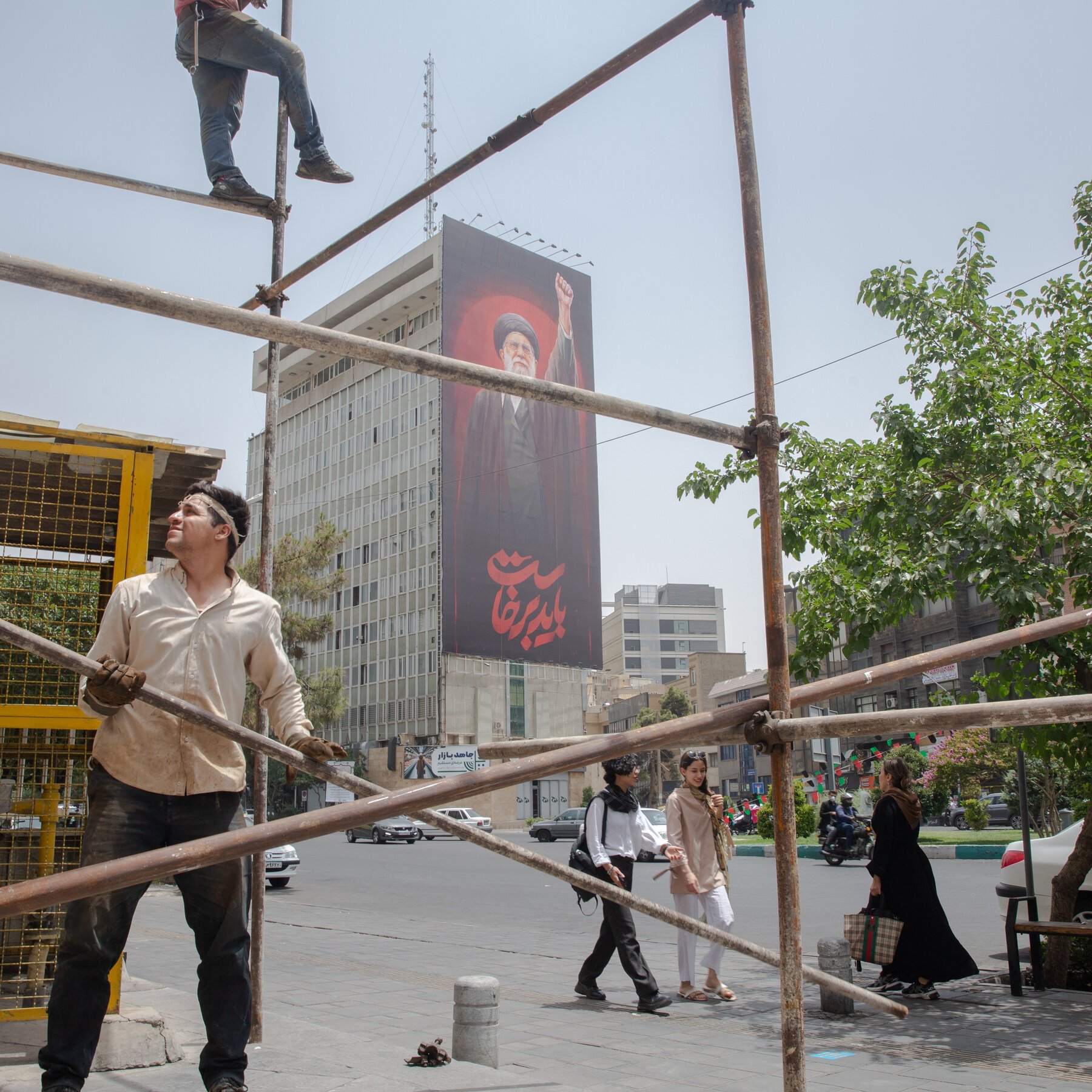
By 04:13 UTC on 4 July 2026, the streets around Tehran Mosque were already over capacity. State-linked outlets Fars and Tasnim carried near-identical footage: columns of mourners moving toward the mosque, the building itself described as full, with crowds still arriving from the surrounding streets for the farewell ceremony at the burial site of Iran's Supreme Leader and members of his family killed in the Israeli strikes of late June.
The choreography of the scene is the news. The Islamic Republic has always understood that legitimacy, in a system without free elections, is performed rather than conferred. A funeral is not a private grief; it is a stress test of the order that follows. Tehran's choice to fill the mosque with bodies and the streets with people is a message aimed simultaneously inward — at a population still absorbing the shock of decapitation strikes — and outward, at a regional audience weighing whether the regime can hold.
What the footage actually shows
Two threads, timestamped within twenty minutes of each other, tell the same story. Fars's 03:58 UTC item describes a "flood of people" moving through the streets leading to the mosque; Tasnim's 03:54 UTC item adds that the mosque had already reached capacity while mourners continued to stream in from surrounding districts. The visual language is deliberate: long processions, packed courtyards, the repeated framing of a "holy body" — Ayatollah Khamenei, alongside relatives killed in the same strike — laid out for public veneration.
The compressed timeline matters. Ceremonies of this scale normally require days of preparation; the mourning period began only after the 13 June strikes that killed Khamenei, his wife, son Mojtaba, daughter-in-law, and grandchild. The decision to hold a public farewell at the centre of the capital — rather than a quieter burial in Mashhad or Qom — signals that the post-strike leadership wants its first major domestic ritual to look like a coronation by mourning, not a hurried interment. Coverage from Iranian state media frames the gathering in explicitly religious, almost devotional, language: the martyrdom framing, the reference to a "sudden journey," the imagery of a leader whose death consecrates the political order he leaves behind.
The regime-friendly read and the structural counter
The official narrative — the only narrative permitted in Iranian domestic media — is straightforward: a martyred leader, a grieving nation, a system that absorbs the blow and continues. State outlets are already seeding the next chapter: the Assembly of Experts will meet, a successor will be named, the institutional architecture will hold. The street turnout is being presented as evidence that it will.
The structural counter is harder to verify but equally important to name. A funeral of this scale tells the outside world very little about what happens inside the closed rooms of the Expediency Council, the IRGC command chain, or the office of the acting Supreme Leader. Mass mobilisation can reflect genuine grief; it can also reflect the same coercive choreography that delivered four-decade-high turnout in managed elections. The crowd in the footage is real. Whether it is voluntary, in the sense Western readers usually mean, is a question the Iranian state has never allowed to be tested.
What is structurally clear is this: a regime that has lost its symbolic apex in a single air strike does not respond with a quiet funeral. It responds with the largest possible public performance of continuity, in the hope that performance becomes reality. The decision to centralise the ceremony in Tehran rather than disperse it across the holy cities is the giveaway — every other senior Iranian cleric of the last fifty years has been mourned in the religious centres. Khamenei is being mourned at the seat of state.
What the succession fight will actually be about
The next decision is not, in the first instance, ideological. It is institutional. The Assembly of Experts, dominated by clerics appointed under Khamenei, must name a successor. The candidates visible in Iranian commentary — the president's office, the judiciary chief, the head of the Expediency Council, and a handful of senior ayatollahs in Qom — each represent a different balance between clerical authority, military power, and elected (if constrained) institutions.
The IRGC's role is the variable the outside world is watching most closely. Iran's security forces have spent four decades positioning themselves as the regime's indispensable arm; an unprecedented strike that killed the Supreme Leader, his designated clerical heir, and members of his family in one blow is a humiliation the corps will be under pressure to avenge. Whether the next Supreme Leader is a cleric who can command the clergy, a former security chief who can command the IRGC, or a compromise figure who commands neither, will set the trajectory of Iranian policy toward Israel, the Gulf states, and the United States for the next generation.
Stakes, and what remains uncertain
For Tehran's neighbours and for Washington, the farewell ceremony is a reading exercise. A regime that can fill central Tehran a fortnight after decapitation strikes is a regime that has absorbed the blow. A regime that needs to fill central Tehran to prove it has absorbed the blow is a regime that is performing for its own survival. The two readings are not mutually exclusive, and which one prevails will depend on decisions taken behind closed doors in the coming days.
What the sources do not specify — and what no Western wire reporting has yet been able to confirm — is the composition of the Assembly of Experts' working majority, the IRGC command's preferred candidate, and whether any faction within the security apparatus is preparing to contest the succession on grounds that the clerical model itself has failed. The footage from Tehran Mosque is real and the turnout is real. The politics of what it produces is, for now, opaque.
Desk note: Monexus is reading Iranian state media as the primary source for a domestic Iranian event that Western wires are still catching up to. The framing treats the ceremony as both grief and governance — and flags that performance and consent are not the same thing in a system that does not permit the distinction to be tested.
Wire provenance
This editorial synthesis draws on the following public wire/social posts:
- https://t.me/farsna/
- https://t.me/farsna/
- https://t.me/tasnimplus/