The Martyr Frame and the Mandate: Reading Tehran's Farewell
Crowds at Imam Khomeini's mosque chant "Labik ya Khamenei" at a farewell for figures styled as "Martyrs of Iran." The frame is older than the men.
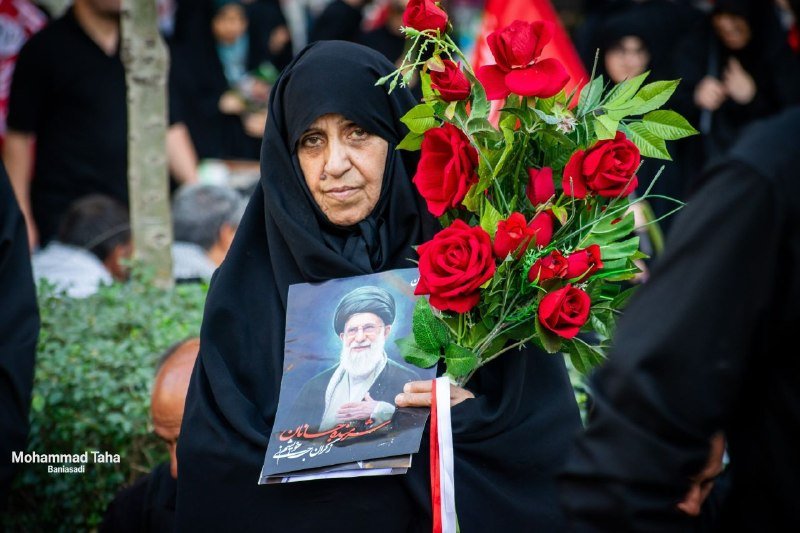
At 05:31 UTC on 4 July 2026, the Tasnim News English channel posted footage of a farewell ceremony at Imam Khomeini's mosque in Tehran. The crowd, the channel reported, chanted "Labik ya Khamenei" — an answer to a call, lifted from the lexicon of the Hajj — for a figure styled in Tasnim's caption as "Mr. Martyr of Iran." Twenty minutes earlier, the official Khamenei_in English channel had posted a Quranic verse (34:46) — "stand up (for heaven's sake), singly and in pairs" — alongside an image of the stage bearing the coffins. By 04:28 UTC, the same Tasnim feed was already carrying verses recited by the poet Haj Mehdi Rasouli at the same ceremony. The three messages, set against each other, are not incidental. They are the architecture of the frame.
The "martyr" designation in the Iranian republic is a political title before it is a religious one. It is administered, conferred, and curated. Whoever lies beneath the cloth at Imam Khomeini's mosque does not become a martyr by dying; they become one by being read as one. The chant, the verse, the elegy, the stage design — each is a gear in a familiar machine, and the machine works whether or not the man is known to the mourners filing past.
The vocabulary is the message
"Labik" is the pilgrim's reply to God. It belongs to Mecca. To direct it at a sitting political-religious authority in a Tehran mosque is to translate the Hajj's grammar into a national one: the leader as the one who calls, the people as the ones who answer. Tasnim's pairing of the slogan with the title "Martyr of Iran" fuses two registers at once — sacrifice and covenant — and asks the reader to hear them as a single sound. The Khamenei channel's choice of 34:46, a verse about standing up "singly and in pairs," layers in a third instruction: do not wait for the crowd; stand now, and stand in small formations. The poetic reading by Rasouli, broadcast in the same minute-bounded window, completes the sequence. Image, verse, slogan, elegy: a liturgy of allegiance compressed into a Telegram scroll.
Whose funeral is it, really?
Outside Iran, the instinct is to ask who died. The Iranian state's own coverage suggests the more durable question is who the funeral is for. The frame is constructed so that the departed becomes a peg for a claim about the living — about the legitimacy of the order that names him martyr, and about the willingness of the public to answer the call when it is made. Tasnim's choice of "Mr. Martyr of Iran" rather than a personal name in its caption is itself the editorial act: it universalises the dead man into a placeholder for the office he is said to have served. The crowd's slogan does the rest, attaching itself to the sitting Supreme Leader rather than to the deceased.
Western wire reporting will, in the coming days, read the scene through the lens of succession politics, factional score-keeping inside the Islamic Republic, or the management of grief at a moment of regional strain. Those readings are not wrong. They are, however, partial. They explain the choreography as if it were instrumental — a calculation — and miss the part where the choreography is also sincere. Millions of Iranians do weep at these ceremonies, and the frame works precisely because it harnesses that grief to a politics that outlasts any one funeral. The Tasnim footage shows the tears; the Khamenei channel supplies the verse; the sloganeers supply the answer. The republic does not have to choose between manipulation and belief. It builds on both.
A frame older than the men
This grammar predates the present Supreme Leader and, in some of its elements, predates the republic itself. The martyr-as-political-title has a deep Twelver Shia inheritance, in which the memory of Karbala supplies a vocabulary of legitimate suffering and legitimate rule. The republic took that vocabulary and welded it to a modern state apparatus. The slogan "Labik ya Khamenei" is a recent coinage; the willingness to chant it in a mosque is not. Outside Iran, it is tempting to read such chants as performative — the price of attendance — and inside Iran, it is tempting to read them as total submission. The honest reading is somewhere else: a political theology in which attendance, slogan, and grief are three names for the same act of belonging. To watch a Tasnim broadcast of the ceremony and see only stage-management is to miss what the audience is doing; to see only belief is to miss what the stage is doing. Both are doing their work.
Stakes, and what remains unresolved
What this frame purchases, when it works, is durability. A leader who can be answered to in the language of the Hajj is a leader whose authority is thicker than a ballot or a security service. What it costs, when it is overused, is the devaluation of the title it confers: every additional "Martyr of Iran" dilutes the currency a little, and the regime's media apparatus is plainly aware of the risk, hedging with qualifiers like "Mr." even as it universalises the name. The sources for this article do not specify which casualty or which episode produced the coffins on the stage. They do not name the deceased. They show, with unusual clarity, the relay between a Telegram channel of the Supreme Leader's office, a state-aligned news agency, and a poet whose verses are selected to fit a frame the state has spent four decades refining. Until the missing facts arrive, what can be said with confidence is narrower than the frame itself: on 4 July 2026, at a known time, in a known place, three messages were published in a known sequence, and the sequence is the story.
Desk note: Monexus reads this ceremony through the lens of the political theology the Iranian republic itself supplies — martyrdom, covenant, pilgrimage — rather than through the succession-or-no succession framing that Western wires will favour. The two are not mutually exclusive, but they are not the same story.
Wire provenance
This editorial synthesis draws on the following public wire/social posts:
- https://t.me/khamenei_en
- https://t.me/tasnimnews_en
- https://t.me/tasnimnews_en