Tehran's farewell and the choreography of succession
State-aligned outlets filled the streets around Mosalla with mourners for a "martyred leader." The visual choreography, not the victim's identity, is the news.
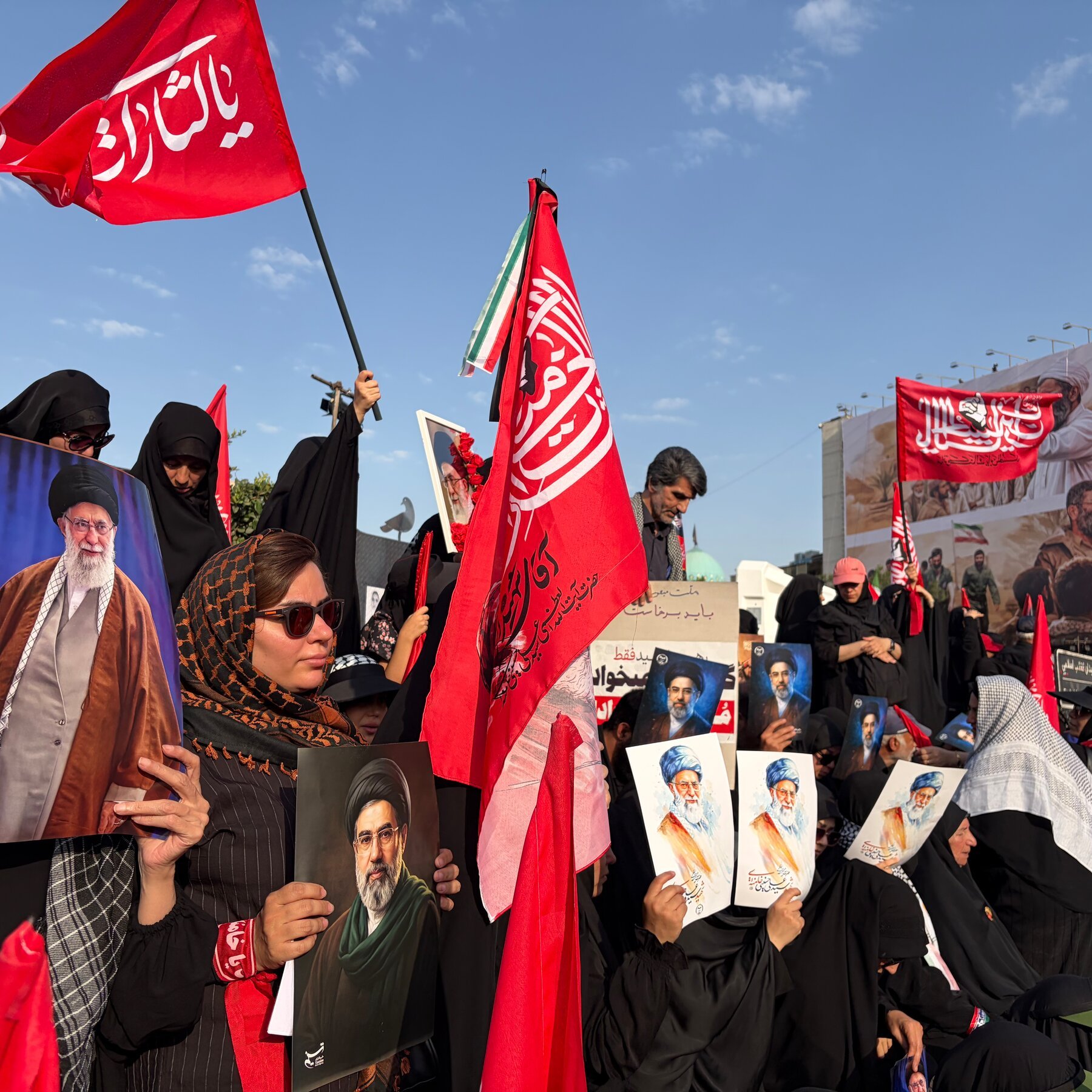
Before sunrise on 4 July 2026, the avenues feeding into Tehran's Mosalla filled with mourners carrying photographs and chanting for revenge, according to Tasnim News and Mehr News. State-aligned outlets described a "farewell ceremony" for a "martyred leader" and members of his family, framed in the religious register of the Islamic Republic. The identity of the deceased is not specified in the thread material; what is specified is the choreography — hours of staged devotion, controlled access to the body, and the deliberate use of martyrdom language to bind a political moment to sacred narrative.
The story here is not who died. It is what the public staging tells us about how succession, legitimacy, and public emotion are produced in the Iranian system — and how that production is being broadcast to two distinct audiences, one domestic, one regional.
A funeral as state performance
Iranian state-aligned media have a long-established template for processing the deaths of senior figures: dawn vigils at Mosalla, controlled entry to the bier, religious chanting, and the rotation of clerical and political dignitaries past the body. Tasnim's English feed and Mehr's domestic coverage on 4 July both reproduce that template beat for beat. The chants in the footage, invoking "the son of Fatima" and demanding revenge, sit inside a known repertoire rather than emerging organically; they signal a continuity of framework between clerical authority, revolutionary identity, and martyrdom that the regime has refined across four decades.
That continuity is itself a piece of information. When a death occurs, the template does the work of converting grief into political capital, and the speed with which the template is deployed is often the most reliable signal of how central the figure was.
The dual audience problem
What complicates the read is that the same images are doing two jobs at once. For a domestic Iranian audience, the farewell at Mosalla functions as a binding ritual — a moment when private grief is collectivised and then redirected into the symbolic economy of the state. For a regional audience, the same footage, circulated in English by Tasnim and in Persian by Mehr, lands as a softer signal: the system is intact, its rituals still draw crowds, its martyrs still produce vows of retaliation.
Iran International and the wider Persian-language opposition media will interpret the visuals very differently — as theatre, as evidence of regime-managed mobilisation, or as warning. The thread material does not include those readings, so any conclusion about which framing dominates the diaspora conversation would be guesswork.
The martyrdom register
The phrase "martyred leader" is doing real work here. In the Islamic Republic's political vocabulary, martyrdom is not a passive state; it is a credential that converts a death into a mandate for action. Tasnim's English feed leans heavily on this register across its 4 July posts, and Mehr's domestic feed matches it. The combination of "revenge" chants with the term "martyr" is a deliberate pairing: the first channels grief outward, the second channels it back into the regime's narrative architecture.
The pattern is familiar from previous Iranian cycles of mobilisation around senior killings. The same vocabulary, the same religious scaffolding, the same downstream expectation that the state's adversaries will be the targets. The novelty, where there is any, is not in the language but in the calibration.
What remains unverified
The thread items establish the staging and the language, but they do not specify the name, office, or circumstances of death of the figure being mourned. They do not name which security services were involved, what the official cause of death has been declared, or whether state-aligned channels have placed responsibility on a specific actor. A fair read requires waiting for those particulars before drawing conclusions about the political consequences — for succession inside the system, for its regional posture, or for the trajectory of any retaliation the chants seem to anticipate.
The visuals are unambiguous. Their meaning is not, yet.
Desk note: where wire outlets typically lead with identity and cause of death, this publication is leading with the choreography of the farewell — the part of the event that is fully sourced in the thread material and that is itself analytically revealing about how the Iranian state converts a death into a political instrument.
Wire provenance
This editorial synthesis draws on the following public wire/social posts:
- https://t.me/tasnimnews_en
- https://t.me/tasnimnews_en
- https://t.me/tasnimnews_en
- https://t.me/mehrnews