Britain's policing crisis is now a video crisis
Footage of officers dragging a man off his feet after a single blow has reopened the question of who polices the police — and why the courts keep siding with the cameras.
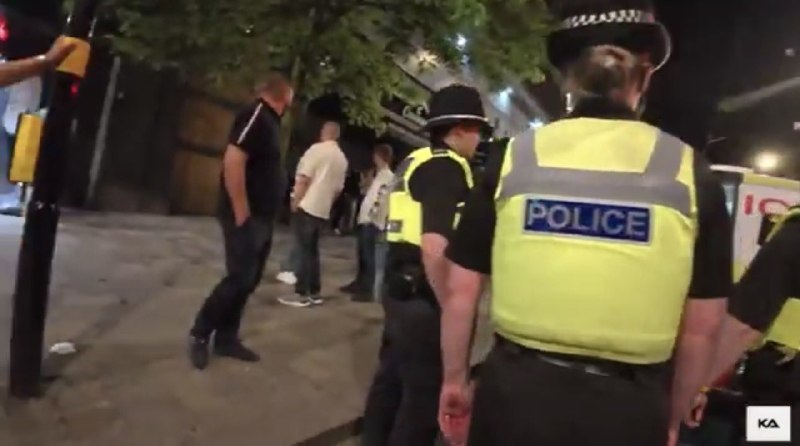
The footage is twelve seconds long, shot by a passer-by, and it has done more damage to a local constabulary's reputation than any press release could repair. Circulated across UK Telegram channels from roughly 08:00 UTC on 5 July 2026, the clip shows a man in a white t-shirt standing near a pavement when a blow lands from behind; within a second, a group of uniformed officers — visibly closer to the action than the camera — converge and drag him to the ground. The man had not seen the officers coming. He is now facing charges; the officers are still on duty.
That last detail is the story. Britain's policing problem is no longer a story about isolated rogues in uniform. It is a story about institutions that, armed with body-worn video and a decade of post-Levenson language about transparency, have somehow emerged from the smartphone era less accountable than the civilians they film. The video is the evidence. The official version is the denial.
The incident as it has been reported
According to footage reviewed by independent channels on 5 July, the sequence is unambiguous: a punch is thrown, the man turns, and before he can register that the figures behind him are police, multiple officers have taken him to the ground. The bystander filming — further away than the officers themselves — captures the whole encounter. A second angle circulating the same morning shows the wider scene, including the full officer presence. Neither clip supports the working assumption officers are reported to have offered afterwards: that they "had not seen the attack." They were, on the camera's own geometry, the closest sober witnesses to it.
The channels surfacing the footage — Telegram accounts including myLordBebo, which posted the perspective analysis at 09:02 UTC on 5 July — are not the first place a serious newspaper would source a story. They are, however, the place the story is moving fastest, and that itself is part of the problem. When the public square migrates to encrypted channels because the official record cannot be trusted, the institutions responsible for the public square have already lost something they will not get back by issuing a statement.
The credibility collapse
British policing has had a difficult half-decade. The Casey Review in 2023 catalogued institutional racism and misogyny inside the Metropolitan Police; the IOPC has logged year-on-year rises in conduct complaints; the Crown Prosecution Service has issued repeated guidance on disclosure failures that have collapsed rape and other serious trials. None of that is contested by serious sources. What is new — and what the footage of 5 July sharpens — is the widening gap between the official account of any given encounter and the visible record.
When a force tells a court that an officer "did not see" an act that was captured from further away, the burden shifts. It shifts onto the officers to explain, with specifics, how that is possible; and it shifts onto the Crown to ask, in public, why a charge is being brought against a man whose account of the moment is materially consistent with the video. The instinct of the constabulary, in the immediate aftermath, appears to have been to defend the process rather than examine the footage. That instinct is the entire story.
The structural frame
What we are watching is not a freak incident. It is the predictable endpoint of a system in which the visible record has grown cheaper than the official narrative. Twenty years ago, a bystander's video was grainy and rarely admissible. Today it is HD, time-stamped, and uploaded within minutes. Forces that have not rebuilt their internal review culture around that reality are now being tried in public, one clip at a time, by juries of millions. The institutions that survive this will be the ones that treat the camera as a partner in the truth-finding process, not an adversary to be outflanked with prose. The ones that don't will keep producing clips like the one moving through UK Telegram at 08:00 UTC on 5 July 2026 — clips in which the cameras see everything and the police statement sees less.
What changes next
Two things will determine whether this becomes a moment or a footnote. The first is whether the CPS drops the charges against the man once the footage is formally before it; a continuation of the prosecution in the face of the video would be an extraordinary act of institutional self-harm. The second is whether any senior officer in the force resigns, is suspended, or is moved sideways. If the answer to both is no, then the public square will do what it has been doing for years: migrate around the official record, and trust the footage.
It is worth saying plainly what the sources do not yet tell us. We do not know the force involved, the identity of the man, the exact sequence of the punch, or whether any officer has been placed on restricted duties. We do not have a statement from the IOPC, the CPS, or any named senior officer. What we have, as of 5 July 2026, is a clip, a Telegram commentary thread, and a question that the institutions can answer only by acting visibly — or by failing to. The video has already done its work. The institutional response is the only thing left.
This publication treated the footage as the starting point and the Telegram thread as the venue where it was first framed; the question of whether British policing can police itself is older than the clip and will outlast it.
Wire provenance
This editorial synthesis draws on the following public wire/social posts:
- https://t.me/myLordBebo
- https://t.me/myLordBebo
- https://t.me/myLordBebo
- https://t.me/myLordBebo