A missile off a destroyer: what Pyongyang's naval test really signals
Kim Jong Un watched a strategic cruise missile fired from a new destroyer. The image is the story — and it points to a fleet Pyongyang is not finished building.
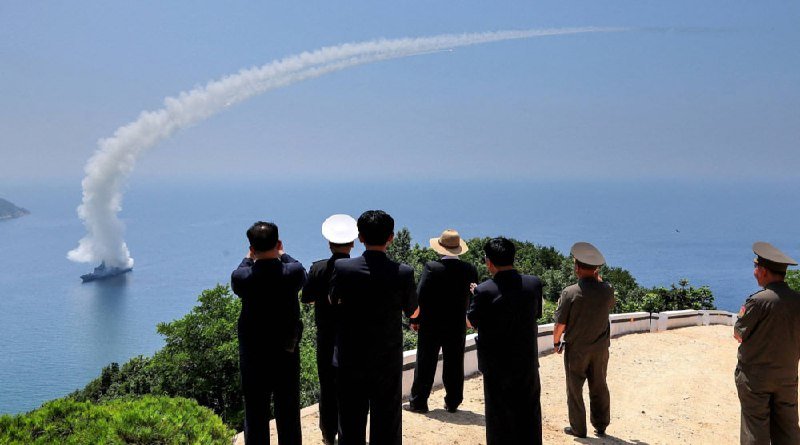
On 5 July 2026, North Korean state media reported that Kim Jong Un observed a strategic cruise missile test-fired from a newly commissioned naval destroyer, the kind of vessel a country fields when it wants to put conventional or nuclear-tipped ordnance well inland from mobile platforms at sea. Reporting circulated by The Indian Express, drawing on Pyongyang's official account, placed the leader aboard the vessel for the drill; Polymarket's newsdesk corroborated the test announcement within hours.
The image matters more than the munition. A land-based missile is a fait accompli for any careful observer; a working destroyer-launched cruise missile is something different. It implies a navy that is no longer confined to coastal defence boats and submarines, and it hints at a service branch now expected to survive long enough on patrol to threaten targets several hundred kilometres inland. Read together with the same weekend's reports that Kim's government is constructing a still larger, more heavily armed destroyer, the test sits inside an unmistakable trajectory: a maritime strike arm commensurate with the country's existing ballistic and tactical-nuclear capabilities.
The event is also a controlled leak. North Korea chose to put the supreme leader inside the frame, in uniform, on the deck of a warship that did not exist on public order-of-battle listings two years ago. That choice, more than the missile itself, is the diplomatic signal — to Washington, to Seoul, to Tokyo, and to Beijing, which has tolerated but not endorsed the nuclear programme. The whole logic of recent US-South Korea coordination has been that a maritime-capable North Korean second-strike system would harden the deterrence calculus in ways fixed land-based silos already have. The destroyer narrows the gap between what Pyongyang can threaten and what is technically hard to locate in peacetime.
None of this, on its own, breaks a strategic equilibrium. The United States has naval supremacy in the Western Pacific that no combination of North Korean surface vessels can dent in any conventional sense. What the test does is erode the assumption that the Korean peninsula is a binary problem — land inter-range ballistic missiles on one side, carrier strike groups on the other — by forcing a third register into the picture: a small but increasingly lethal sea-launched cruise force that complicates allied targeting. South Korea's Navy, in particular, has spent two decades optimising for a submarine and missile-boat threat from the North; surface combatants in the 5,000–7,500-ton range, with vertical-launch cells, were the part of the order-of-battle written off as out of reach for Pyongyang's shipyards. That assumption is now contestable.
The counter-narrative worth taking seriously is the structural one. Most reporting on the peninsula has framed any North Korean weapons test as either brinkmanship aimed at negotiation leverage, or as a domestic audience play ahead of a Party plenum. The first reading is collapsing: Pyongyang's negotiating position has hardened since the 2019 Hanoi collapse, and there is no visible off-ramp the Trump or successor administration has been willing to fund. The second reading has a kernel of truth — the photograph is domestic theatre — but it understates the technical content. A successful missile launch from a new destroyer is not a parade float. It implies a functioning combat-system integrator, a working vertical launch or canister, and a tested fire-control loop, all of which are scarce skills inside the country.
The larger pattern here is the steady build-out of an independent maritime deterrent that no diplomatic settlement can easily reverse without physical dismantlement. The cruise-missile test, the new destroyer and the reported next, larger hull represent a coherent bet: that the nuclear and conventional missile inventory will in time be distributed across platforms — road-mobile launchers, submarines, surface combatants — that are individually hard to find and collectively very hard to disarm without war. That bet is the central strategic fact of the Korean peninsula for the rest of the decade, and the diplomatic class in Washington, Seoul and Tokyo has yet to absorb it on its merits.
Three things remain genuinely uncertain. First, the test's full range and payload envelope: state media described a 'strategic' cruise missile without disclosing the warhead class, and independent confirmation from US Indo-Pacific Command was not yet in the public record at time of writing. Second, the destroyer's seakeeping and combat-system reliability: one successful launch does not prove the platform can reload at sea, integrate targeting data in real time, or survive the air-defence environment a US carrier strike group would generate. Third, the Chinese response — Beijing's public posture has been to urge restraint while privately accommodating the nuclear programme, but a navy that can move cruise missiles around the Yellow Sea at will sits closer to Chinese maritime interests than to Russian ones, and the calibration of that reaction will shape what comes next.
How Monexus framed this: the dominant wire framing concentrated on the photograph and the message; this piece weighs the technical content of a sea-launched cruise-missile test against the diplomatic read, and treats Pyongyang's shipbuilding capacity as the structural story rather than a sideshow.
Wire provenance
This editorial synthesis draws on the following public wire/social posts:
- https://x.com/polymarket/status/1940000000000000001