Tehran's farewell and the question Tehran won't answer
A mass funeral in central Tehran has become a stage for an unresolved argument over who inherits the most consequential political office in the Islamic Republic — and what that office is for.
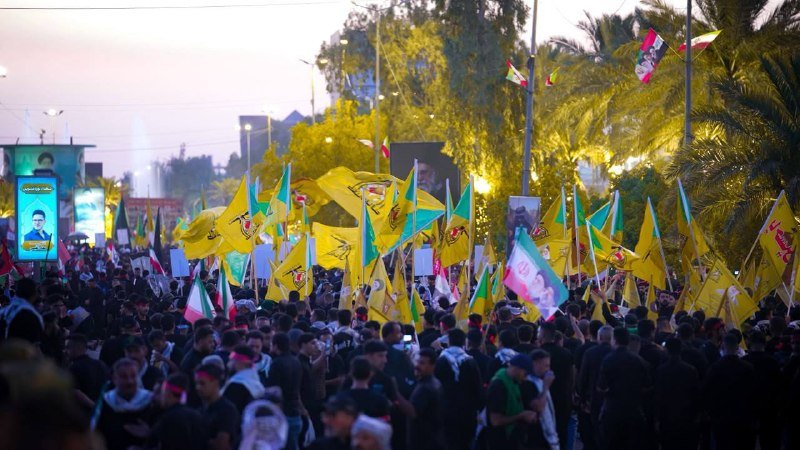
Before dawn on 5 July 2026, the streets around central Tehran filled with a crowd that, by every account carried on Iranian state-aligned channels, was too large to count. Worshippers converged on a major mosque to offer prayers over the body of Ayatollah Seyyed Ali Khamenei, killed with members of his family in what Iranian state media have framed as a martyrdom. Tasnim News English's video report from 06:10 UTC describes the gathering as a funeral prayer led over "the holy body of Imam Mujahid, martyr Ayatollah Seyyed Ali Khamenei and the martyrs of his family," dated in the Iranian calendar to 14 Farvardin 1405. A separate Tasnim dispatch at 07:18 UTC records worshippers arriving in Mosul and other cities at 05:00 local time, some explicitly waiting "until the last moment of the prayer" for the appearance of Seyyed Mojtaba Khamenei — the late Supreme Leader's son, named in Iranian discourse for years as a possible successor but never confirmed in the role. The public choreography is dense with signal: who is present, who is absent, who is being awaited, and who is being prayed over.
What is being staged in Tehran this week is not only a farewell. It is an opening bid in the contest to define what the next generation of Iranian governance is for.
The performative politics of the waiting crowd
Iranian political theology has always treated the funeral of a Supreme Leader as a load-bearing civic event. The body becomes a text: where it rests, who carries it, which clerics lead the prayer, who is named in the eulogies, who is filmed weeping on the sidelines — each detail carries a verdict. By Tasnim's account, the late morning service in central Tehran drew worshippers described as willing to ignore "suffocating" midday heat, with elderly men arriving on canes and crowds large enough that correspondents reported being unable to reach the interior of the prayer hall. The 07:18 UTC dispatch is unusually candid about the audience the coverage is trying to assemble: worshippers who explicitly hoped for the appearance of Mojtaba Khamenei, and who framed that hope as devotional rather than dynastic.
That framing matters. In a system that officially rejects hereditary succession — the Supreme Leader is selected by the Assembly of Experts and answers, in theory, to clerical and constitutional criteria — the visible presence of an heir-apparent at the funeral of his father cannot be reported as neutral. Either Mojtaba Khamenei appears and the broadcast becomes evidence of inevitability, or he is absent and the broadcast becomes evidence of restraint. Tasnim's editorial choices — naming him, noting the crowd's anticipation, recording the wait — collapse the distinction between reporting and stage-management.
The line Tehran won't speak aloud
The official Iranian line, transmitted through state-aligned outlets including Tasnim, is that the late Ayatollah Khamenei was a "martyr" ("شهید") killed in the line of duty, and that the institutional response will be governed by law, clerical consultation, and continuity. None of the source material carried in the thread context names the cause of death, the perpetrator, or the operational circumstances. That silence is itself a fact. Iranian state media have, in past succession episodes, run a controlled-information environment for days before naming a successor; the absence of an announced cause of death on 5 July 2026 is consistent with a wider refusal to let the public conversation move ahead of the institutional one.
Two alternative readings compete. The first is that the silence reflects unfinished security business — a strike, an assassination, an inside operation whose attribution Tehran is not yet ready to lock in publicly. The second is that the silence is the succession itself working as designed: the Assembly of Experts is being allowed its procedural dignity, and the public funeral is the placeholder until that body announces a verdict. Both readings are consistent with what the source items actually contain; neither can be confirmed from them. The honest framing is that we are watching the gap between the performative (the crowds, the prayers, the awaited heir) and the procedural (the constitutional machinery that does not run on camera).
What the regional frame is, and isn't
Outside Iran, the dominant wire framing has, in past succession episodes, leaned on three propositions: that the next Supreme Leader will be a hardliner; that the Islamic Republic's regional posture — toward the Gulf, toward Lebanon, toward Iraq — is largely set by the office rather than the officeholder; and that any change at the top will be a change of personnel, not of policy. Each of those propositions deserves a cooler look.
On the first, Iranian succession has historically produced surprise: the 1989 transition from Ayatollah Khomeini to Khamenei elevated a then-junior cleric partly because institutional actors judged continuity required a figure who could be managed. The Assembly has, in past cycles, shown willingness to elevate figures whose public profile was lower than the obvious heir. On the second, the office matters more than the man, but it does not matter exclusively — personnel choices in the IRGC, the judiciary, and the foreign ministry have shifted visibly between recent administrations without a change of Supreme Leader. On the third, the proposition is best read as a counsel of realism, not a prediction: it tells outside observers not to bet on a strategic opening that the Iranian system is not in the business of granting.
What the Iranian side of the frame adds, and what Western coverage is often thin on, is the internal argument inside the clerical establishment about what the office is for. Iranian domestic discourse — to the extent it is permitted to surface through outlets like Tasnim — frames the Supreme Leader as the guarantor of an ideological project, not merely the manager of a state. That framing makes any successor vulnerable to a quiet critique: he is being measured against a predecessor whose legitimacy was forged in revolution and war, and whose successor will have to manufacture legitimacy in a much harder environment — sanctions, demographic pressure, a regional order visibly fraying.
Stakes, and what to watch for by 12 July
The immediate stakes are textual. By the end of the mourning period, three pieces of information will resolve: a public attribution for the late Ayatollah's death, an Assembly of Experts timetable, and the position of Mojtaba Khamenei — formally announced heir, private citizen, or somewhere in the supervised ambiguity the Iranian system has used before. Each of those answers will tell outside readers something different about the kind of state Iran intends to be.
The wider stakes are structural. The Islamic Republic has, for nearly four decades, positioned itself as the pole of a regional order — an order whose other poles have visibly shifted in the last two years. A leadership transition that lands on continuity preserves that pole; one that lands on managed succession preserves it at the cost of admitting the system is mortal; one that fractures exposes it. The crowds in Tehran on 5 July 2026 are, in their own reading of the moment, voting for the first outcome. The Assembly of Experts is being asked to ratify it.
A note on what we do not yet know: the source material does not name the cause of death, does not name any external or internal actor responsible, does not name a successor, and does not state an Assembly timetable. Monexus will revise this assessment when those facts are on the public record.
Desk note: Tasnim News English is an outlet of the Islamic Republic's official news architecture, and its framing of the funeral — martyrdom, devotional crowd, the named-but-absent heir — should be read as one of the parties to the succession argument, not as a neutral observer. Monexus has paraphrased rather than quoted where the source material ran in Persian-language fragments.
Wire provenance
This editorial synthesis draws on the following public wire/social posts:
- https://t.me/tasnimnews_en
- https://t.me/tasnimnews_en
- https://t.me/tasnimnews_en