Tehran's farewell and the choreography of a martyrdom narrative
Iranian state outlets are broadcasting a national farewell to a fallen leader. The framing tells us more about the regime's needs than about the man.
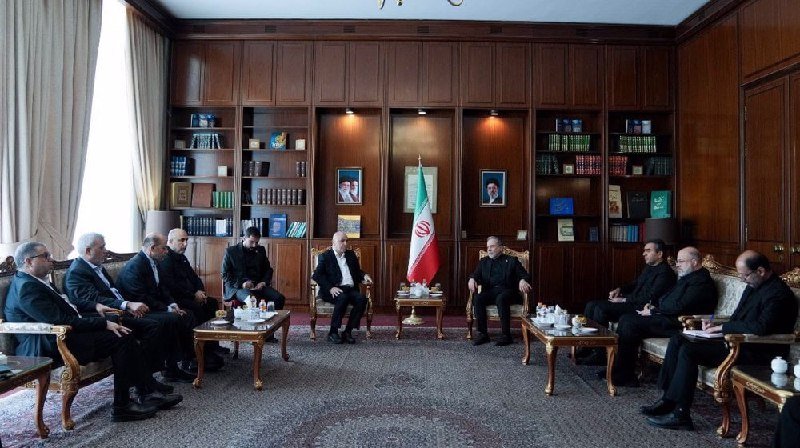
At 05:45 UTC on 5 July 2026, Tasnim News — the Iranian state-affiliated outlet tied to the Islamic Revolutionary Guard Corps — began publishing a tightly coordinated sequence of images from a farewell ceremony in central Tehran. By 07:06 UTC, the outlet had released "exclusive pictures" via its Rianavost unit showing what it described as large public attendance. By 07:27 UTC, aerial photography was being circulated under the hashtag #Badarqa_Aghai_Shahid_Iran, framing the fallen figure as a "martyred leader of the revolution." By 07:30 UTC, the messaging had hardened into a script about "entry points of the capital" being secured in parallel with the procession — a logistical and rhetorical coupling that suggests the operation is being managed as both mourning and mobilisation.
The ceremony matters less as a piece of journalism than as a piece of evidence. Iran's state-aligned outlets do not broadcast grief on this scale for figures whose deaths can be absorbed quietly. The decision to put the entire apparatus — Tasnim's newsroom, Rianavost's image desk, the hashtags, the security choreography — behind a single narrative sequence tells readers something about how the regime reads its present moment. It is performing legitimacy at volume, and the volume is itself the story.
What the framing is doing
The vocabulary Tasnim is deploying is deliberate and traditional. "Shaheed" — martyr — is the single most consequential word in the Iranian political lexicon. It does not commemorate a death; it sacralises a cause and converts the deceased into capital the regime can spend against rivals, foreign and domestic. Pairing it with "leader of the revolution" elevates the dead above a cabinet minister or general and into the founding pantheon. The hashtag the outlet is pushing, #Badarqa_Aghai_Shahid_Iran, makes that equation explicit to anyone scanning the wire.
This is not unusual. Iran's system has long used martyrdom rituals to consolidate factions, signal resolve to adversaries, and reset internal political balances. What is worth watching is the choreography of the present cycle: the combination of mass aerial imagery, repeated references to "the nation" rather than to a party or faction, and the logistical framing of "entry points to the capital" suggests the leadership is treating this moment as a test of administrative control as much as one of public emotion. A state that can choreograph a million mourners can choreograph other things.
The counter-narrative the wire will not run
Western outlets covering the same event will default to a familiar register: anonymous officials, euphemisms for Iran's theocratic structure, and a tone of detached irony about the spectacle of mass grief. That framing is not wrong, but it is incomplete. A serious account has to acknowledge that the crowds Tasnim is documenting — to whatever extent they are documented accurately — include Iranians for whom the fallen figure mattered, not as a symbol of repression but as a patron, a protector, or a piece of personal history. The instinct to dismiss state-managed grief as pure performance erases the people inside the frame.
It also erases the adversary's problem. The same Iranian system that can fill central Tehran at short notice is the system that Western policymakers have spent four decades trying to contain, deter, and periodically negotiate with. The farewell is a reminder that the apparatus still has operational depth — media, security, clerical, and street-level — and that its internal cohesion is not yet the brittle thing it is sometimes portrayed as in Western commentary.
The structural read
Across the Middle East, legitimacy is increasingly performed in public. Mass funerals, drone footage of crowds, hashtags synchronised across regime-aligned outlets — these are the modern instruments of a contest that used to be fought with longer-form propaganda and slower news cycles. Iran is not unique in this; the technique has been visible in Iraq, in Syria, in the Gulf monarchies' counter-programming, and in Israel's own rituals of national mourning. What distinguishes Tehran's iteration is the willingness to fuse the sacred register ("martyr") with the managerial register ("entry points") inside a single broadcast cycle. The message is that mourning and statecraft are the same operation.
The geopolitics flows from that. A regime that can demonstrate this kind of organisational capacity on a few hours' notice is one that adversaries have to price in — in sanctions design, in nuclear diplomacy, in the calculation of how far any escalation can be pushed. The farewell, in other words, is not a sidebar to Iranian politics. It is a piece of Iranian politics, and the wire framing it as colour would miss the point.
Stakes and what remains contested
What the sources do not specify is the cause of death, the identity of the fallen figure beyond Tasnim's ceremonial titles, or the scale of attendance independent of the outlet's own framing. Iranian state media is reporting its own production; the audience for the broadcast is partly domestic, partly the wider axis of resistance, and partly the diplomatic readers in Washington, Riyadh, and Tel Aviv who consume these images for what they signal about regime cohesion. None of those audiences will receive an honest reading from the wire alone. They will read the choreography.
What this publication finds worth saying plainly: the farewell is real, the crowds are at least partly real, and the political use to which the event is being put is real in a way that does not depend on whether every figure Tasnim publishes is verified. The question for the next seventy-two hours is not whether the ceremony took place. It is whether the succession, the security choreography, and the diplomatic signalling that follow from it match the scale of the imagery. That is the test a serious reader should apply to whatever comes out of Tehran next.
Desk note: This piece leans on Iranian state-affiliated wire material because that is the primary source for the event itself; it reads the framing against itself rather than substituting Western wire paraphrase. Where independent verification is absent, it says so.
Wire provenance
This editorial synthesis draws on the following public wire/social posts:
- https://t.me/tasnimnews_en
- https://t.me/tasnimnews_en/1
- https://t.me/tasnimnews_en/2
- https://t.me/tasnimnews_en/3
- https://t.me/tasnimnews_en/4