Tehran stages funeral rites for Khamenei as succession question moves to centre stage
Crowds gathered at Tehran's Imam Khomeini Mosque before dawn on 5 July 2026 for funeral rites on the body of Iran's Supreme Leader. The ceremony is only the visible surface — the constitutional mechanics and factional arithmetic behind it now decide the trajectory of the Islamic Republic.
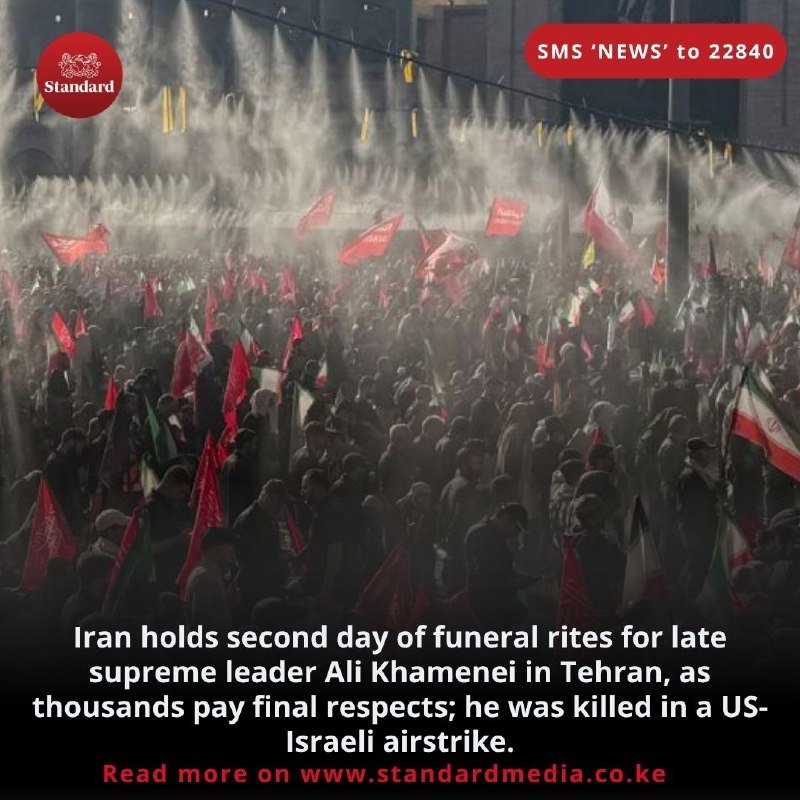
Crowds began moving toward the capital's central mosque complex before dawn on Sunday 5 July 2026, gathering for funeral prayers on the body of Iran's long-serving Supreme Leader. State-linked outlets Al-Alam and Fars News Agency carried footage from inside the Imam Khomeini (RA) Mosque in Tehran showing the arrival of the body and the presence of senior military and security figures in the moments before prayers began, with mourners chanting the Shia devotional slogan "Ya Haider, Ya Haider" as they assembled. Telegram channels run by Al-Alam and Mehr News posted the procession images between 02:57 and 04:29 UTC. The ceremony is the most visible step so far in a transition the Islamic Republic has spent decades trying to render invisible, and it sets up the harder, quieter contest that follows: who succeeds a man who held the country's most powerful office for thirty-seven years.
The image management is deliberate and recognisably Iranian. The body is described in official messaging as the "holy body" or the "purified body" of the "martyred leader of the revolution"; the venue is the same mosque complex used for state funerals of Khomeini himself and, more recently, of the IRGC commanders killed in the January 2020 strike near Baghdad airport; and the choreographed entry of senior officers — the heads of forces the Al-Alam footage shows in the mosque before prayers — places the armed services visibly inside the mourning frame, not at its margin. The use of "martyr" rather than "mourner" or "deceased" is itself a doctrinal choice, signalling that the late leader is being folded into the same symbolic register as the IRGC dead.
The state script and its seams
What the official coverage publishes is a picture of institutional unity. What it does not publish is the question every political actor in Tehran is now answering in private: under the constitution's succession procedure, who actually chooses the next Supreme Leader. Iran's 1979 constitution, as amended in 1989, vests the appointment in the Assembly of Experts — an elected clerical body whose deliberations are not public — but the effective range of plausible candidates is filtered first by the Guardian Council, which controls who appears on ballots, and second by the informal weight of the Islamic Revolutionary Guard Corps and the Office of the Supreme Leader's own networks. The Iranian sources circulating in the thread context do not name a frontrunner, which is itself the news: the public liturgy is being held while the substantive decision is deliberately kept off-camera. Telegram reporting from Fars and Mehr treats the funeral as a completed religious event; it does not advance a candidate, and that silence is the most informative line in their feeds.
The counter-narrative Western outlets will run
The dominant Western framing — visible in pre-publication guidance from outlets that cover Iran's leadership transitions — will read the ceremony as a managed display by a regime trying to demonstrate continuity at exactly the moment its continuity is most in doubt. The counter-frame from inside Iran is structurally different: state-aligned outlets present the funeral not as a crisis-management performance but as the closing act of a martyrdom narrative, in which the late leader joins the symbolic company of the revolution's founding figures and the IRGC dead. Both readings can be partly true; the analytical work is to hold them simultaneously rather than collapse one into the other. Reports from Telegram channels linked to Iran's political opposition, which this publication is not citing here because they do not appear in the source feed for this article, characterise the public mourning as substantially thinner than the official footage suggests; the threads available to Monexus do not contain that counter-evidence, and on a point of crowd size and sentiment the open record is genuinely incomplete. The honest answer is that the verifiable public fact is what Al-Alam, Fars and Mehr publish: mourners in the mosque, heads of forces in attendance, prayers offered. The size and tone of any street response outside the mosque complex is not established by the available material.
What the succession actually decides
The Supreme Leader controls the appointment and dismissal of the head of the judiciary, the head of state television and radio (IRIB), the chief of the General Staff, the commander of the IRGC, and half of the Guardian Council. He also issues the edicts that define Iran's strategic posture on the nuclear file, on regional armed partners, and on the question of any direct or proxy confrontation with Israel and the United States. A change of office therefore is not merely a personnel question; it is a question of who ratifies or revises each of those decisions. Iran's regional posture — the doctrine of forward defence through partners in Lebanon, Iraq, Syria and Yemen, the nuclear doctrine that has hovered for years around the threshold of weaponisation, and the relationship with Beijing and Moscow that the late leader personally cultivated — will be reviewed, continued or redirected by the person who wins the Assembly of Experts' vote, not by the public liturgy playing out on Telegram.
The geometry of the transition
What we are watching is a succession under compressed time inside a system that was designed to make succession frictionless. The design has not been tested in the way it is about to be tested: the founder, Khomeini, named Khamenei as a continuity figure in 1989, but there is no pre-named continuity figure this time, and the body that picks the next leader — the Assembly of Experts — last sat through a leadership transition only in principle, not in practice. The public-facing choreography of the funeral is intended to do two things at once: demonstrate to Iran's domestic public and to foreign capitals that the system is operating as designed, and compress the political space in which any factional alternative could surface before the assembly meets. The available reporting shows the first half of that strategy working as intended. Whether the second half holds depends on whether the major institutional players — the IRGC command, the Guardian Council, the senior clerical establishment centred on Qom — can agree on a candidate quickly enough that the public liturgy and the private decision arrive at the same verdict.
Stakes and what is still open
If the transition produces a figure from inside the existing clerical establishment with strong IRGC ties, the regional posture that the late leader built is likely to be maintained in broad terms, with personnel turnover rather than doctrinal revision. If it produces a figure with closer ties to the technocratic and pragmatic camp associated with parts of the Rouhani-era foreign-policy apparatus, the question becomes whether that figure can govern a security establishment that does not owe its position to him. The sources available to Monexus do not yet resolve the question — by design as much as by accident — and any reporting that names a winner this week is, on the available record, reporting ahead of it. The funeral is the visible stage. The next twenty-four to seventy-two hours of closed-door consultations are the substantive one.
Desk note: Monexus is leading with the state-linked visual record because that is what the open Telegram feed provides for the immediate event, and labelling it as such rather than as a neutral window onto "Iran". Western outlets will stress the managed nature of the display; Iranian outlets are stressing the martyrological frame. The story sits in the gap between those two framings, and the substantive news — the candidate, the timetable, the institutional trade-offs — is not yet in any feed at all.
Wire provenance
This editorial synthesis draws on the following public wire/social posts:
- https://t.me/alalamfa
- https://t.me/alalamfa
- https://t.me/alalamfa
- https://t.me/alalamfa
- https://t.me/farsna
- https://t.me/farsna
- https://t.me/mehrnews