The funeral that wasn't on the wire
Iranian state television broadcast mass funeral rites for Ayatollah Khamenei in Tehran. Western wire desks declined to corroborate. The gap between the two pictures is the story.
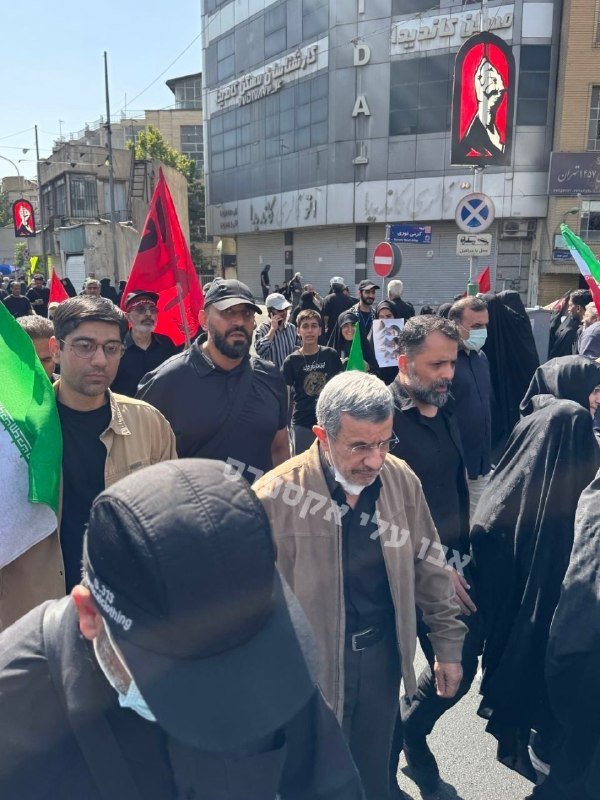
On the morning of 5 July 2026, PressTV's broadcast desk filled its rolling ticker with footage from a single site: Tehran's Grand Mosalla, the great prayer hall south of the capital, packed floor-to-walks with mourners. The banner read "MartyrKhamenei". At 09:22 UTC the channel released aerial shots of the crowd; at 09:40 UTC the national anthem had been sung and a military salute rendered in advance of the funeral prayer; by 10:16 UTC it was inviting international readers to note that Turkish mourners had joined the congregation; at 10:36 UTC the channel described the gathering as a "sea of mourners" filling the forecourt of the hall, where funeral prayers were said for the Leader and his family.
A death at the apex of the Islamic Republic is not, in itself, a story Western wire desks scramble to confirm. It is, however, the raw material from which a story is built — and on this Sunday morning the raw material coming out of Tehran was saturated with the language of martyrdom, an active present tense ("heartbroken Iranians"), and the broadcast conventions of a state channel rolling its most solemn programming.
What the footage shows, and what it doesn't
PressTV's clips depict crowds, religious ritual, and a flag-bedecked hall. They do not independently corroborate the central claim — that the Leader whose funeral is being marked is, in fact, dead. Iranian state media can credibly mourn; it can also perform mourning when the politics demand it. There is no way, from a single channel's visual feed, to settle the question either way. The West's major wire agencies have not, as of the time of writing, confirmed or denied the event on the public record visible to this publication. Reuters, AP, AFP, the BBC, and Bloomberg have not yet carried a verification. Their reticence is itself data: editors who clear copy on the Leader of the Islamic Republic without triangulation do not keep their jobs.
That gap is the story. Not what Iranian television says happened, which is on the record. Not what Western desks will eventually confirm, which is not. The story is the gap itself: a state broadcaster filling a global information vacuum with its own narrative, on its own terms, at high volume, while the verification apparatus of the international wire service remains silent.
The information asymmetry
In a contest where one side controls the cameras and the other side controls the cross-checks, the cameras always move first. The cost of getting the call wrong is asymmetric. A Western outlet that runs a death report and turns out to be wrong gets retracted and mocked; an Iranian channel that runs a martyrdom narrative before the fact has simply pre-positioned itself as the originator. By the time the wires are ready to file, the framing has already done its work in Tehran, in Beirut's southern suburbs, in Sanaa, and in the Shi'a communities of Iraq's south whose mourning calendars will be set by what the Grand Mosalla broadcast on the morning of 5 July.
This is not a new problem. It is the routine condition of fast-moving news from jurisdictions with restricted press access. But the structural read matters: when a state broadcaster owns the visual ledger on a defining political event, it does not need to lie. It needs only to be loud, first, and continuous, until the rest of the world's reporting arrives in its wake.
Why mainstream desks hesitate
Western newsrooms operate under a discipline their readers rarely see. The Leader of the Islamic Republic has not, in the past, been the subject of confirmed death reports in international media — partly because succession in Iran is itself an opaque political process, and partly because any premature report functions, in regime terms, as a stress test. Editors know this. They will wait for an official Iranian government statement, for a confirmation from a second state's foreign ministry, for the kind of visual evidence that cannot be staged — and they will wait in silence while state media performs the absence of that silence as consensus.
The result is a peculiar information landscape. A reader watching PressTV on Sunday morning sees a confirmed funeral. A reader scanning the wires sees nothing. The truth is almost certainly between the two — somewhere on the spectrum from public mourning of a privately deceased figure to a more elaborate choreography — but until the triangulation firms up, the truth is not the point. The point is whose picture of the world is in the room while the world waits.
Stakes
If the Leader has died and the Iranian system is in transition, the next seventy-two hours matter more than the next seventy-two years. The Guardians Council, the Assembly of Experts, the IRGC's conventional operations, the foreign-axis portfolio in Lebanon, Syria, Iraq and Yemen — all of it ripples outward from a single piece of information that no Western newsroom has been willing to print. Whoever owns that beat first owns the framing of succession. Whoever owns the framing owns the diplomatic choreography that follows. The state's own camera, in other words, is not a record of an event. It is the first draft of geopolitics.
What remains uncertain
The sources at hand do not establish, on the Western-wire standard, that Ayatollah Khamenei is dead. They establish only that Iranian state television is broadcasting his funeral. The mainstream press has not corroborated; no foreign government has publicly confirmed; the surgical question of succession is therefore not, strictly speaking, reportable yet. Readers should hold the picture loosely, whatever the volume from Tehran suggests.
Desk note: Monexus is publishing this without confirming the underlying death, which the wire services have not yet corroborated. The piece is about the information gap, not the obituary.
Wire provenance
This editorial synthesis draws on the following public wire/social posts:
- https://t.me/s/presstv
- https://t.me/s/presstv
- https://t.me/s/presstv
- https://t.me/s/presstv