China's Pacific Missile Test and the Australia–Fiji Pact: A Coordinated Pressure Campaign
Beijing notifies Canberra hours before a long-range missile test in the South Pacific, the same day Australia and Fiji sign a defence pact aimed at countering Chinese influence in the region.
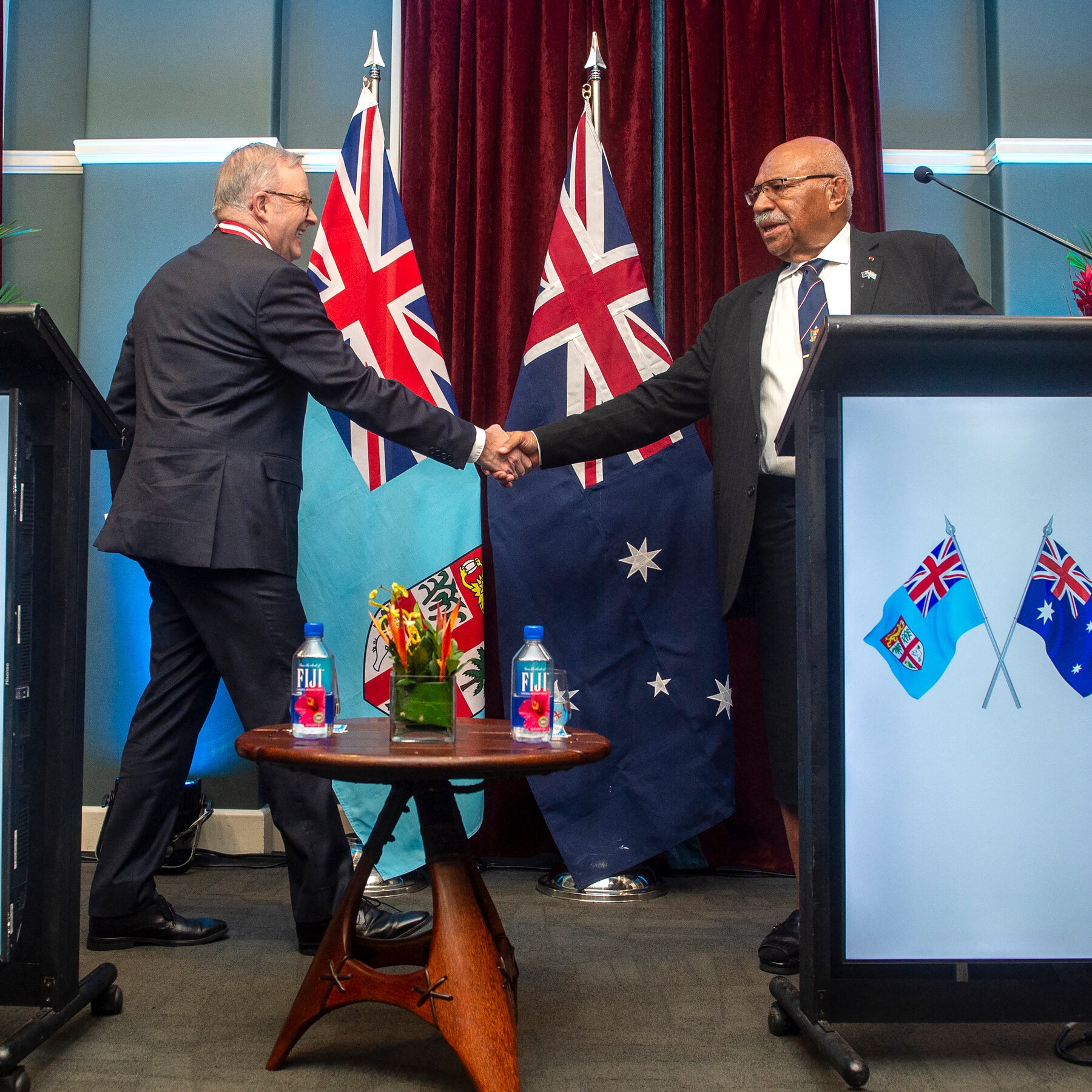
At 06:06 UTC on 6 July 2026, Australia's Department of Foreign Affairs confirmed it had received advance notice from Beijing of a long-range missile test due to fire into the Pacific within 24 hours. The notification landed the same morning Canberra signed a new bilateral defence pact with Fiji — a small, deliberate piece of choreography between two actors who do not, on the surface, share much. Together they form one of the more pointed signals yet that the South Pacific has stopped being a peripheral theatre and become a frontline one.
What is unfolding is a calibrated Chinese pressure campaign paired with a calibrated Australian response, conducted in a region where the United States has, until recently, treated its influence as essentially uncontested. The missile test, the diplomatic notification, and the simultaneous Pacific-island courtship are not separate stories. They are the same argument, pressed from two directions.
The test, the warning, the read-out
China informed Canberra of its intent to conduct the test on Monday, according to a world-news dispatch carried by wire services and aggregated on Telegram channels tracking Pacific security. Australian officials characterised the move as "destabilising to the region," a phrasing notable less for its force than for its restraint — Canberra stopped short of the more inflammatory language used in earlier disputes over South China Sea air-defence zones and live-fire drills near Taiwan. That calibration matters: an Australian government that genuinely feared escalation would have framed the test as a provocation. One that wants to leave diplomatic space open frames it as destabilisation.
The notification itself is the story as much as the test. China does not routinely telegraph long-range ballistic-missile firings to its competitors. The 2019 DF-41 test series and the 2020 DF-31AG follow-on tests were announced post-facto, if at all. A pre-flight advisory to Canberra is closer to the practice the United States and Russia use when they want a rival's tracking assets pointed in the right direction, partly out of legal habit under the Hague Code of Conduct against Ballistic Missile Proliferation, and partly because the test is meant to be observed. Beijing wants this flight read.
The 05:29 UTC wire note flagged that the missile in question would carry a nuclear warhead configuration. That detail, if confirmed in the Australian government's formal read-out, puts the test in the same category as the 1980s Soviet Pacific firings that did so much to harden Ronald Reagan's missile-defence programme. A successful demonstration of an intercontinental-range strike capability launched from Chinese territory and impacting in the open Pacific is, in the first instance, a message to Washington. Australia is the audience that happens to be in the room.
The Fiji pact, and what it actually changes
At roughly the same hour, Australia and Fiji signed a defence pact in Suva. The Nikkei Asia wire carried the signing on its Telegram channel at 06:01 UTC, framing the agreement as part of Canberra's broader effort to "boost its influence in the Pacific and prevent China from gaining" further inroads in the region. That phrasing — prevent China from gaining — is unusual for a bilateral communique and signals how openly the contest for Pacific islands is now being run.
Fiji matters more than its population of roughly 900,000 suggests. It is the largest English-speaking island state in the Pacific by some measures, holds the rotating presidency of the Pacific Islands Forum at irregular intervals, and sits astride the sea lines of communication that link Australia and New Zealand to the United States. A defence pact with Suva gives Canberra basing access, joint-exercise rights, and — most importantly in a counter-influence frame — a diplomatic veto over any future security agreement Fiji might sign with Beijing. The 2022 China–Solomon Islands security pact remains the standing precedent that pushed Australia into this new courtship cycle; Canberra does not intend to be surprised twice.
The pact is also a careful piece of work because Fiji has, historically, been the most non-aligned of the major Pacific states. Frank Bainimarama's government leaned toward Beijing from 2014 through 2022. Sitiveni Rabuka's administration, in office since late 2022, has rebuilt bridges with Australia and New Zealand without formally breaking with China. A defence pact that survives domestic Fijian politics will need to read as sovereignty-consolidating rather than alignment-locking. That is a constraint on how far Canberra can push.
What the Chinese counter-frame looks like
Beijing's framing of the moment, on the evidence available so far, runs along three lines. First, that routine military testing in international waters is a sovereign right and that pre-notification to a regional partner is itself evidence of responsible behaviour — a pointed contrast with the United States, which has conducted Pacific test flights without prior advisory to China. Second, that Australia's courtship of Pacific island states is itself the destabilising act, drawing the region into a great-power alignment it had managed to avoid. Third, that the Fiji pact is best understood as Australia attempting to lock small states into a US-led security architecture from which they would otherwise be free to diversify.
There is a coherent case behind each of those arguments, and it does not reduce to propaganda. Chinese missile tests in international waters are, as a matter of treaty law, lawful. Pacific island states are sovereign actors whose right to sign defence agreements with whomever they choose is not diminished by the inconvenience that causes Canberra or Washington. And the United States does, in fact, maintain a denser network of Pacific basing arrangements than China does at present. The counter-frame holds together because some of it is true. The question for Australian and Western analysts is how much weight to put on the truthful parts and how much on the strategic intent they are being deployed to obscure.
What we verified / what we could not
What we verified: the timing of the Australian government's confirmation of advance Chinese notification (06:06 UTC, 6 July 2026); the same-day signing of the Australia–Fiji defence pact (reported at 06:01 UTC, 6 July 2026); the Australian characterisation of the test as "destabilising"; and the wire framing of the Fiji pact as an explicit counter to Chinese influence in the region.
What we could not independently verify from the available thread items: the specific missile variant tested; the precise impact point in the South Pacific; whether the warhead configuration reported at 05:29 UTC as "nuclear-capable" was in fact a nuclear-armed test or a conventional re-entry vehicle; the text of the Australia–Fiji pact itself, including any basing or status-of-forces provisions; and any Chinese MFA formal statement on the test or the pact. The wire notes that have surfaced so far are the public record; the read-outs from Canberra, Beijing, and Suva over the next 48 hours will determine whether the day's headlines describe a routine test conducted with unusual openness or a strategic inflection point with a date stamp.
The structural picture
What is happening in the South Pacific is the same transition playing out in the Arctic, the Indian Ocean, and increasingly the southern Atlantic — the diffusion of strategic competition into regions that were, for a generation after 1991, treated as effectively uncontested by any power other than the United States. China is testing whether it can demonstrate peer-range strike capability while operating in what it presents as its own near-abroad. Australia is testing whether it can build a Pacific-island coalition dense enough to deny Beijing the diplomatic and logistical footholds that turn occasional presence into permanent posture. Fiji is testing whether it can extract value from being courted by both sides without paying the alignment cost either side will eventually ask for.
None of those tests resolves cleanly. The most likely outcome is the unsatisfying one: an incremental ratchet in which each side's moves become slightly more frequent, slightly more visible, and slightly harder to walk back. The South Pacific has not yet had its Cuban-missile moment, and the structural incentives on both sides argue against forcing one. But it has clearly entered the period in which such a moment becomes possible, and the 6 July 2026 missile test and Fiji pact will, in retrospect, look like one of the markers.
Stakes
For Australia, the immediate stake is the integrity of its second-tier defence perimeter and the credibility of its Pacific-step-up policy launched in 2018 and rebuilt several times since. For China, the stake is whether demonstrated long-range strike capability translates into diplomatic leverage at the bargaining table — whether in the Pacific, in the South China Sea, or in any future crisis over Taiwan that the public record is not yet permitted to discuss in detail. For Fiji and the smaller Pacific island states, the stake is the survival of genuine non-alignment in a region where the menu of options is narrowing.
For readers further afield, the takeaway is that the South Pacific has joined the list of regions where great-power competition is now open, regular, and consequential. It is no longer sufficient to read it as a backdrop to climate diplomacy or fisheries management. The missiles, the pacts, and the pre-notifications are the new substance.
Desk note: This piece leans on the 6 July 2026 wire window for its factual claims. The Australia–Fiji pact and the Chinese missile-test notification are reported as a pair because they landed within the same hour and because the two events read coherently as one signal sent in two directions. Where the wires diverge from the framing either side will eventually adopt in formal read-outs, we have flagged the gap rather than papering over it.
Wire provenance
This editorial synthesis draws on the following public wire/social posts:
- https://t.me/s/sprinterpress
- https://t.me/s/nikkeiasia