Overnight barrage hits Kyiv with cruise missiles and drones
Russian forces struck the Ukrainian capital with Kh-101 cruise missiles and Geran-2 drones in the early hours of 6 July 2026, marking the latest in a renewed aerial campaign against civilian infrastructure.
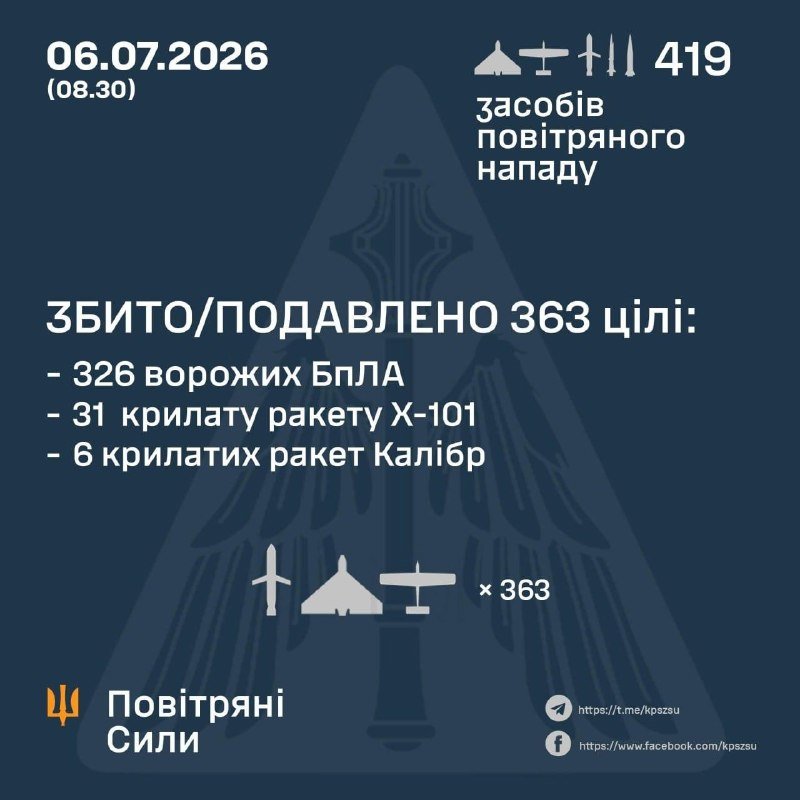
Multiple cruise missiles and loitering drones struck the Ukrainian capital in the small hours of Monday, 6 July 2026, with monitors reporting roughly twenty explosions across Kyiv inside a fifteen-minute window before dawn. Telegram channels aligned with Ukrainian open-source intelligence posted imagery of rising smoke from a reported Kh-101 impact inside the city and footage of Geran-2 strike hits, as air-defence crews worked through the overnight raid.
The salvo, recorded between approximately 22:53 UTC on 5 July and 00:40 UTC on 6 July, is the latest in a sustained Russian aerial campaign that has hammered Kyiv and other Ukrainian population centres with combined missile-and-drone packages over the past months. Ukrainian air-defence units were engaged across the capital throughout the night; the scale of the strike and the mix of long-range cruise missiles with cheaper Iranian-designed Geran-2 one-way attack drones underscores the layered character of the campaign.
What struck, and how the night unfolded
The reporting cycle began at 22:53 UTC on 5 July, when Ukrainian journalist Andriy Tsaplienko posted that monitors had logged about twenty explosions in Kyiv inside fifteen minutes. Within two hours, the Telegram channel @rnintel — a channel tracking Russian strikes on Ukrainian infrastructure — had posted footage of rising smoke from what it identified as a Kh-101 cruise-missile impact inside the city, followed by confirmation that both Kh-101s and Geran-2s had come down inside Kyiv. The channel @intelslava added imagery arriving from the capital as the raid progressed.
The Kh-101 is an air-launched, long-range, conventionally armed cruise missile fired from Russian strategic bombers, typically Tu-95MS and Tu-22M3 platforms operating inside Russian and Caspian airspace. The Geran-2 is a propeller-driven, GPS-guided loitering munition — Iranian in design lineage and produced domestically in Russia — used in saturated waves to overwhelm air-defence intercept capacity and to force Ukraine to expend expensive surface-to-air missiles against cheap airframes. Striking both classes of target inside the same city on the same night is the routine signature of this combined-arms strike doctrine.
The early-July timing matters: Kyiv has been hit with intensified, multi-wave packages through late spring and early summer 2026, with officials repeatedly warning that Russia is trying to break air-defence stockpiles and force Ukrainian civilians into hours-long shelter orders through the night. The 6 July salvo lands inside that pattern rather than as a discrete event.
The counter-narrative, and where it strains
Russian state outlets characterise the strikes as retaliatory for Ukrainian drone and missile attacks on Russian territory, including long-range strikes inside Belgorod, Bryansk and Krasnodar regions. That framing — strikes on Kyiv as response, not aggression — recurs in Russian-language coverage and in some sympathetic Western analysis, and it has a kernel of factual basis: Ukraine has, since 2023, been building out a domestic long-range strike capability, and 2025 saw a sharp escalation of Ukrainian one-way attack drones and domestically produced missiles hitting Russian military and energy sites.
But the framing strains at two points. First, it elides the starting condition: Russia invaded Ukraine in February 2022, and strikes on Ukrainian cities are the original offence, not the response. Ukrainian long-range action against Russian targets is a defensive measure against an aggressor that retains the initiative in air and ground operations. Second, the script recasts a campaign of attrition — sustained nightly bombing of a capital city of three million people — as a discrete tit-for-tat. The 6 July raid fits a pattern of deliberate, repeated strikes on civilian infrastructure documented since at least the winter of 2022–23, with energy and water systems the frequent target.
Structural frame: the economics of a saturated air campaign
What the Kh-101-plus-Geran-2 pattern reveals is less a tactical story than an economic one. Cruise missiles cost an order of magnitude more than one-way attack drones. The point of mixing the two is to force defenders to engage threats asymmetrically: every Geran-2 downed by a Ukrainian Patriot or Iris-T battery is a missile Russia's defence industry did not need to replace. The Kh-101s in the salvo, by contrast, are the high-value warheads — meant to slip through intercept capacity that has been diluted by the cheaper drones, and to hit hardened targets that the Geran-2s cannot.
For Ukraine, the arithmetic is the reverse. Air-defence interceptors are the binding constraint, not the drones. Western pledges of interceptors throughout 2025 and into 2026 have repeatedly failed to keep pace with the firing rate, which is why Ukrainian officials have framed each major package as existential. The structural point is that the air campaign is a logistics contest Russia is structurally better positioned to win — unless the production lines for intercept capacity, on the Western and Ukrainian sides, move faster than Russian missile-and-drone output. The latest Kyiv salvo is a data point in that ledger; another night logged, another inventory drawn down.
What remains uncertain, and the stakes ahead
The available reporting does not specify which Kyiv districts the missiles and drones hit, whether any intercepted debris fell on residential areas, or the casualty toll — Ukrainian authorities typically update those figures hours after the raid ends. Russian-aligned channels have not, in the material available, claimed a specific target set inside the capital for the 6 July strike; earlier salvos this year have hit energy infrastructure, defence-industrial sites and railway nodes, and Kyiv's air-defence umbrella has, in past campaigns, intercepted a majority of incoming munitions.
The forward question is whether the salvo represents a routine cycle or an escalation in tempo. Russia has, since spring 2026, signalled its willingness to absorb Ukrainian long-range strikes on its own territory and to retaliate with deeper, harder waves against Ukrainian cities. If that pattern continues, the binding constraint on the war's trajectory in the second half of 2026 will be the air-defence interceptor balance — not the number of drones or missiles fielded, but the capacity to shoot them down cheaply enough that the offensive calculus breaks.
Desk note: Monexus tracks Russian strikes on Ukrainian cities as a sustained campaign against civilian and energy infrastructure, with Kyiv targeted on a near-nightly basis through 2026. Where Russian state media frames these raids as tit-for-tat, this publication reports from the established starting condition: Russia is the invading party and strikes on Ukrainian cities are aggression, not retaliation.
Wire provenance
This editorial synthesis draws on the following public wire/social posts:
- https://t.me/rnintel
- https://t.me/Tsaplienko
- https://t.me/intelslava
- https://en.wikipedia.org/wiki/Kh-101
- https://en.wikipedia.org/wiki/Shahed-136