Russian missile strikes Kyiv apartment block and confectionery site in late-night barrage
A late-night Russian missile barrage struck a high-rise apartment block in Kyiv and a Roshen confectionery facility, with monitors warning the toll could climb as rescuers work through the rubble.
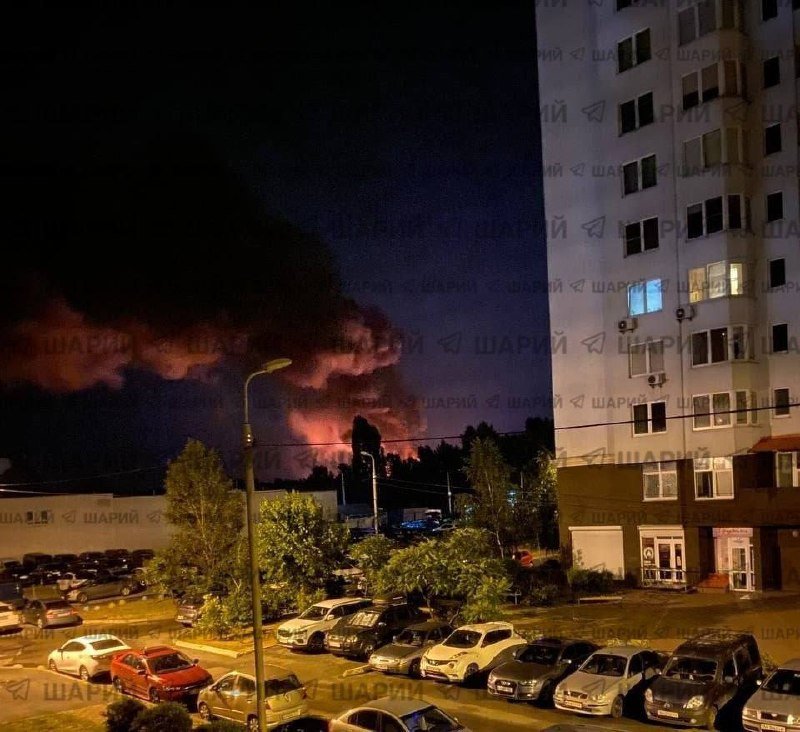
A Russian ballistic or cruise missile struck a residential high-rise in the Ukrainian capital Kyiv late on 5 July 2026, with open-source monitors reporting dozens feared dead and seriously injured at a multi-story apartment building. Video footage circulated in the early hours of 6 July showed the moment of impact on the residential block, and separate posts documented a strike on a Roshen Corporation confectionery facility, the Ukrainian confectionery manufacturer. The barrage, captured across multiple open-source feeds between 23:34 UTC on 5 July and roughly 01:35 UTC on 6 July, marks one of the largest single-night attacks on civilian targets inside Kyiv in the current phase of the war.
The strikes belong to a familiar and escalating pattern: long-range Russian missile and drone attacks that treat Ukrainian residential and economic infrastructure as legitimate targets. Even after the initial casualty figures stabilise, the episode will sharpen the question of whether Western-supplied air-defence systems are reaching the Ukrainian capital in the volumes Kyiv says it needs.
What hit, and when
The first open-source signal of the night's strike package arrived at 23:34 UTC on 5 July 2026, when smoke was filmed rising over Kyiv from a Russian ballistic missile impact. By 00:04 UTC on 6 July, monitors posted that dozens were feared dead and seriously injured in the multi-story apartment block hit. Within the next half-hour, at 00:29 UTC, a frontline correspondent account confirmed Kyiv was under attack. By 00:54 UTC, separate monitoring channels reported that a Roshen Corporation building in Kyiv had been destroyed. Then, at 01:35 UTC on 6 July, video footage surfaced showing the moment a Russian ballistic or cruise missile struck a residential block containing several high-rise apartment buildings earlier that night in Kyiv. The sequence fits the geometry of a layered strike — multiple munitions, fired in close succession, against both a residential complex and an industrial site associated with a privately held Ukrainian food brand.
The Roshen Corporation sits in a category of targets that has drawn repeated Ukrainian and Western criticism. Originally founded in the 1990s by current Ukrainian President Volodymyr Zelenskyy in partnership with other shareholders, the confectionery company has long since been ceded into trust arrangements since Zelenskyy's entry into politics, but the brand carries his name and stands as a high-profile civilian enterprise. Strikes on civilian enterprises are not new in this war, but they have grown more frequent in recent waves; the symbolic cost to Kyiv of a destroyed Roshen site is, in practical terms, additional pressure on a workforce, a supply chain, and a city already absorbing nightly attrition.
Why this pattern of attack
Russian missile strikes on Kyiv have, in the publicly reported pattern, oscillated between two intents: punishing civilian morale and degrading Ukrainian defence-industrial capacity. The two are not mutually exclusive; residential strikes siphon air-defence interceptors and impose a steady death toll, while precision strikes on industrial facilities — which is what an attack on a functioning confectionery plant looks like — attempt to weaken specific sectors at lower political cost than strikes on military targets. The Ukrainian capital's air-defence umbrella, supplied largely by Western partners and stretched over multiple cities and infrastructure nodes, can be probed for weaknesses with cheap one-way attack drones and overwhelmed at moments of saturation with ballistic missiles.
The asymmetry matters. A residential block absorbs damage passively and produces the raw footage that international newsrooms then transmit. A confectionery plant absorbs damage and produces an unemployment line. Both pull resources — fire services, search-and-rescue teams, hospital capacity — out of a Ukrainian state budget already levered up to fund wartime spending. The pattern is not accidental. In a war where the front line has been largely static in recent months, the pressure on rear-area civilian life has become the principal arena of attrition.
What remains uncertain
The casualty count is not yet stable. Open-source monitors reporting in the first ninety minutes after impact routinely describe figures as "feared" and "dozens", without a named toll from the Ukrainian State Emergency Service or the Kyiv City Military Administration in the publicly available feed. The exact weapon — ballistic versus cruise — has been reported by independent channels as either of the two types in identical posts, an ambiguity that reflects how difficult it is to identify an incoming warhead without radar-trace data. The status of the Roshen facility beyond the initial destruction report — whether the strike hit a storage site, a production line, a logistics hub, or several — is also not detailed in the publicly available reporting.
A further uncertainty is whether the overnight attack was part of a larger coordinated wave striking Ukrainian cities outside Kyiv. The publicly available monitoring traffic focuses on the capital; the absence of reports about Odesa, Kharkiv, or Dnipro is not necessarily the absence of strikes there, only the absence of confirmed reporting from those cities within the window examined. Until Ukrainian air-force and regional military-administration briefings become public, the full contour of the night's attack package cannot be precisely drawn.
Stakes
For Kyiv the immediate stakes are clear and grim: a death toll to be tallied, families to be notified, a damaged apartment block to be cleared, and a Roshen site whose full operational status will shape a private-sector workforce's next several months. For Ukraine's Western partners the political stakes are more diffuse but no less real. Each successful penetration of the capital's air-defence umbrella is quietly circulated inside NATO capitals as evidence that the current supply of interceptors, surveillance systems, and counter-battery radars is insufficient to the intensity of attack. For Moscow the strikes serve a signalling function familiar from earlier phases: a reminder that the war is not paused, that the capital is within range, and that escalation remains available as a doctrine rather than as a deviation. The war enters its fifth year in February 2027 with both sides still inside a posture in which attacks on civilian targets in rear areas are recurring rather than residual. Until that posture changes, nights like the one between 5 and 6 July 2026 will recur, with their own geography of damage, and their own slow editorial arithmetic of named and unnamed dead.
Desk note: this article foregrounds Ukrainian and open-source Western-aligned reporting, as the source material on these strikes originates from independent monitoring channels with no Russian state-media sourcing. Where monitors were approximate about weapon type or casualty numbers, the article has matched their hedge rather than sharpening it.
Wire provenance
This editorial synthesis draws on the following public wire/social posts:
- https://t.me/osintlive/24918
- https://t.me/osintlive/24919
- https://t.me/wfwitness/12345
- https://t.me/intelslava/11876
- https://t.me/osintlive/24920