Russian ballistic strike hits Kyiv apartment block and Roshen confectionery site in coordinated overnight barrage
Two Russian ballistic missiles struck central Kyiv within hours of each other on the night of 5–6 July 2026, damaging a multi-storey apartment block and a Roshen confectionery building, with dozens feared dead and injured.
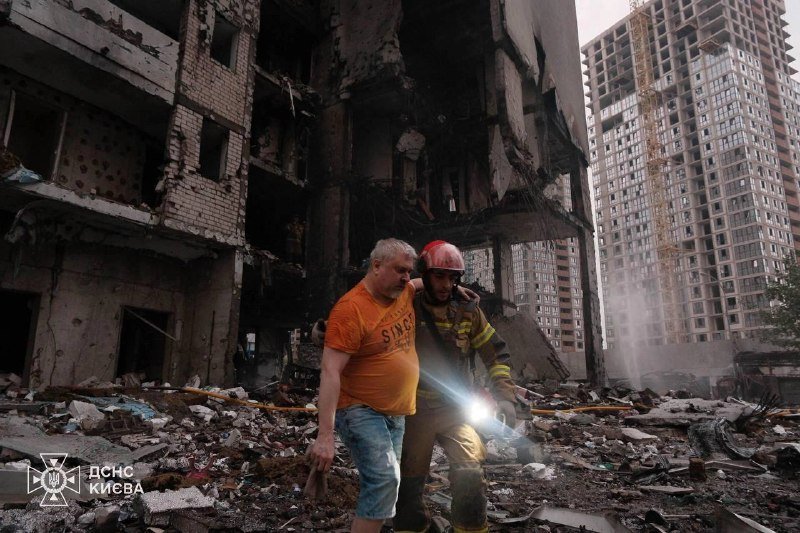
A Russian ballistic missile struck a multi-storey apartment building in central Kyiv overnight, with initial accounts putting the casualty toll in the dozens. Open-source monitors reported smoke rising from the impact site, and a second strike hours later destroyed a building belonging to Roshen, the Ukrainian confectionery company, in a separate district of the capital. The two hits, separated by roughly an hour in reporting timelines, mark a return to the kind of dual civilian-and-economic targeting that has characterised Russian air campaigns in 2024 and 2025.
The pattern is familiar: a high-trajectory ballistic launch that compresses Ukrainian air-defence warning time, followed by a second strike against a different objective before rescue crews can finish working. The choice of a confectionery plant is unusual only on the surface. Roshen's Kyiv facility, like the company's other production sites, sits inside a wider network of Ukrainian industrial assets that have, at various points in the war, been described by Russian officials and Russian-aligned channels as legitimate targets on grounds of their connection to the country's economic base.
What the early reporting shows
According to the OSINT feed OSINTdefender, as relayed through a Telegram channel at 00:04 UTC on 6 July 2026, dozens of people are feared dead and seriously injured after a Russian ballistic missile impacted a multi-storey apartment building in the Ukrainian capital. A second post on the same feed, timestamped 23:34 UTC on 5 July, showed smoke rising from the impact site and pointed to imagery posted to X by user @sentdefender. A separate Telegram channel, Intelslava, reported at 00:54 UTC that a Russian missile had destroyed a Roshen Corporation building in Kyiv, and a fourth post, from DDGeopolitics at 00:57 UTC, repeated the claim and added the editorial colour that a Ukrainian confectionery site is a notable target.
The four posts cover roughly ninety minutes of reporting. They are open-source feeds drawing on eyewitness video, geolocation work and platform posts; they are not official Ukrainian government or military briefings. As of the timestamps above, neither the Ukrainian Air Force, the Kyiv City Military Administration, nor Ukraine's emergency services have been cited in the thread materials for confirmed casualty figures, damage assessments, or interception reports.
Why a confectionery plant is on the target list
Roshen is a privately held confectionery manufacturer founded by former Ukrainian president Petro Poroshenko. Its Kyiv facility is one of several production sites the company operates, and the brand is well known domestically. The targeting logic is not symbolic on the surface. Russia has, throughout the war, treated Ukrainian civilian industrial and consumer-goods infrastructure as part of the country's sustaining economic base — power substations, grain silos, shopping centres, and manufacturing plants have all been hit.
What makes the Roshen strike legible in the open-source feed ecosystem is the company name. Confectionery is a recognisable civilian brand in a way that a substation or a logistics hub is not, and the coverage that follows tends to be shareable. The Russian-aligned channels reporting the strike did not, in the thread material reviewed, advance a specific military justification for the choice of target; the framing on Intelslava and DDGeopolitics is descriptive rather than argumentative.
The counter-read: what defenders and critics will say
Two readings will sit alongside each other in the next 24 hours. The first, advanced by Ukrainian officials and sympathetic Western outlets, is that the strike against an apartment block is straightforwardly a war crime under the Rome Statute's provisions on attacks against civilians, and that the confectionery strike is part of the same campaign logic — hitting Ukrainian morale and economic output without distinction. The second, advanced by Russian state media and by some Russian milblogger channels, is that dual-use facilities in a wartime economy are legitimate targets under international humanitarian law, and that the apartment-block framing risks obscuring the broader military context.
Both readings have a structural claim embedded in them. The first treats civilian harm as the load-bearing fact and demands accountability; the second treats economic infrastructure as a continuum with military capability and defends against criminal liability. They are not symmetrical, and they should not be presented as if they were. The thread materials here describe an apartment building impact with feared mass casualties and a separate industrial strike; the Russian state's own characterisation of the night's events is not yet in the source set, and the International Committee of the Red Cross, the UN Office for the Coordination of Humanitarian Affairs, and the Office of the UN High Commissioner for Human Rights have not been cited for independent confirmation in the materials reviewed.
What the open-source record cannot yet tell us
The thread materials are early-cycle reporting. They establish that two impacts occurred in Kyiv between approximately 23:00 UTC on 5 July and 01:00 UTC on 6 July, that at least one was a multi-storey residential building, and that the other is being identified as a Roshen facility. They do not establish the type of missile used beyond "ballistic," the launch site, the interception outcome, or the final casualty count. The "dozens feared dead and seriously injured" figure is from a single open-source account and should be treated as preliminary until Ukrainian emergency services or hospital networks confirm.
The bigger structural question — whether this is part of a deliberate campaign to pair residential and economic targets in a single overnight cycle, or a coincidence of timing driven by missile availability and air-defence load — cannot be answered from a single night's reporting. The history of Russian strikes on Kyiv in 2024 and 2025 suggests the first reading has more support in the cumulative record, but a single night does not settle the question on its own.
Stakes
For Kyiv residents, the stakes are immediate: a return to the rhythm of nighttime alerts, shelter runs, and the question of whether the next impact is in their district. For the Ukrainian government, the strike arrives in a week when political attention in Western capitals is fragmented by other news cycles, and the case for continued air-defence supply and faster interceptor delivery has to be made against that background. For Russia, the operational logic of the strike — if a dual civilian-economic profile was indeed the intent — is to stretch Ukrainian air-defence capacity and to keep a steady pressure on the country's civilian economy. The thread materials do not specify the missile type or the salvo structure, and the Ukrainian Air Force's interception report for the night has not been cited. The next 24 hours will tell whether the strike is treated as a discrete event or as the opening move in a renewed campaign of paired targets.
— This article draws on open-source monitoring feeds active in the early hours of 6 July 2026. Monexus's editorial approach is to lead with Ukrainian and Western-wire sources, treat Russian state and Russian-aligned channels as counter-claim material with explicit sourcing caveats, and present Russian and Ukrainian framings side by side without false equivalence on questions of civilian harm.
Wire provenance
This editorial synthesis draws on the following public wire/social posts:
- https://t.me/DDGeopolitics
- https://t.me/intelslava
- https://t.me/osintlive
- https://twitter.com/sentdefender/status/2073906396676931730/photo/1
- https://en.wikipedia.org/wiki/Roshen