Spain ends Portugal's run and, with it, Ronaldo's World Cup career
A 6 July win in the round of 16 sends Spain into the quarterfinals and closes the tournament chapter on Cristiano Ronaldo, whose tears at full-time crystallised the end of a generation.
Spain eliminated Portugal from the 2026 FIFA World Cup on 6 July 2026, ending Cristiano Ronaldo's career at the tournament and sending La Roja into the quarterfinals for the first time since 2010. The round-of-16 result, confirmed in posts circulating on X from the Spanish press box at 21:51 UTC, was followed within minutes by images of a visibly emotional Ronaldo at full-time, framed by international outlets as a farewell moment rather than merely a defeat.
What looked on paper like a generational handover between two European heavyweights resolved, by the final whistle, into a clean break: Spain's youthful core, built around Lamine Yamal, advances; Ronaldo, now 41, departs the World Cup stage for the last time. The contrast in how the two sides are being read is itself the story.
What the result settles
Portugal's exit is being treated across European coverage as the closing bracket on a career that has spanned five World Cups. The 6 July framing, carried in the Spanish press and picked up in English-language wire copy, is that Spain played the more complete tournament football and that Portugal's dependence on individual moments — rather than collective pattern — was finally exposed by a side organised around a teenager.
A simple piece of arithmetic underlines the magnitude: a quarterfinal appearance for Spain is the national team's first at a World Cup since 2010, when Vicente del Bosque's side won the tournament in South Africa. That sixteen-year gap is a fact about institutional renewal as much as about results: the Spanish federation has cycled through three head coaches and a generation of attackers, and is now banking on a core whose most famous name is still a teenager.
Ronaldo's tears, captured in broadcast imagery republished across X within minutes of the final whistle, are being read by sympathetic coverage as the natural coda to a tournament that consumed him. By harder-edged commentary, they are simply what elimination looks like for a player who has spent two decades treating the World Cup as a stage owed to him personally.
The generational counterweight
The other half of the story is Lamine Yamal, the 18-year-old attacker whose emergence through 2024 and 2025 turned Spain from an ageing possession side into a counter-attacking threat with a defined central talent. The framing emerging from Spanish outlets on the night is unambiguous: Yamal is the future, Ronaldo was the past, and the 6 July result simply ratified the timeline that European football has been writing for two years.
This is also where the nationalist edge sharpens. Iberian rivalry has always read sports results as proxies for cultural standing, and Spanish press coverage of the night is leaning into that register — Portugal, the smaller federation, the smaller economy, the smaller talent pipeline, outperformed for two decades by one player and now exposed once that player's body has given everything it had. The economic subtext is real: Spain's La Liga and youth academies have produced more top-flight attackers in the past five years than Portugal's Primeira Liga, and the gap is structural rather than cyclical.
The plausible counter-read is that Portugal over-performed for two decades precisely because of individual genius in a system that doesn't reliably produce collective ones. The 6 July defeat is, on this telling, a single-elimination result inside a tournament format that punishes thin squads. The argument is honest; it just doesn't move the result.
What the structural pattern actually shows
Step back from the result and the larger pattern is straightforward. The World Cup, like every other elite men's football tournament of the past decade, is being won by sides whose institutional infrastructure — academy systems, coaching depth, data-driven recruitment, sports-science budgets — can absorb the loss of any individual player without collapse. Spain qualifies on that metric. France qualifies. England, even with their institutional dysfunction, qualifies because the Premier League is the deepest talent pool in the world. Portugal, despite Cristiano Ronaldo, despite Bruno Fernandes, despite Bernardo Silva, has been one good tournament cycle away from that depth for fifteen years.
The point is not that Ronaldo was a problem. The point is that he was a solution to one — Portugal's thin squad, its academy bottlenecks, its reliance on a generation exported to the Premier League before their technical football was finished — and that once the body gives out, the underlying gap is exposed in a single elimination match.
This is also the structural reason that Spain's bet on Yamal looks rational even when the player is still finishing school. The institutional bet is on depth, not personality, and the institutional bet is what wins tournaments in this era.
Stakes and what remains uncertain
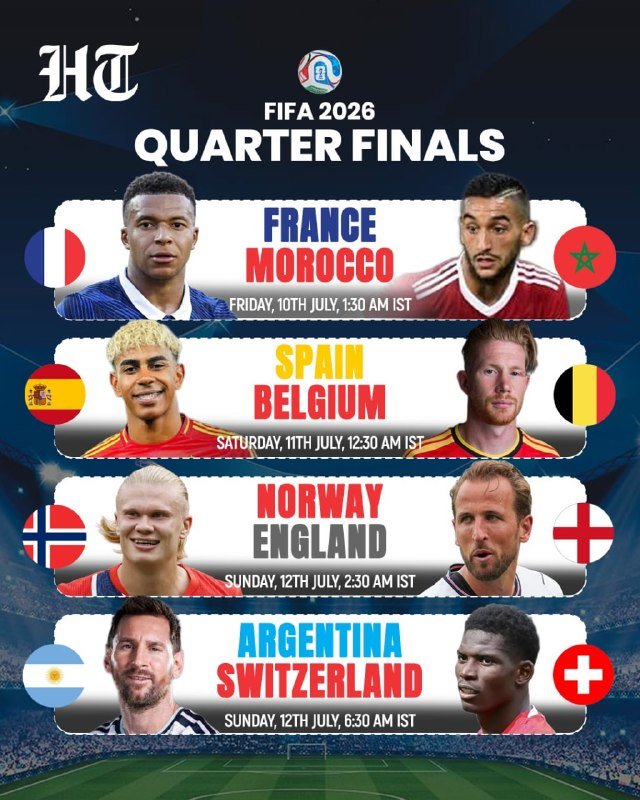
For Spain, the stakes now are conventional: a quarterfinal against whichever side emerges from the other half of the bracket, with a semi-final appearance a realistic outcome. For Portugal, the question is harder and longer-running — whether the federation can build the kind of depth that would let the post-Ronaldo era be anything other than a slow decline. The 2026 squad's average age at the forward line is the wrong side of 30.
What the night did not resolve, and what no source clarifies, is whether this was genuinely Ronaldo's final World Cup or whether he will attempt a sixth tournament at 45 in 2030. Public statements from the player and from the Portuguese federation were not in circulation by 22:31 UTC. Until those appear, the safe framing is that 6 July ended Ronaldo's World Cup career as a player, not that it ended his career as an aspirant.
The tournament continues. Spain advances. The era that ended was, in the end, less about one player than about a specific arrangement between a country, a sport, and a single body. Bodies give out. Arrangements, occasionally, do too.
This article maps the immediate wire reporting and Spanish-press framing against the structural question of squad depth that the result exposes. The hero image is broadcast imagery republished on X; the underlying photograph belongs to the originating broadcaster.
Wire provenance
This editorial synthesis draws on the following public wire/social posts:
- https://x.com/alanrmacleod/status/1944420289290777088
- https://x.com/sprinterpress/status/1944416210521456856
- https://x.com/sprinterpress/status/1944409111449026678