U.S. strikes hit Iran's Bandar Abbas port as footage of attack circulates on social media
Amateur video posted on 7 July 2026 appears to show U.S. aircraft striking the southern Iranian port city of Bandar Abbas, in what would mark a major escalation against a critical node in the Strait of Hormuz corridor.
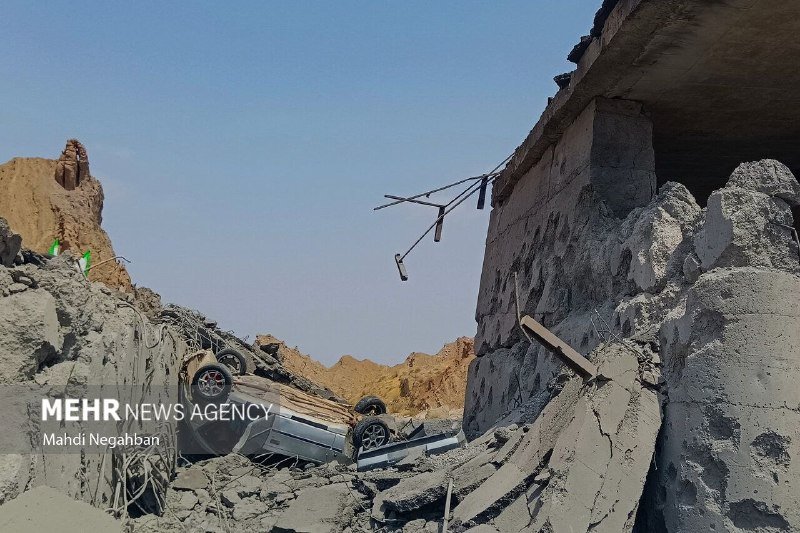
Amateur video circulating on Telegram and X on 7 July 2026 purports to capture the moment United States aircraft struck targets at the port of Bandar Abbas, Iran's principal container terminal on the Strait of Hormuz. Local footage published by Iranian state-linked channel PressTV at 22:17 and 22:22 UTC shows the impact sequence and its aftermath in the southern port city; parallel clips were re-posted by the conflict-monitoring channels Intelslava, BellumActaNews and Geopolitical Watch between 22:04 and 22:26 UTC. Independent verification of the footage — its location, timestamp and the ordnance involved — was not yet available at the time of publication.
If the strikes are confirmed, they would represent the most direct kinetic action against Iranian strategic infrastructure of the current escalation cycle, and a deliberate test of Tehran's threshold for retaliation against targets inside its own territory.
What the footage appears to show
Three of the six items in the public thread are PressTV's own amateur uploads. The Iranian state broadcaster framed the clips as capturing "the moment of the US bombing of Iran's southern port city of Bandar Abbas," a phrasing that asserts the U.S. as the strike's perpetrator without independent sourcing. The remaining three reposts — Intelslava, BellumActaNews and Geopolitical Watch — re-distributed similar footage labelled as "American strikes on Bandar Abbas port" with the same U.S.-as-actor framing.
The convergent content of the clips — a bright flash, an audible detonation, a port-side smoke plume, and onlookers filming from a distance — is consistent with an aerial strike on an industrial zone, but the sources do not specify the target building, the ordnance, or whether casualties resulted. One of the Geopolitical Watch captions notes an onlooker standing roughly 200 metres from the impact site "didn't give a singular fuck," a colloquial detail that adds to the footage's apparent authenticity without confirming it.
The significance of Bandar Abbas
Bandar Abbas is not a symbolic target. It handles the majority of Iran's container throughput, sits a few kilometres from the narrowest point of the Strait of Hormuz through which roughly a fifth of the world's oil passes, and hosts facilities operated by the Islamic Republic of Iran Shipping Lines and the military-linked Khatam al-Anbiya construction conglomerate. A successful strike on the port would degrade Iran's commercial logistics and its ability to project force into the gulf.
It would also, by the same logic, raise the prospect of Iranian retaliation against shipping or against the U.S. and Gulf-state assets that host the aircraft involved. Tehran's doctrine through past escalations has been calibrated: missile and drone strikes on tankers, the 2019 attack on Saudi Aramco facilities at Abqaiq and Khurais, and the January 2020 ballistic-missile strike on Al Asad airbase in Iraq all followed U.S. action against Iranian assets. The port of Bandar Abbas is a more sensitive node than any of those previous targets, and a strike there would push the cycle into territory where Iran's own doctrine of "strategic patience" becomes harder to defend in domestic terms.
A counter-reading worth taking seriously
There is a second reading the available material does not foreclose. PressTV is a state-aligned outlet whose framing is, on past form, designed for both Iranian and Arab audiences to consolidate a narrative of victimhood. Telegram channels that aggregate open-source footage sometimes recycle clips with imprecise captions, particularly in fast-moving events. It is possible that what is circulating is older footage, footage of an Israeli strike mis-attributed, or footage of an incident at an adjacent industrial site.
The thread context contains no U.S. Central Command statement, no Iranian official acknowledgment, and no independent wire confirmation (Reuters, Associated Press, AFP, BBC or Al Jazeera English). On those grounds, the cautious framing — that the footage is consistent with a U.S. strike but unverified — is the only one the evidence currently supports.
What is at stake
A confirmed strike would compress several timelines at once. The Strait of Hormuz, the narrow chokepoint between Iran and Oman through which roughly a fifth of seaborne crude transits, would face an immediate insurance and rerouting premium; Lloyds and other insurers have used past escalations to push war-risk premiums for gulf shipping into triple-digit-percentage territory within hours. Iran's own oil exports — already constrained by sanctions — would face renewed enforcement pressure, and the clerical establishment would face a domestic political cost for failing to respond.
The U.S., for its part, would be operating inside an established doctrine: limited, precise strikes on Iranian-proxy assets have been Washington's preferred escalation instrument for two administrations. The choice of Bandar Abbas, if confirmed, would mark an escalation in target-value terms — infrastructure of strategic rather than tactical importance — without, on the face of it, targeting Iranian civilians directly. That distinction matters less in Iranian domestic politics than in Western commentary, where the framing of "kinetic action against Iranian state infrastructure" and "strikes on Iran" tends to blur.
What remains uncertain
At the time of writing, the footage has not been geolocated by an independent open-source intelligence outfit, the U.S. side has not confirmed or denied the strikes publicly, and Iranian state media's claim of U.S. authorship has not been corroborated outside Iranian and Iran-sympathetic channels. The thread's six items are exclusively from Telegram channels, four of them state-linked or state-adjacent, and none cite primary on-the-record sources. Reader caution is warranted: the visuals are striking, the location and time are plausible, but the institutional corroboration has not yet arrived.
Desk note: this publication treats the Iranian state-aligned sources as the originating voice for the strike attribution while flagging that attribution explicitly; U.S. and Western wire confirmation is the missing piece that would convert a credible claim into a confirmed event.
Wire provenance
This editorial synthesis draws on the following public wire/social posts:
- https://t.me/intelslava
- https://t.me/BellumActaNews
- https://t.me/presstv
- https://t.me/presstv
- https://t.me/GeoPWatch
- https://t.me/GeoPWatch