US strikes hit Bandar Abbas as Strait of Hormuz tanker attacks trigger escalation with Iran
US Central Command confirmed waves of air strikes on the Iranian port city of Bandar Abbas late on 7 July, citing Iranian attacks on commercial shipping in the Strait of Hormuz as the trigger.
The United States opened a wave of air strikes against the southern Iranian port city of Bandar Abbas late on 7 July 2026, in what US Central Command described as retaliation for Iranian attacks on commercial oil tankers transiting the Strait of Hormuz over the preceding days. Initial reporting from regional observers and from CENTCOM itself placed the first detonations around 21:23 UTC; by 21:46 UTC, columns of smoke were visible above Bandar Abbas Air Base and across the wider coastal strip.
The escalation closes a week of tit-for-tat moves across the world's most consequential energy chokepoint, and it does so in the middle of a global market that has spent the last two years learning to price precisely this kind of event. The question now is whether this is a calibrated, time-limited punitive strike — the kind the US has run before in Iraq, Syria and Yemen — or the opening salvo of something more durable.
What CENTCOM says happened
The trigger, in CENTCOM's own framing, was Iranian action against commercial shipping. According to a CENTCOM statement relayed by Telegram channels tracking the operation, the US launched "major strikes on Iran after Iran attacked three commercial ships in the Strait of Hormuz." Telegram channel GeoPWatch reported at 21:24 UTC that CENTCOM had "announced the beginning of a wave of air strikes against Iran in retaliation to the attacks on Oil Tankers in the Strait of Hormuz over the past days," and that at least ten explosions were audible over Bandar Abbas within minutes of the announcement.
A US official, quoted by PBS via Telegram aggregator War and Footage of the World (wfwitness) shortly after the strikes began, said Iran had "clearly demonstrated they're not listening." The phrasing matters: it implies an attempted diplomatic channel existed immediately before the strikes, and that Washington concluded that channel had been exhausted. The strikes themselves, according to footage reviewed by Middle East Spectator and wfwitness, lit up the sky above Bandar Abbas Air Base and produced fires and heavy smoke across the port area visible in subsequent clips.
The geography is not incidental. Bandar Abbas is not a remote target. It sits on the coast of Hormozgan province, handles the bulk of Iran's container and crude shipping, and sits roughly 30 kilometres north of the Strait itself. Striking the city rather than a forward military installation in the country's interior signals that the operation is intended to register across the Iranian system, not simply to degrade a single air wing.
The shipping pretext
Strait of Hormuz tanker incidents have provided the rhetorical scaffolding for the operation. The CENTCOM statement references "attacks on Oil Tankers in the Strait of Hormuz over the past days," and independent maritime reporting has for several weeks documented a steady drumbeat of seizures, drone strikes and small-boat approaches attributed to Iranian forces or their proxies. Three named commercial vessels are cited in CENTCOM's account as having been attacked in the immediate run-up to the 7 July strikes, according to Telegram coverage of the briefing.
The 21 July – early July sequence sits inside a longer pattern. Since the start of 2026, Western wire services have periodically carried reports of drone and fast-boat harassment in the Strait, often with attribution to Iran's Islamic Revolutionary Guard Corps Navy. Iranian state-aligned outlets have typically framed those incidents as enforcement of legitimate maritime sovereignty in Iranian waters. The choice, in this latest round, to escalate from harassment to air strikes against a major Iranian population centre — rather than against IRGC naval assets — is the variable that breaks the pattern.
What the Iranian counter-frame looks like
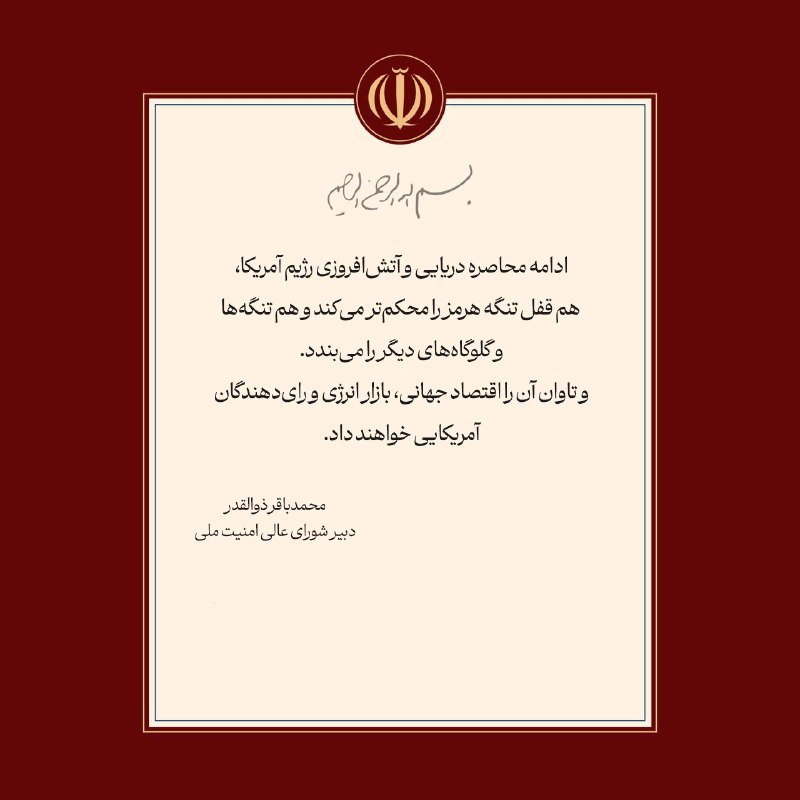
Iranian state and state-adjacent media have not been quoted in the source items reviewed for this article, but the structural counter-narrative is straightforward to reconstruct and should be stated rather than guessed at. From Tehran's vantage point, the Strait of Hormuz is sovereign Iranian water under long-standing legal claim, and Iranian action against vessels it characterises as violating that sovereignty falls inside the recognised prerogatives of a coastal state. Strikes on Bandar Abbas, in that frame, are not a measured response to tanker harassment but an act of war against a sovereign capital of a province — and an attempt to break Iranian leverage over the chokepoint without addressing the underlying grievance.
That counter-frame does not erase Iranian responsibility for any specific tanker incident. But it explains why Iranian outlets, when they speak, frame CENTCOM's language about "listening" as a demand for submission rather than a diplomatic opening. It also explains the political logic of attacking the city rather than a forward base: an Iranian government that absorbs strikes on its principal southern port will face domestic pressure to escalate in kind, and Iran's available escalation menu — closure of the Strait, proxy strikes on US bases in Iraq and the Gulf, escalation through Hezbollah on the Israel–Lebanon frontier — remains substantial.
Structural frame: chokepoint politics in an election year
What is unfolding in the Gulf is not best understood as a one-off incident. It is the latest round in a long-running contest over who controls the chokepoints through which roughly a fifth of the world's seaborne oil moves. The Strait of Hormuz, the Bab el-Mandeb further south, and the Suez canal to the west form a triangle of vulnerability that any power projecting force into the global energy market has reason to dominate — or, failing that, to deny to a rival.
The United States has, since the 1980s, treated the Gulf as a defended sea lane. That posture depends on the assumption that the cost of interrupting flow is higher than the cost of sustaining the presence required to deter it. The 7 July strikes operationalise a slightly different premise: that intermittent Iranian action against commercial shipping can be punished at acceptable cost, and that the punishment itself deters further action. Whether that premise holds depends on the next forty-eight hours — specifically, on whether Iran responds with a measured tit-for-tat move, which the structure of the present crisis invites, or with a more comprehensive disruption of the Strait.
For oil markets, the immediate question is whether Bandar Abbas port operations and Iranian retaliatory action can jointly remove enough supply from the global market to drive a sustained price move. The architecture is already there. The event, in other words, has not happened yet — it is the retaliation, not the strikes, that will set the price.
Stakes and what we do not yet know
In the immediate term, the burden falls on the Iranian leadership to calibrate. A measured response — a single retaliatory strike against a US position in Iraq or Syria, framed as sovereignty defence — would let both sides claim victory and contain the escalation. A maximalist response — closure of the Strait, attack on a Gulf state oil installation, escalation through the regional proxy network — would put the US in the awkward position of having started a war to prevent one.
The source material reviewed here does not establish several facts that will matter in the next 24 to 48 hours. It does not specify which Iranian military facilities were struck inside or around Bandar Abbas, beyond the air base referenced in initial reports. It does not give a confirmed casualty count on either side. It does not record any official Iranian government statement; the Iranian-language state media cycle was not present in the thread context reviewed. It does not name the three commercial vessels that CENTCOM cited as the proximate cause. Those gaps are not editorial failures; they are the shape of an event that is still unfolding, and any reader trying to trade the news is well advised to wait for the morning.
The wider frame is also worth holding. Strikes on a major Iranian city are not a tool that can be used twice without consequence. The first strike delivers shock. The second delivers only the news that the first was not a one-off. By the time the third is contemplated, the structure of the conflict will have moved beyond punishment and into something both sides will find harder to leave.
This piece has been sourced primarily to Telegram channels covering the operation in real time — Middle East Spectator, War and Footage of the World, AMK Mapping, GeoPol Watch and Clash Report — together with the FRANCE 24 wire bulletin. Where source items did not contain detail (Iranian official statements, casualty counts, facility identification), this publication has said so rather than inferred.
Wire provenance
This editorial synthesis draws on the following public wire/social posts:
- https://t.me/Middle_East_Spectator
- https://t.me/wfwitness
- https://t.me/AMK_Mapping
- https://t.me/GeoPWatch
- https://t.me/ClashReport