Live Wire
02:11ZBRICSNEWSIran says "we will respond forcefully to the American terrorist aggression.""We will not allow the United Sta…02:09ZCLASHREPORDefense Secretary Pete Hegseth expected to visit Israel on Wednesday in first trip as defense chief02:09ZAMKMAPPINGIranian Army, not IRGC, launched all drones so far02:09ZKHAMENEIENNow underway:The bodies of the martyred members of Martyr Khamenei's family were carried in procession and ci…02:09ZWFWITNESSU.S. strikes on ports along Strait of Hormuz reported in online post02:05ZEPOCHTIMESTrump reiterates US should control Greenland02:05ZHONGKONGFPHong Kong churches urged to adopt anti-sexual harassment policies after study finds complaints mishandled02:05ZALALAMARABNajaf funeral procession scheduled for six in the morning from hospital bridge
Markets
S&P 500747.71 0.48%Nasdaq25,819 1.16%Nasdaq 10029,173 1.77%Dow528.45 0.31%Nikkei93.07 2.31%China 5032.49 0.00%Europe89.04 1.03%DAX42.05 1.43%BTC$62,807 1.54%ETH$1,750 2.25%BNB$570.44 2.05%XRP$1.1 3.78%SOL$78.95 3.50%TRX$0.3299 0.10%HYPE$67.82 4.49%DOGE$0.0728 4.27%RAIN$0.0148 1.64%LEO$9.36 0.36%QQQ$709.43 1.85%VOO$687.08 0.51%VTI$369.61 0.55%IWM$296.19 0.91%ARKK$81.19 2.89%HYG$79.76 0.14%Gold$377.49 1.21%Silver$54.46 2.94%WTI Crude$108.92 4.38%Brent$41.93 4.98%Nat Gas$11.76 0.43%Copper$37.39 1.19%EUR/USD1.1433 0.00%GBP/USD1.3386 0.00%USD/JPY161.89 0.00%USD/CNY6.7935 0.00%
CLOSEDNYSEopens in 11h 17m
The Monexus
Vol. I · No. 189
Wednesday, 8 July 2026
Saturday Ed.
Updated 02:12 UTC
  • UTC02:12
  • EDT22:12
  • GMT03:12
  • CET04:12
  • JST11:12
  • HKT10:12
← The MonexusGeopolitics

US strikes on Iran's south hit air defences and coastal infrastructure, Iranian state media says

Late on 7 July 2026, Iranian state television said US strikes around the southern port of Sirik hit a commercial pier, a fishing pier and the village of Ziyarat. A US official said the targets were air-defence radars, coastal surveillance systems, surface-to-air missiles, anti-ship cruise missiles and drone launch sites. Kuwait separately reported an outage of several electrical transmission lines.
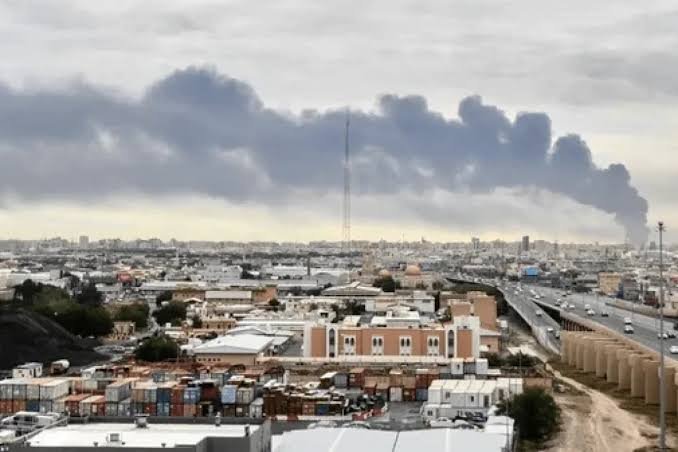
A nighttime cityscape shows illuminated buildings and traffic below, with a large orange fire and smoke rising in the distant background. @gazaalanpa · Telegram

On 7 July 2026, in the half-hour before midnight UTC, Iranian state television broke into its programming to report that missiles had struck a commercial pier and a fishing pier in the port town of Sirik, on Iran's southern coast facing the Strait of Hormuz. Within minutes, the same channel said two further explosions were heard on the edge of the village of Ziyarat, inland of the town, and that "the majority of raids on the south of the country targeted non-military areas". The framing was immediate and consistent: civilian infrastructure, not military.

A US official told Western wire services within the same window that the targets were different, and narrower. The strikes, the official said, were directed at Iranian air-defence systems, coastal surveillance systems, surface-to-air missiles, anti-ship cruise missiles and drone launch sites. There was no US confirmation of the damage Iranian state media described, and no immediate Iranian admission of military losses. The two accounts are not necessarily contradictory; the same set of impacts can be described from one side as a pier and a village, and from the other as the radar, launcher and stockpile that sat nearby. They are, however, framed very differently — and the difference is itself part of the story.

The Sirik strikes arrived on a day of widening regional shockwaves. At 22:49 UTC, Kuwait's authorities announced an outage of several electrical transmission lines, without publicly attributing a cause. The timing, on a night when Iran and the United States were exchanging fire along the Gulf coastline, was conspicuous; the cause, for the moment, was not.

What is known, and in what order

The chronological record of the evening, drawn from the wire traffic alone, is narrow but specific. At 22:04 UTC, Iranian state television reported that "aggression targeted a commercial pier and a fishing pier in Sirik in the south of the country with several missiles". At 22:30 UTC, a US official briefed that the strikes had been directed at air-defence systems, coastal surveillance systems, surface-to-air missiles, anti-ship cruise missiles and drone launch sites. At 22:31 UTC, Iranian television reported two new explosions in Ziyarat, the village next to Sirik. At 22:49 UTC, Kuwait announced the transmission-line outage. At 23:27 UTC, Iranian state media returned to the theme, asserting that "the majority of raids on the south of the country targeted non-military areas".

The sequence matters because each of the four Iranian-flagged items comes from the same outlet — Al-Alam Arabic, the Arabic-language Iranian state channel, republishing Iranian domestic television. That is not a reason to discount it; it is a reason to read it carefully. Iranian state media has a documented interest in framing strikes as attacks on civilian infrastructure, both for domestic legitimacy and for international sympathy. It is also, on this stretch of coast, the only camera in the room.

The US official's account, by contrast, fits a wider pattern of US targeting that has been visible across the past week of reporting: air-defence radars first, command-and-control second, launchers and missile stocks third. Sirik sits roughly 70 kilometres inland from the Strait, and the southern Iranian coast is the part of the country from which any attempt to close the strait would have to be launched. The targeting list a US official described is, in plain terms, the kit you would hit if you were trying to keep the strait open.

The counter-narrative from Tehran

The Iranian framing is not only a propaganda reflex; it is a strategic argument. By foregrounding piers, fishing boats and a village, Iranian state media places the strikes inside a longer ledger of what it calls attacks on Iranian civilian life. The same framing also gives Tehran a domestic case for escalation that does not depend on acknowledging any military loss — a useful political position when the actual military loss, if any, is the kind of fact a government prefers to bury in classification rather than argue about on television.

Western wire reporting has so far been cautious, sticking to the official US list of targets and not independently confirming either the military or the civilian description of the damage. That is the right caution; the Strait of Hormuz is one of the world's most surveilled waterways, and the absence of independent satellite or on-the-ground confirmation is itself a data point. It means the civilian-damage narrative, for now, rests primarily on Iranian state media's account of its own coastline.

Why the south coast, and why now

The geography is doing most of the work. Iran's southern littoral stretches from the Shatt al-Arab waterway in the west to the Pakistan border in the east, but the relevant stretch for maritime coercion runs from Bandar Abbas, the main naval base, eastward past Bandar Lengeh and down to the smaller ports of Sirik and Jask. The coast is a launchpad. Coastal-defence cruise missiles, anti-ship batteries and surveillance radars placed here can threaten any tanker moving through the strait. Drone-launch sites extend that threat inland, but the long-range systems sit within a few tens of kilometres of the water.

The US targeting list — coastal surveillance first, air-defence second, anti-ship cruise missiles and launchers third — is, in this sense, the order in which a competent naval campaign would dismantle that threat. The implication is not that the United States is preparing to seize the strait; it is that it is preparing to make sure Iran cannot. The two are different operations, with different escalation ladders, and they should not be conflated.

What remains contested

Three things are not yet settled on the available record. First, the actual damage: Iranian state media describes piers and a village; the US describes radars and launchers. Both could be partly right; a missile aimed at a radar can land near a pier. Second, the cause of the Kuwaiti transmission outage, which the Kuwaiti announcement did not attribute. Third, the wider political envelope in which the strikes are being conducted — the diplomatic track, if any, running in parallel, and what the next round of US action is intended to enable or prevent.

The most plausible alternative reading is that this is a continuing degradation campaign, not a one-off retaliation, and that Sirik is one node in a longer list of southern coastal sites that have been, or will be, struck in succession. The dominant framing — strike, response, brief news cycle, return to tension — holds for now, but the tempo of the week suggests the campaign is doing something other than signalling. What it is doing is the question that the next 48 hours of wire traffic will answer.


Desk note. The wire traffic on this story is, for the moment, almost entirely Iranian state media and a single US official, with a Kuwaiti utility announcement sitting awkwardly alongside. Monexus has reported what each side has said, in the order each side said it, and resisted the temptation to merge the two accounts into a single tidy damage assessment that the underlying reporting does not yet support.

Wire provenance

This editorial synthesis draws on the following public wire/social posts:

  • https://t.me/alalamarabic
  • https://t.me/alalamarabic
  • https://t.me/alalamarabic
  • https://t.me/intelslava
  • https://t.me/insiderpaper
  • https://t.me/insiderpaper
© 2026 Monexus Media · reported from the wire