Strait of Hormuz, Round Two: Reading CENTCOM's New Strikes Against Iran
CENTCOM says additional strikes on Iran are underway at presidential direction, framed as punishment for Tehran asserting itself in the Strait of Hormuz. The framing matters more than the ordnance.
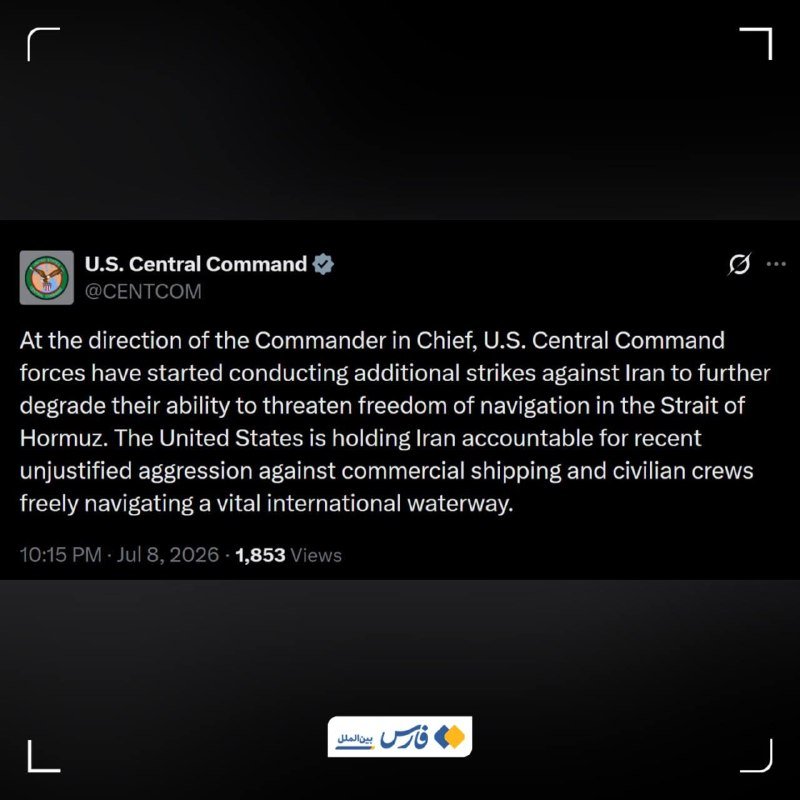
On 8 July 2026, at approximately 20:16 UTC, U.S. Central Command announced that it had begun "additional strikes against Iran" at the direction of the Commander in Chief, framing the action as a continuation of an existing campaign rather than a fresh escalation. The wording — "further degrade their ability to threaten freedom of navigation" — recycled language from previous CENTCOM bulletins, but the timing, on a single news day when the Strait of Hormuz is the world's most-watched oil chokepoint, made clear that this round is about the waterway, not the nuclear file.
The framing matters more than the ordnance. Within minutes, Iran-aligned outlet The Cradle reframed the announcement as a punitive response to Tehran "imposing its will in the Strait of Hormuz" — a deliberate inversion of CENTCOM's own narrative. Two accounts of the same event, broadcast simultaneously, one in Pentagon register and one in resistance register. Readers parsing the strike map will be doing so through whichever feed they trust.
What CENTCOM actually said
The CENTCOM text, as relayed by channels monitoring U.S. Central Command communications and amplified across Telegram at 20:16 UTC on 8 July 2026, was short. U.S. forces have "started conducting additional strikes against Iran" under presidential direction. The stated purpose was to "further degrade their ability to threaten freedom of navigation" — the canonical phrasing CENTCOM has used since the earliest rounds of this campaign. The phrase "additional strikes" implies prior rounds, which is consistent with the trajectory of U.S.-Iran friction through the first half of 2026 but is not itself a count of sorties, munitions, or facilities hit. The statement, as carried in the available feeds, does not enumerate targets.
That silence is itself the story. Wire reporting routinely names provinces, IRGC bases, radar sites, and missile depots within hours of a CENTCOM bulletin; the absence of those specifics in the first wave of posts suggests either a deliberately under-specified opening salvo or, more likely, the kind of rolling disclosure pattern Washington has used throughout the campaign — drip information through official channels, let allies and adversary-facing outlets amplify each piece, then issue a consolidated read-out the following day.
The Cradle's counter-frame
Iran-aligned media did not wait for the consolidated read-out. Within three minutes of the CENTCOM statement, The Cradle posted its own interpretation: "US CENTCOM announces that it is attacking Iran to punish it for imposing its will in the Strait of Hormuz." That single sentence flips the causal arrow. In CENTCOM's telling, Iran is the aggressor against shipping; in The Cradle's telling, the U.S. is punishing Iran for asserting jurisdiction over its own coastline. Both accounts use the verb "to impose."
This is not a minor rhetorical difference. The legal status of the Strait is the entire dispute. The 1982 UN Convention on the Law of the Sea guarantees transit passage through straits used for international navigation, including Hormuz, and the United States has historically insisted on that right with naval deployments. Iran, since the late 2010s, has periodically detained commercial vessels, seized tankers, and exercised what its own diplomats describe as legitimate coastguard and IRGC Navy authority over its northern shoreline. Whether those seizures are "piracy," "law enforcement," or "hybrid warfare" depends entirely on whose legal register you accept. The Cradle's framing positions Iran as the sovereign authority and the U.S. as the outside party enforcing an interpretation it has the military weight to impose but not the legal title to enforce.
A corridor, not a country
The structural story here is not about Iran. It is about the corridor. Roughly a fifth of globally traded oil moves through the Strait of Hormuz on any given day; the energy ministries of Japan, South Korea, India, and China depend on its uninterrupted flow in ways that European and North American consumers, cushioned by pipeline alternatives and strategic reserves, do not. When CENTCOM publishes "freedom of navigation" language in the context of an Iranian coastline, it is speaking into a multi-decade argument over who sets the rules for the world's most consequential maritime corridor.
This is what regional powers mean when they argue that the U.S.-led order has become extractive rather than stabilising. The Western framing — that the strait is a global commons requiring constant naval policing — is not wrong on its own terms, but it inevitably centres the country with the largest blue-water navy. The opposing framing — that the strait is bounded on the Iranian and Omani sides and that littoral states have primary authority — is not wrong on its own terms either, but it centres the country whose coast hosts the narrowest chokepoint. There is no neutral position on this. Anyone claiming one has chosen a side without admitting it.
What remains uncertain
The available posts do not specify the number of strikes, the targets struck, the weapons used, or any Iranian response as of the 20:21 UTC cutoff. There is no indication, in the immediate text of the CENTCOM statement, that this round differs in scope or target set from previous rounds — the word "additional" is suggestive but not conclusive. Iran-aligned framing has consistently framed these operations as aggression, but the Iranian government's own formal response, via MFA briefings or state media releases, is not yet visible in the feed. The Strait of Hormuz transit data — how many tankers are rerouting, whether insurers have raised war-risk premia, whether the IRGC Navy has issued any new advisory to commercial shipping — will be the first hard indicator of whether the strike round has actually changed behaviour at sea, or only at the level of communiqués.
Until those numbers land, this is a story about language. Both sides chose their verbs deliberately. CENTCOM chose "further degrade"; The Cradle chose "to punish." The reader's job is to notice the choice.
Desk note: Monexus carried both CENTCOM's literal text and The Cradle's interpretive reframing at face value, without privileging either. Where wire reporting emerges with named targets and casualty figures, this piece will be updated.
Wire provenance
This editorial synthesis draws on the following public wire/social posts:
- https://t.me/disclosetv
- https://t.me/TheCradleMedia
- https://t.me/ClashReport
- https://t.me/intelslava