Gertrude Abercrombie and the Midwest Surrealists Who Built Their Own Stage
A pair of Milwaukee shows re-centre the self-styled "Queen of the Bohemians" and her circle of painter-friends, asking why a midcentury American surrealism had to wait this long for its institutional due.
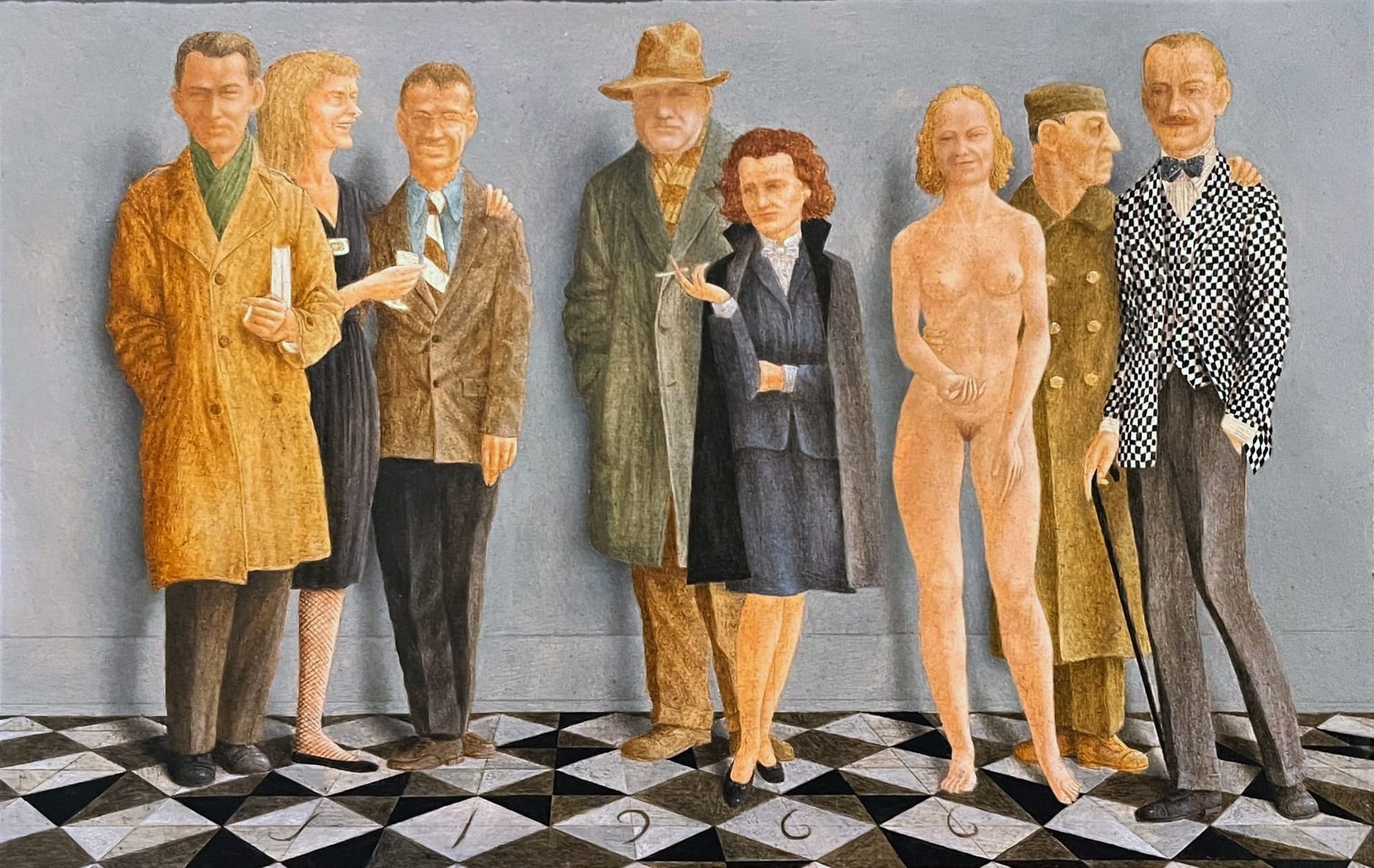
On 8 July 2026 the Milwaukee Art Museum opens a two-part exhibition that treats the midcentury Chicago painter Gertrude Abercrombie not as a regional curiosity but as the centre of a small, durable, unmistakably American surrealist scene. The shows, reported by Hyperallergic on 8 July 2026 UTC, gather Abercrombie's paintings, personal objects and the work of the friends who passed through her Hyde Park apartment, reframing an artistic movement that for decades was treated as a footnote to the New York School.
The case the exhibitions quietly argue is straightforward. A self-taught artist who called herself the "Queen of the Bohemians" built, from a third-floor flat near the University of Chicago, a salon that ran for almost three decades, supported working painters through friendship and patronage, and produced a body of dreamlike, hard-edged work that the institutional art world is only now catching up to. The shows' significance lies less in any single canvas than in the network those canvases imply.
The salon as studio
Abercrombie's paintings — bare interiors, a recurring owl, a single seated woman, the lake-front of the Midwest rendered as a stage set — were never the product of an isolated imagination. They were the product of a working social institution: Sunday-afternoon parties, jazz musicians jamming in the kitchen, painters trading canvases, the steady presence of figures including the photographer Ivan Keever and the gallerist-playwright Paul Courian, with whom she shared decades of artistic kinship. Hyperallergic frames the two Milwaukee exhibitions as an attempt to render that institution visible — to show, in other words, that the surfaces of Abercrombie's pictures are inseparable from the friendships that produced them.
The framing matters because midcentury American surrealism has long been written from the coasts. New York's émigré surrealists, the Abstract Expressionist generation, the West Coast mythmakers: the canonical map leaves the Midwest as a blank space between galleries. Abercrombie's circle — practiced magic realists working in Chicago, Milwaukee and the small college towns of Illinois and Wisconsin — operated largely outside that map. The Milwaukee shows make the case that the omission was editorial, not artistic.
A counter-history of the movement
Read against the standard art-historical line, the exhibitions amount to a quiet correction. Surrealism in America was not a single import that landed at Peggy Guggenheim's gallery in 1942 and radiated outward; it was a polycentric scene, with at least one node sitting in a Hyde Park walk-up where musicians, writers and painters traded ideas over cheap wine. The same network produced exhibitions, organised mutual aid, and — crucially — supported women artists, Black jazz musicians, and queer figures whose work was being thinned out of the dominant narrative in real time.
Hyperallergic's reporting is careful not to overstate the claim. Abercrombie was not a movement-builder in the manifesto sense; she was a host, a peer, and a maker. The rebellion the show invokes is not avant-garde fireworks but the more durable kind: the insistence that a regional scene could produce work of consequence without seeking New York's permission. The exhibitions' attention to the rooms in which this work was made, and the people in them, is itself a small refusal of the curated mythology that has tended to govern how American surrealism gets told.
Why Milwaukee, and why now
The institutional logic of the shows is worth naming. Milwaukee is not a metropolis by art-world standards, and the city's art museum is not the sort of institution that typically gets first refusal on a midcentury American-surrealism retrospective. That the museum has committed gallery space to two concurrent Abercrombie-focused exhibitions, and that it has done so while foregrounding the circle around her rather than the canonical artist alone, suggests a reorientation in curatorial priorities — away from the single-name blockbuster and toward the network study, away from the New York and Paris maps and toward the American interior.
There is also a generational pressure at work. Decades of feminist recovery work, of regional-museum acquisitions of women artists, and of growing institutional discomfort with a canon that excludes the majority of working artists by gender, geography, or race, have built a pipeline of scholarship the Milwaukee shows are now drawing on. Abercrombie's work, long treated as a charming regional footnote, has become a usable case study for what an alternative art history looks like in practice. The shows do not announce this as a thesis. They let the hang do the work.
Stakes and what remains unsaid
The larger stakes of the exhibitions are not curatorial. They concern who gets to be called an American surrealist, on what evidence, and at what institutional cost. If a small Milwaukee museum can mount two shows that credibly argue for the centrality of a self-taught Chicago painter and her friends, then the longstanding map of midcentury American art is more politically constructed than its surviving partisans have been willing to admit. That is a stake worth naming, even gently.
What the Hyperallergic dispatch does not settle — and what the exhibitions, by their nature, can only partially address — is the question of durability. Network studies are now fashionable in museum programming, and the risk is that Abercrombie's circle becomes another example of a curatorial methodology applied to a genuinely singular body of work, rather than the inverse. The paintings on view will have to do their own advocacy: the men and women depicted in them, the recurring owl, the stripped-down Chicago interiors, will have to keep justifying the claim that this is not a regional footnote being over-amplified but a coherent artistic project that the canon has simply failed to credit. On the evidence the show assembles, the bet is plausible. The rest belongs to the visitors.
This article leans on Hyperallergic's 8 July 2026 dispatch as its primary source; Monexus has not independently catalogued the works on view, and the biographical details above are drawn from that single outlet's framing of the exhibitions.
Wire provenance
This editorial synthesis draws on the following public wire/social posts:
- https://en.wikipedia.org/wiki/Gertrude_Abercrombie
- https://en.wikipedia.org/wiki/Milwaukee_Art_Museum
- https://en.wikipedia.org/wiki/Magic_realism_(art)