The funeral that wasn't on the wire
A senior cleric's burial at Imam Ali's shrine in Najaf drew a wall-to-wall crowd and a wall-to-wall silence in Western wire copy. That gap is the story.
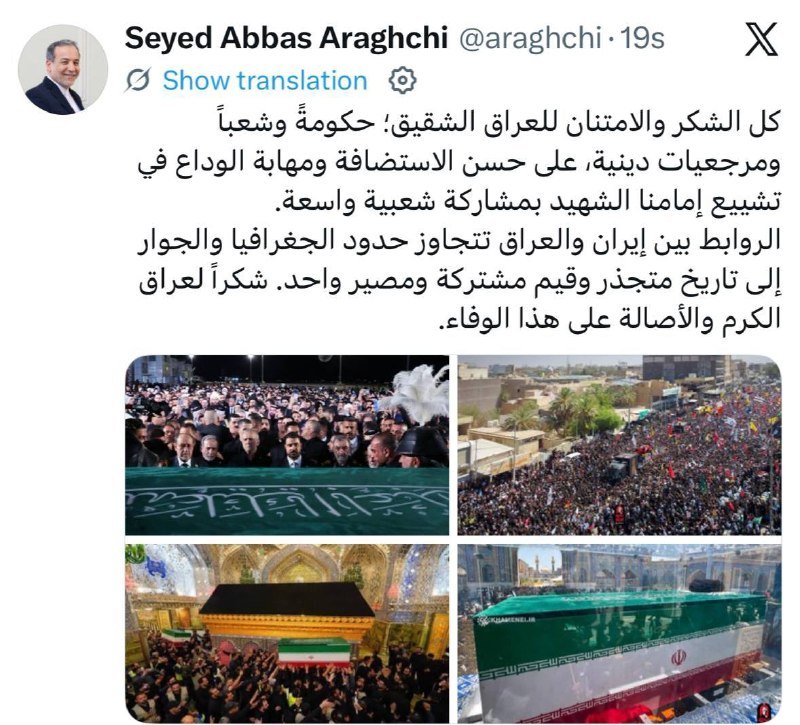
On the morning of 8 July 2026, the shrine of Imam Ali in Najaf could not hold the crowd. State-linked Persian outlets, including Tasnim, published a rolling sequence of images from before 09:22 UTC, when the cleric's body entered the courtyard, to after 10:28 UTC, when the burial was complete. A correspondent on the wire described the courtyard as having "no place to stand anymore." The hashtag on every Tasnim dispatch — Badarqa_Aghai_Shahid_Iran — frames the cleric in question, in the registry of Iranian state-aligned coverage, as a martyr, with the must_rise tag repurposed as a mobilisation slogan around the funeral.
The scale of the event, judged by the visual evidence Persian-language outlets are willing to publish, would normally register as a regional headline in Western wires. It has not. Reuters, AP, AFP, the BBC and the Guardian had not, as of midday UTC on 8 July 2026, run a stand-alone English-language story on the funeral at the time of writing. The silence is the news.
The story that ran
The Persian-language coverage is uniform. Tasnim's English wire, mirrored by its Jahan Tasnim Arabic-language channel, treated the burial as a moment of national-religious consolidation, with the body processed into the shrine, surrounded, and interred over the course of roughly an hour. Nine distinct dispatches, timestamped between 09:22 and 10:28 UTC, documented a continuous flow of mourners. None of the messages identified the cleric by full civil name in the public-facing English text; the framing — "Imam Shahid," "Martyr Imam," "Imam Shahidim" — did the labelling work instead. That is itself a choice, and a load-bearing one: it converts a personal obituary into a portable political symbol, legible to a Shia-mobilisation audience across Iran, Iraq, Lebanon, and the Gulf Shia diaspora.
The story that did not
English-language wire copy from the major Western agencies is, in effect, choosing not to cover the event on its own terms. A state funeral at one of Shia Islam's four holiest sites, drawing what Tasnim's photographers describe as a courtyard-filling crowd and stretching the procession to the point that a Tasnim stringer reports overflow, would, if the deceased were aligned with a Gulf monarchy or a Western-backed Iraqi faction, generate at least a stand-alone Reuters piece within hours. The asymmetry is not new, but it is unusually visible today.
Two factors plausibly explain the gap. The first is institutional: there is no full civil name in Tasnim's English-text material that a Reuters or AP editor could verify against an independent obituary, and Western wires have been burnt in the past by carrying identifications drawn from Iranian state-aligned sources. The second is editorial: the framing Tasnim itself is offering — martyrdom, mobilisation, the must_rise hashtag — is the kind of register that Western copy desks, rightly or wrongly, treat as a flag for "regime-adjacent messaging" and downgrade accordingly.
The framing problem in plain English
Both instincts are defensible. None of them, however, justifies a total absence of reporting on a funeral that is, by any reasonable metric, a major Shia religious event. The default Western heuristic that "if it came through Iranian state media, treat it as messaging, not news" has, over time, produced a coverage map in which Shia religious life in the Iraqi shrine cities is legible to English-language readers only when it intersects with Iranian state security, Iraqi parliamentary politics, or a crisis that is already on the Western agenda. The default is convenient, and the default is distorting.
The structural pattern is straightforward: a major regional event, sourced almost entirely through the channel that has a stake in how it is read, and then under-reported by the channels that could, in principle, send a stringer to Najaf. The result is not censorship, exactly. It is gentler than that. It is a slow, routinised choice by editors to allocate attention elsewhere, dressed up in the language of source caution.
Stakes and what to watch
The cleric's identity, the cause attributed to the death, and the political affiliations of the mourning crowd are all facts that, once established by an independent wire, would force the story back onto the desk. Until then, the framing of Imam Shahid as a martyr — and the must_rise hashtag as a call to action — is the only version of the day circulating in English. The audience that matters most to that framing, Shia publics in Iran, Iraq, Lebanon, and the Gulf, is not waiting for Reuters to catch up. The audience that is waiting is the one that uses Western wire silence as a default measure of what counts as a story. On that measure, Najaf did not happen today. It should have.
Desk note: this publication framed the burial as an event whose absence from Western wire copy is itself the lead, rather than reproducing Tasnim's martyrdom frame. The Persian-language sources used here are Tasnim and Jahan Tasnim, identified explicitly as Iranian state-aligned throughout.
Wire provenance
This editorial synthesis draws on the following public wire/social posts:
- https://t.me/tasnimnews_en
- https://t.me/JahanTasnim
- https://t.me/tasnimnews_en/1409
- https://t.me/tasnimnews_en/1410
- https://t.me/tasnimnews_en/1411