Live Wire
07:13ZPRESSTVForeign Ministry condemns US strikes on Iran as blatant breach of Islamabad MoU 🔴 Iran’s Foreign Ministry sa…07:12ZKHAMENEIENThousands attend funeral procession in Najaf07:09ZLIVEUAMAPIran says Hormuz violation, Israeli strikes on Lebanon render07:09ZTASNIMNEWSIrish parliament votes to ban imports from Israeli settlements07:08ZJAHANTASNIIreland's parliament votes to ban imports from Israeli settlements07:08ZTWOMAJORSVolkswagen shareholders including Porsche, Piech families face difficult situation07:07ZMIDDLEEASTIraq: Approximately 1.2 Million Gather for Ayatollah Khamenei's Funeral07:07ZPRESSTVIran condemns US strikes, threatens retaliation over alleged breach of Islamabad agreement
Markets
S&P 500747.71 0.48%Nasdaq25,819 1.16%Nasdaq 10029,173 1.77%Dow528.45 0.31%Nikkei93.07 2.31%China 5032.49 0.00%Europe89.04 1.03%DAX42.05 1.43%BTC$62,629 1.12%ETH$1,748 1.81%BNB$565.73 2.39%XRP$1.09 3.76%SOL$77.86 4.55%TRX$0.3287 0.24%HYPE$67.82 4.62%DOGE$0.0719 4.70%RAIN$0.0148 1.73%LEO$9.45 0.41%QQQ$709.43 1.85%VOO$687.08 0.51%VTI$369.61 0.55%IWM$296.19 0.91%ARKK$81.19 2.89%HYG$79.76 0.14%Gold$377.49 1.21%Silver$54.46 2.94%WTI Crude$108.92 4.38%Brent$41.93 4.98%Nat Gas$11.76 0.43%Copper$37.39 1.19%EUR/USD1.1433 0.00%GBP/USD1.3386 0.00%USD/JPY161.89 0.00%USD/CNY6.7935 0.00%
CLOSEDNYSEopens in 6h 15m
The Monexus
Vol. I · No. 189
Wednesday, 8 July 2026
Saturday Ed.
Updated 07:14 UTC
  • UTC07:14
  • EDT03:14
  • GMT08:14
  • CET09:14
  • JST16:14
  • HKT15:14
← The MonexusOpinion

Strikes on Iranian Ports Mark a New Escalation, and Washington Owns the Escalation Ladder

NASA FIRMS thermal data captured fires at Iranian ports in Bandar Abbas and Sirik within an hour of the strikes. The framing inside Washington has not caught up with the scale of what was just ordered.
Thermal signature captured by NASA FIRMS at the Haqani small-boat port in Bandar Abbas shortly after U.S. airstrikes on 7 July 2026. Telegram / @wfwitness

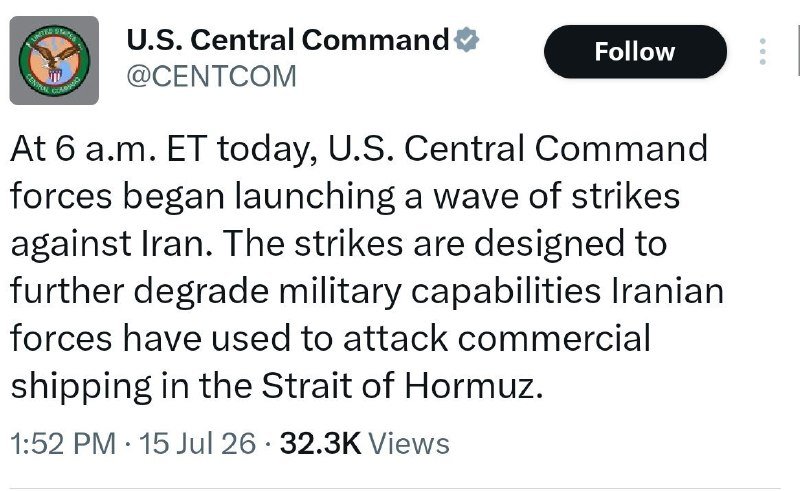
Thermal-satellite data picked up the strikes before the press cycle did. Between roughly 00:41 and 00:53 UTC on 8 July 2026, NASA's FIRMS fire-monitoring system registered large thermal signatures at two ports in Bandar Abbas, on Iran's southern coast, and a third at a port near the city of Sirik, further down the coast toward the Strait of Hormuz. The Telegram channels @wfwitness and AMK Mapping, both of which read FIRMS data as it posts, place the strikes at the Haqani small-boat harbour in Bandar Abbas — a facility widely associated with IRGC fast-craft operations — and at port infrastructure near Sirik and Qeshm. Al Jazeera's breaking-news feed, timestamped 00:00 UTC, reported explosions at Sirik, Bandar Abbas and Qeshm and framed the action as a U.S. response to recent attacks on shipping in the Strait of Hormuz and to a decision to revoke waivers on Iranian oil exports.

Read those three data points together and a picture assembles: a U.S. strike package hitting Iranian port infrastructure on the Persian Gulf coast, justified by the administration as retaliation for Hormuz attacks, and now sitting in the open as the most direct American military action against Iranian state facilities of this cycle.

The escalation ladder, not the strike

The dominant Western framing treats this as a tit-for-tat. That framing is convenient and incomplete. The action is not symmetrical. Striking port infrastructure in a country one has been sanctioning into a controlled economic decline is not the same order of move as a speedboat attack on a tanker. The strikes are a deliberate step up the escalation ladder, and the choice of targets — ports, not vessels; facilities, not just platforms — suggests the decision was made in Washington with an audience in mind that includes Tehran, the Gulf monarchies, the Israeli intelligence community, and the oil market.

Iran's options on the same ladder are narrower and the calculus more punitive. Tehran can attempt to close the Strait of Hormuz, accelerate proxy operations, or absorb the blow and wait for the political cycle in Washington to turn. None of those is attractive. Closing the strait would hit Iran's own crude exports and its Chinese customers first. The asymmetry is structural, and it shapes everything that follows.

What the wires are not yet saying

Al Jazeera's bulletin frames the strikes as a reaction to "Hormuz attacks" and to the revoking of Iranian oil-export waivers. The language is admin-friendly: a cause, an effect, a procedural pretext. What it leaves out is the targeting logic. A small-boat harbour associated with IRGC fast craft, plus two larger commercial-style ports plus a port near Qeshm Island, is not a minimum-force response to a tanker incident. It is a degrading strike against the maritime infrastructure the IRGC uses to project power into the strait, plus a warning to the civilian logistics layer underneath it. The pattern matches what U.S. Central Command has done before in other theatres: hit the host state's dual-use infrastructure and call it self-defence.

The thermal data is publicly available. The Telegram channels that read it are doing what journalists should have been doing in real time — overlaying commercial satellite fire detections on known port coordinates and publishing the result within minutes. The mainstream wires are, at this hour, still routing through official statements. That ordering — official framing first, open-source verification after — is how escalation gets normalised before it gets examined.

The structural frame, in plain prose

A unipolar power whose currency is the global reserve and whose navy dominates the chokepoints through which a quarter of seaborne oil flows does not need to win a war with Iran to reshape Iran's options. It can degrade port capacity, revoke oil waivers, and let insurance premiums, freight rates and Iranian domestic politics do the rest. The strikes are the kinetic surface of a structural pressure campaign. The Iranian economy is being squeezed at the export tap and the loading dock at the same time. The military strike is the part that makes the evening news; the financial architecture underneath it is the part that decides outcomes over the next twelve months.

The Global South reading of this is straightforward, even if it rarely makes the front page in Washington: the country that prints the reserve currency and patrols the strait gets to define what counts as "escalation" and what counts as "de-escalation," and it gets to do the defining from the top of the ladder. Tehran's complaint that the strait is being weaponised is, on the evidence, correct in form even when its own tactics are not.

Stakes, in concrete terms

If the trajectory continues, the short-term winners are defence contractors, oil traders positioned for a sustained Brent bid, and Gulf monarchies whose own export routes are temporarily less at risk. The short-term losers are Iranian civilians, who will absorb the price of any port damage through fuel and import costs, and the broader developing-world importers already running on thin margins. The medium-term loser is the non-proliferation architecture: a country that is attacked on its own soil has every domestic-political incentive to accelerate the one deterrent that would foreclose the next round of strikes.

What remains genuinely uncertain, even an hour after the FIRMS detections, is the operational scope. The Telegram-sourced reporting names three port areas; the Al Jazeera feed references Sirik, Bandar Abbas and Qeshm. The U.S. side has not, at the time of writing, published a full target list. Casualty figures are not in the source material and should not be invented. The framing of the strikes as a finished retaliatory action versus the opening move of a longer campaign will turn on what the U.S. Central Command briefing eventually says — and on whether the strait stays open in the seventy-two hours after.

For now, the satellite has spoken. The press cycle is still catching up.

This publication treats the FIRMS-detected thermal signatures and the Telegram-channel OSINT as the open-source floor of the record. The mainstream wires will set the official narrative over the next 24 hours; the open-source record is the only one currently traceable to a timestamp, a coordinate, and a sensor.


Word count: 1,084

Wire provenance

This editorial synthesis draws on the following public wire/social posts:

  • https://t.me/wfwitness
  • https://t.me/AMK_Mapping
  • https://t.me/AMK_Mapping
  • https://t.me/wfwitness
© 2026 Monexus Media · reported from the wire