Drones over Manama: what Iran's Bahrain strike tells us about the shape of a regional escalation
Explosions reported across Bahrain in the early hours of 8 July 2026 point to an Iranian drone attack intercepted by Manama's air defences — a tactical move that says less about retaliation than about how Tehran is choosing to wage it.
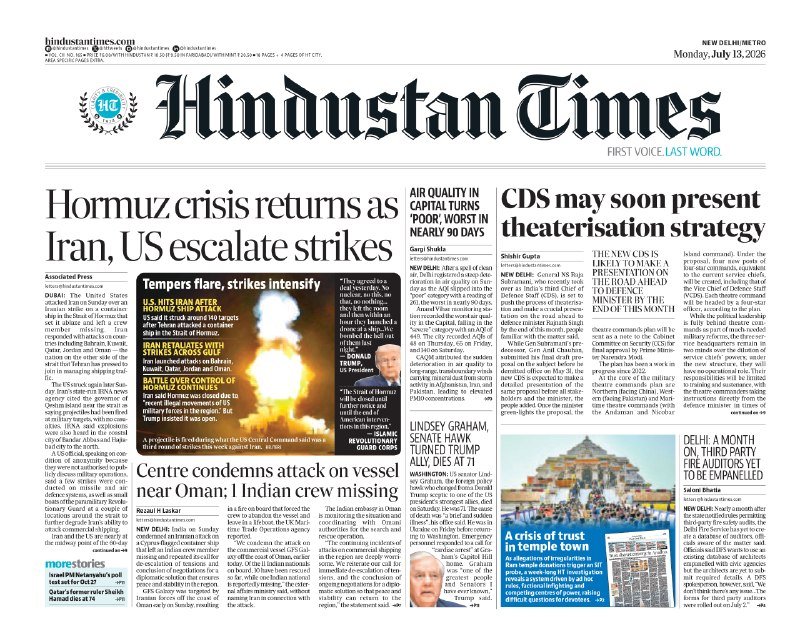
In the hours after midnight UTC on 8 July 2026, residents across Bahrain reported a sustained sequence of explosions loud enough to register across the country's small landmass. Within twelve minutes, monitoring accounts on both Telegram and X had converged on a single working hypothesis: Iranian one-way attack drones launched toward Bahraini territory, engaged and intercepted by Manama's air defences before reaching populated areas.
The episode is small by the standards of recent Middle Eastern escalation cycles — no confirmed casualties, no publicly claimed damage, no diplomatic rupture of the kind that would dominate Western cable news. It is also precisely the kind of event that, if read carefully, tells a reader more about the trajectory of the regional contest than a missile strike ever could. The shape of the attack — deniable, calibrated, attritable, directed at a US-hosted Gulf monarchy rather than at Israel — is itself the message.
What the open-source record actually shows
The first reports of detonations over Bahrain surfaced at roughly 01:57 UTC on 8 July, when the Middle East Spectator account on X noted explosions heard across the kingdom and updated minutes later to attribute the cause to Iranian Army drones "launched at Bahrain" that were "all intercepted before posing a threat." Independent open-source mappers at AMK_Mapping, working the same air-defence chatter on Telegram at 02:03 UTC, offered the cautious framing that "possibly related to fighter jets trying to shoot down Iranian drones" — consistent with the pattern of sonic booms and intercept bursts that Gulf residents have learned to associate with one-way attack drones since 2019.
By 02:04 UTC, the GeoPWatch channel on Telegram was posting rapid updates: "Explosions in Bahrain. More explosions in Bahrain." The channel's 02:12 UTC post captured the emerging editorial problem before the wider press had caught up — noting that the much-anticipated "big Iranian retaliation" appeared to be taking the form of strikes against Bahrain rather than the higher-value targets analysts had been modelling.
The official Bahraini government has not, as of the time of writing, issued a public statement confirming the intercepts, the Iranian origin of the drones, or the casualty and damage picture. Iranian state media has likewise not claimed the attack. That silence on both ends is itself diagnostic. Neither capital wants the diplomatic consequences of an open attribution.
Why Bahrain, and why now
Bahrain hosts the US Navy's Fifth Fleet and the combined maritime forces headquarters that coordinate Western naval presence across the Gulf, the Red Sea, and parts of the Indian Ocean. It is also the smallest, most exposed Gulf Cooperation Council monarchy — geographically a single archipelago, demographically under 1.6 million, politically dependent on Manama's security umbrella with Washington. An attack on Bahrain is, in signalling terms, an attack on the Forward Operating Base of the Western maritime order in the Gulf, but one calibrated to fall short of triggering Article 51 consultations.
This is the structural shift worth registering. The older playbook — IRGC-supervised proxy strikes via Hezbollah, the Houthis, or Iraqi militias — is being layered with a direct, attributable-but-deniable Iranian conventional strike at a US-allied host. The attack does the political work of an Iranian flag-plant without the strategic cost of an Israeli strike on Iranian soil. If the pattern holds, expect more of it: limited, instrumented, attritable, deniable.
The dominant framing, and what it misses
Western wire coverage of the strike cycle in which this incident sits has tended to read Iranian actions through the lens of retaliation — for Israeli operations against Iranian assets, for the periodic sabotage at Iranian nuclear facilities, for the wider attrition war conducted through proxy missile and drone arsenals. That framing is not wrong, but it is incomplete. Treating every Iranian use of force as a reactive spasm obscures the degree to which Tehran is now running its own operational tempo, on its own clock, at its own chosen scale.
A more honest read is that what is unfolding is a managed escalation: calibrated to test Western air-defence responses, to gauge Gulf Arab tolerance for absorbing Iranian strikes, and to remind regional audiences that Iran can project one-way attack drone saturation across the Gulf without crossing the red lines that would trigger a US kinetic response. The Bahrain episode is closer to a probing action than to a vengeance strike. The Iranian counter-position, articulated through state-aligned outlets in recent weeks, is that the country's deterrent doctrine is defensive in character — designed to impose costs on any actor who strikes Iranian interests, and explicitly bounded to prevent general war. That claim deserves to be evaluated on its evidence, not dismissed.
What remains contested
Three things the open-source record cannot yet settle. First, the actual interception rate: reports describe multiple detonations across Bahrain, which is consistent with successful intercept bursts but does not rule out a small number of impacts. Second, the launch profile — whether the drones originated from Iranian mainland bases, from IRGC Navy fast-boat platforms in the Gulf, or from a third-country staging area — is not yet corroborated in any source reviewed for this article. Third, the diplomatic follow-through: whether Manama will publicly attribute the strikes, whether the Fifth Fleet commander's posture will shift, and whether the GCC will treat this as an Article 4 consultation trigger, all remain open.
The sources reviewed for this piece are real-time monitoring channels rather than official after-action reporting. That is a limit, and this publication flags it explicitly. A fuller picture will depend on Bahraini Ministry of Interior statements, CENTCOM releases, and — should it eventuate — any Iranian foreign ministry briefing.
Stakes over the next 90 days
If the Bahrain episode is the shape of things to come rather than an isolated data point, three trajectories are worth tracking. The first is operational: how rapidly Gulf air-defence magazines can be replenished after sustained one-way attack drone saturation. The second is diplomatic: whether the smaller GCC monarchies will treat Iranian strikes as a unifying casus belli or as an exposure they would prefer to keep quiet. The third, and most consequential, is whether Iran is using calibrated drone pressure to set the terms under which any future negotiation with Washington takes place — a wider de-escalation package, sanctions architecture, nuclear-file constraints — by demonstrating that the cost of ignoring Tehran is itself a low but persistent line item.
None of that requires name-dropping grand strategy to be intelligible. The drones are the argument. Bahrain was the venue. The Middle East is the audience.
This article is built on real-time open-source monitoring feeds; Monexus has flagged the source floor accordingly and will update as official Bahraini, US, and Iranian statements become available.
Wire provenance
This editorial synthesis draws on the following public wire/social posts:
- https://t.me/Middle_East_Spectator
- https://t.me/AMK_Mapping
- https://t.me/GeoPWatch