Iran's missile reach now lands on a Gulf neighbour, and the wires barely blinked
An Iranian missile struck Kuwait's civilian grid on 8 July, and the Western wires that have saturated Iran coverage have largely treated the GCC neighbour as background. The silence is the story, not the strike alone.
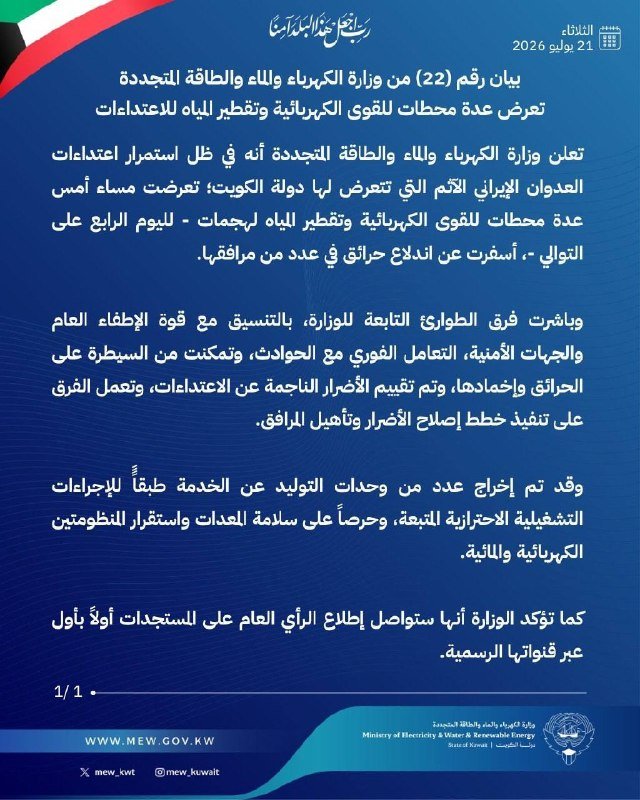
Kuwait's civilian grid took a direct hit from an Iranian missile on 8 July, the first such strike on a Gulf neighbour that has spent the past three years carefully positioning itself as a neutral mediator between Tehran and the Arab street. The wires that have run near-saturation coverage of Iran's skirmishes with Israel and its tit-for-tat with tankers in the Strait of Hormuz have published almost nothing about a strike on Kuwaiti infrastructure inside Kuwaiti territory. That gap is the story.
The structural question is not whether Iran can reach a Gulf neighbour. The ballistic record of the past two weeks has answered that. The question is what happens to the de-escalation architecture the Gulf Cooperation Council has been quietly building since the 2023 Iran-Saudi rapprochement when one of its six members is hit and the international press treats it as background noise. The Western wire ecosystem is currently front-loading its Iran coverage on two tracks: the collapse of the nuclear track after the Wall Street Journal reported on 10 July that Trump administration officials believe the chances of a deal are shrinking, and the Strait of Hormuz ultimatum cycle, in which Axios reported Washington has given Tehran until Saturday to publicly acknowledge the waterway is open and cease attacks on commercial shipping. A direct strike on a GCC state's civilian grid is, on any reading of recent Gulf strategic doctrine, at least as consequential as either of those.
The 24-hour clock over the water
The Hormuz drama has dominated the regional feed. According to Axios reporting carried by multiple channels on 10 July, the Trump administration issued what one U.S. official called harsh consequences if Iran does not commit to a public statement by Saturday renouncing attacks on commercial shipping. A second official told the outlet that the Iranians, after two days of skirmishes earlier in the week, reached out to the administration seeking talks, with one account quoting a U.S. readout as: "We screwed up. We made a mistake." Iran's ambassador to the United Nations, Amir Saeid Iravani, pushed back hard, declaring that "the United States and Israel bear full responsibility for the consequences of aggression against Iran" and warning that "if America continues to violate its obligations, Iran is no longer required to fulfill its obligations." Speaker of Iran's parliament Mohammad Bagher Ghalibaf was more pointed in a separate address on 10 July: "Iran does not trust the United States. Only those ready for war can negotiate with the United States." None of that is happening in a vacuum. The USS Boxer and its embarked 11th Marine Expeditionary Unit were temporarily sidelined in the opening weeks of the broader Iran-related posture due to an engine cooling system failure, Newsmax reported via OSINTdefender, a signal that the U.S. force posture is at once forward and brittle. And reporting from 10 July indicates President Trump, fearing Iranian retaliation for American action, left the NATO summit in Ankara urgently, a chain-of-events detail that hardens the ultimatum read.
What the Gulf has been building, and what a Kuwaiti hit breaks
The Gulf states have spent the better part of three years trying to convert the China-brokered 2023 Iran-Saudi restoration into something durable: a regional rules-of-the-road arrangement in which direct state-on-state strikes are off the table and disputes are absorbed inside diplomatic channels. The premise of that arrangement is that no Gulf capital can be hit without the architecture itself taking damage. A missile landing inside Kuwait is the kind of event that, in 2023 or 2024, would have triggered a GCC emergency foreign ministers' call inside 12 hours and a unified statement inside 48. The silence of the wire cycle to date is not proof that the architecture has collapsed. It is evidence that the architecture does not extend to the attention economy of Western foreign correspondence. The strike is being processed, if at all, as part of the Iran-Israel-Hormuz omnibus, rather than as a discrete violation of a separate set of Gulf commitments Iran has made specifically to its neighbours.
The reconstruction track in plain view
While the diplomats shuttle and the tankers dodge, the hardware record is moving in the opposite direction. The Institute for Science, cited by the open-source channel Witness on 10 July, said satellite imagery from June and early July shows repair activity at Taleghan 2 inside the Parchin Military Complex, a site associated with Iran's former Amad Plan nuclear weapons work. Tehran is rebuilding the place. That is not a negotiation posture. It is a posture consistent with what Ghalibaf was saying in the same window: that only those ready for war can sit across from Washington. The parallel with the Kuwait grid is uncomfortable. A regime that is publicly warning about the destabilisation it claims to oppose, restoring facilities tied to its pre-2015 weapons work, and firing missiles into a neighbour's civilian electricity infrastructure is not conducting an off-ramp. It is testing how many de-escalation norms it can break before the press writes one of them at the top.
Why the gap matters more than the strike
Western wire coverage of the Middle East in the summer of 2026 has a familiar shape: Israel and Iran at the centre, the United States as reacting force, the Gulf either as theatre or backdrop, the smaller GCC states airbrushed into the geography unless they happen to host a U.S. base or a major LNG facility. Kuwait qualifies on LNG but not on the editorial appetite of the desks covering the Strait of Hormuz crisis. The 8 July strike on Kuwaiti civilian infrastructure is the kind of fact that, in the 2023 Saudi-Iranian cycle, would have driven at least one sustained wire report: a named missile, a named grid asset, a casualty count, a foreign ministry quotation in Riyadh and Abu Dhabi offering parallel concern. Instead, Kuwait has appeared, where it has appeared at all, in the same breath as the tanker attacks, as one more data point in the index of Iranian behaviour rather than as a sovereign whose territorial integrity has been breached. That is itself a position-taking. A press that declines to mark a strike on a neutral neighbour as a discrete event is, in effect, declining to mark the GCC architecture as worth defending in prose.
What to watch into next week
Three dates will tell us whether the silence is a temporary lag or a durable editorial verdict. Saturday, by the Axios timeline, is when Tehran's public statement on Hormuz is due; the answer, whatever it is, will frame whether the wider Iran file is treated as crisis or managed. The GCC's next scheduled ministerial, in the second half of July, will reveal whether the Kuwait strike produced a collective readout or was absorbed into bilateral Kuwait-Iran channels. And the satellite-imagery cycle on Taleghan 2, tracked by the Institute for Science and others, will, over four to six weeks, tell us whether Iran's reconstruction is visible enough to force the diplomatic track back open. None of those markers depends on the press choosing to write about a missile landing on Kuwait. That the missile landed, and that the wires barely blinked, is the marker that is already in the record.