Iraq's funeral cortège for Khamenei puts Najaf at the centre of a regional succession story
Millions lined the Najaf–Karbala route on 8 July 2026 as Ayatollah Khamenei's body was escorted through Iraq's holiest cities, placing Baghdad and the shrine network at the heart of the coming succession fight.
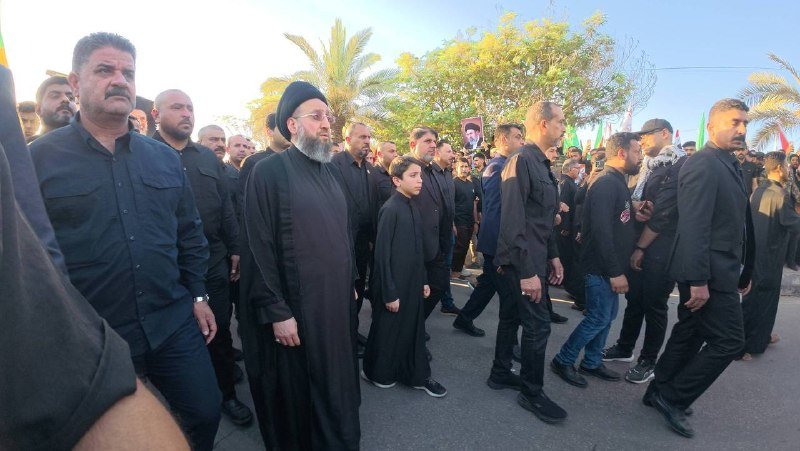
Crowds estimated in the millions filled the road between Najaf al-Ashraf and Karbala on 8 July 2026, escorting the body of Grand Ayatollah Sayyid Ali Khamenei on the Iraqi leg of his funeral procession before burial in Iran. Iran's state-aligned Al-Alam channel and the Khamenei office's official English-language Telegram account both broadcast continuous footage from the route, showing the cortege moving through the shrine courtyards while mourners chanted "Labik ya Hussein" in the Karbala court of Imam Hussein. The scenes place Iraq — and specifically the shrine cities of Najaf and Karbala — at the symbolic heart of the most sensitive political moment the Islamic Republic has faced since 1989.
That moment is now. Khamenei's death does not merely produce a vacancy; it produces a succession fight that will be fought inside Iran's institutions, but also across the regional geography where Iranian clerical authority has been most visibly projected. The Iraqi shrines, with their deep clerical networks and multi-million-strong pilgrim economy, are the first non-Iranian stage on which that fight is now being performed.
The cortege as political theatre
Funerals in this part of the world are never purely liturgical. The framing of Khamenei as a "martyred mujahid Imam" — the language carried by the Khamenei office's English Telegram feed on the morning of 8 July — fuses religious veneration with the politics of resistance that has defined the post-1979 order. By routing the body through Karbala first and then Najaf, the procession reaches two audiences at once: the Iraqi Shi'a public, whose turnout is itself a signal of sectarian solidarity, and the clerical establishment in Qom and Mashhad that will ratify the next Supreme Leader.
Iranian state-aligned coverage has emphasised the scale of Iraqi participation. Al-Alam described "millions" of mourners in Najaf and Karbala, and published images of the family of the deceased leader entering the Karbala shrine courtyard amid the traditional lamentation chants. The framing is unmistakably part of a domestic Iranian narrative too: a Leader whose burial draws the region's largest Shi'a crowds is a Leader whose legitimacy is, in the regime's telling, beyond domestic dispute.
What Iraq gets out of the arrangement
Baghdad's consent for the transit is not free. Iraqi politics has spent two decades balancing its American security relationship, its Iranian-trained paramilitary constituency, and its own clerical institutions — most notably the Hawza of Najaf, which historically has regarded the Iranian revolutionary clergy as a junior offshoot rather than a senior partner. Allowing millions of Iranian-aligned mourners onto Najaf's streets is a calculated bet by Prime Minister Mohammed Shia' al-Sudani's government that the religious-tourism economy and the political symbolism outweigh the risk of sectarian backlash.
The gamble carries clear upside. Iraq is positioning itself as the indispensable geographic host for a transition that the entire regional security architecture will respond to. If Iran's next leader seeks legitimacy through the shrine cities — as the procession suggests the Islamic Republic intends to do — Iraqi institutions become stakeholders in the ratification, not merely spectators.
The succession geometry the footage obscures
The choreography of the funeral is designed to project unity, but the institutional reality behind it is contested. The Assembly of Experts, the clerical body constitutionally empowered to name the next Supreme Leader, has not been visible in the public coverage from Najaf. Hardline institutions tied to the Islamic Revolutionary Guard Corps, the bonyads, and the office of the previous Leader have spent years positioning loyalists, while figures associated with the pragmatist wing have been systematically pushed out of senior security roles since the 2022–23 protest crackdowns.
The crowds lining the Najaf–Karbala corridor therefore read two ways. To supporters, they confirm Khamenei's standing and the durability of the system he consolidated. To skeptics, they are evidence that the regime's mobilisation machinery — state-aligned media, clerical networks, and paramilitary-linked pilgrim buses — remains the dominant producer of public space in Iraq's holy cities. The funeral is the last occasion on which the old guard can credibly invoke the founder's name to discipline rivals. That window closes quickly.
The regional ripple, written carefully
Western and Gulf-based outlets will frame the next forty-eight hours through a security lens: succession uncertainty, the fate of Iran's proxies in Lebanon, Iraq and Yemen, and the question of whether nuclear-file diplomacy resumes from a position of strength or fracture. Those are legitimate framings. The Iraqi street evidence now accumulating should not be read as evidence of popular Iranian dominance — Iraqi Shi'a politics has its own factions, its own clerical hierarchies in Najaf, and its own patron networks in Washington and Tehran that rarely align. What the Najaf footage does establish is that the Islamic Republic still has the logistical and symbolic capacity to fill the holiest corridor in Arab Shi'ism with a million mourners on twelve hours' notice. That is a fact about state capacity, not about popular will.
Stakes
If the succession proceeds inside the institutional rails the Islamic Republic built for it, the Iraqi shrine network will become a routine venue of Iranian political theatre, with predictable economic and security spillovers for Baghdad. If the succession fractures — between hardliners and a residual pragmatist camp, between the Supreme National Security Council and the IRGC, between the Assembly of Experts and the office of the presidency — Najaf and Karbala will become contested terrain in a way they have not been since the 2003 war, with militias that operate in both countries able to mobilise on shared ground. Iraqi sovereignty, already negotiated daily between Tehran and Washington, will be tested harder than at any point since the ISIS war.
What remains uncertain
The scale figures published by Iranian-aligned channels on 8 July — "millions" of mourners in Najaf — have not yet been independently verified, and independent Iraqi press inside the shrine cordon has been constrained. The composition of the procession's accompanying clerical delegation, which will signal the direction of succession, has not been disclosed in the Telegram feeds reviewed here. The Iranian government's official announcement of cause and circumstances of Khamenei's death, which will set the political vocabulary for the entire transition, had not been published in the reviewed sources at the time of writing. Each of those gaps will narrow over the next seventy-two hours; the Iraqi funeral is the prologue, not the verdict.
Desk note: Monexus framed the procession through Iraqi institutional stakes rather than through the Tehran succession horse-race alone, on the view that the geography of the funeral — Najaf and Karbala, not Tehran or Mashhad — is itself the most analytically interesting fact on the wire this hour.
Wire provenance
This editorial synthesis draws on the following public wire/social posts:
- https://t.me/alalamfa/
- https://t.me/alalamfa/
- https://t.me/Khamenei_en/
- https://t.me/alalamfa/
- https://t.me/Khamenei_en/