Karbala's funeral procession and the choreography of Iranian state messaging
Tasnim's rolling coverage of a Karbala funeral is less a newswire than a liturgy of grief — and a reminder that Iranian state-aligned outlets still treat mourning as a broadcast asset.
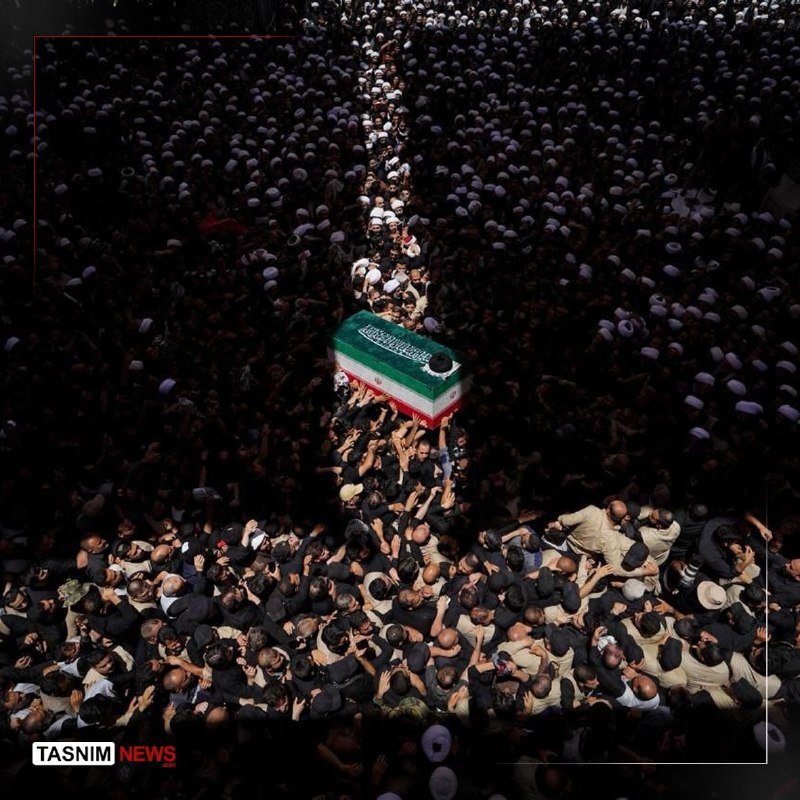
Between roughly 18:55 and 20:15 UTC on 8 July 2026, the English desk of Iran's Tasnim News Agency posted six dispatches from a single funeral in Karbala, Iraq. The first arrived at 18:55 UTC — "Enthusiastic attendance of the crowd at the funeral of the holy body of Imam Martyr" — and the second, seconds later, noted that the body "is still waiting" between the two holy shrines. By 19:22 UTC, Tasnim was circulating video of Karbalais "showering flowers" on the coffin; by 19:06 UTC, a "huge flood of people" was on the move; by 20:01 UTC, a "close view of the holy body" had been distributed; and by 20:15 UTC, mourners were still arriving in the "last hours of the night." Each item carried the hashtags #Badarqa_Aghai_Shahid_Iran and must_rise.
The reporting is its own event. Tasnim is an Iranian state-aligned outlet, founded in 2002 under the supervision of the Islamic Ideology Dissemination Organization and widely treated in Western risk briefs as a propaganda instrument of the Islamic Republic. Its coverage of a Shia funeral in Karbala is, on its face, both news and ceremony: it documents what is on the ground in a city of roughly half a million people, and it performs a particular Iranian reading of that mourning for an audience that extends well beyond the shrine itself.
What the wire actually shows
The six items, read end to end, describe a coordinated nighttime procession. They specify the geography (Karbala, in central Iraq, between the shrines of Imam Husayn and Imam Abbas), the duration (a roughly 90-minute rolling window in which attendance is described as growing rather than thinning), and the emotional register ("enthusiastic," "huge flood," "showered flowers"). They do not name the deceased, identify the family commissioning the procession, or state a cause of death. The hashtags reference an "Imam Martyr" figure associated with Iran, and the running slogan must_rise is repeated across all six items.
That sparseness is the tell. A wire filing by a non-aligned outlet would lead with the dead man's name, his affiliation, and the circumstances. Tasnim's English desk, by contrast, treats the procession itself — the crowd, the flowers, the late hours, the body "still waiting" — as the news. The subject's identity is carried entirely in the hashtag, where it functions as a marker of in-group recognition rather than as an information payload.
The other side of the wire
Independent confirmation from Karbala on 8 July 2026 is, at the time of writing, thin. International wire services in the Reuters-AP-Bloomberg bracket have not, in the items available to Monexus, run comparable text dispatches; the broader English-language conversation around Karbala funerals tends to come either from Iraqi civil-society accounts or from Shia pilgrim networks. That asymmetry matters: a single Tasnim-led narrative, however genuine the on-the-ground grief, is by construction a one-source story. Readers weighing the framing should note that the agency has institutional reasons to emphasise scale, enthusiasm, and continuity — "still waiting," "last hours of the night," "flood of people" — because those are the images its editors want circulated in the hour after a death that the Islamic Republic considers politically significant.
The counter-read is straightforward. A Karbala funeral is a deeply felt local event regardless of any external camera. Karbala hosts millions of pilgrims a year, and a martyr's procession through the city — the third-holiest city in Shia Islam — would draw crowds on its own terms, without any editorial direction from Tehran. To dismiss the turnout as staged is to insult the mourners; to accept Tasnim's framing uncritically is to mistake a liturgy for a newswire.
Mourning as a broadcast asset
What Monexus finds structurally interesting is not whether the crowds were real — they almost certainly were — but the speed and discipline with which Tasnim's English desk turned a private grief into a rolling bulletin. Six items in 80 minutes is a tempo more typical of a breaking-security story than a funeral. The captions are short, the adjectives are choreographed ("enthusiastic," "huge," "holy"), and the hashtag is identical across every post, ensuring that any reader scrolling Telegram's English-language Shia channels sees the same frame on every refresh.
This is what Iranian state-aligned media does when it works as designed. The agency's domestic operations are well documented; its English desk functions as a translation layer that repackages the same framing for an external audience without softening the doctrinal vocabulary. "Martyr," "Imam," "holy body" — these are not neutral descriptors, and Tasnim uses them unhedged. The effect is a newswire that reads, to its intended audience, as both fact and testimony.
What remains uncertain
Monexus has not, on the items available, been able to independently identify the figure Tasnim refers to as "Imam Martyr," nor has it been able to verify a cause or date of death, a commissioning institution, or the size of the procession from a non-Tasnim source. The agency's own reports give no body count, no named organisers, and no independent camera angles. Until a wire service with a different editorial mandate covers the same event, the procession exists in English-language journalism as Tasnim describes it — and the load-bearing word in that sentence is "as."
Desk note: Monexus covered this wire as a study in source posture, not as a stand-alone obituary. Where most outlets either ignore Tasnim's English output or treat it as boilerplate propaganda, the better practice is to log it, contextualise it, and flag where independent confirmation is missing — which is most of the substantive claims here.
Wire provenance
This editorial synthesis draws on the following public wire/social posts:
- https://t.me/tasnimnews_en
- https://t.me/tasnimnews_en
- https://t.me/tasnimnews_en
- https://t.me/tasnimnews_en
- https://t.me/tasnimnews_en
- https://t.me/tasnimnews_en