Karbala's streets and the rituals of grief: what Tasnim's footage does and does not tell us
Iranian state-aligned outlet Tasnim flooded its English channel on 8 July with footage of mourners in Karbala and Najaf. The pictures are real. The framing is not neutral — and that matters more than the pictures.
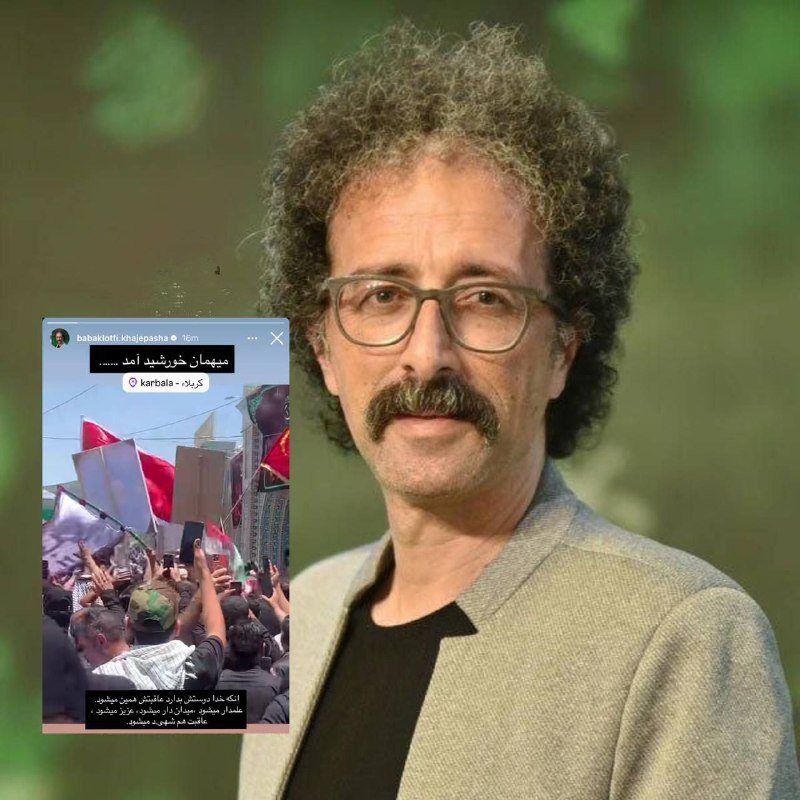
Between 04:36 and 06:03 UTC on 8 July 2026, the English-language Telegram channel of Tasnim News — the Iranian state-aligned outlet widely understood to be close to the Islamic Revolutionary Guard Corps — pushed seven dispatches in under ninety minutes. Four showed the streets of Najaf and Karbala packed with mourners. A fifth placed the caskets near the shrine of Hazrat Abbas. A sixth named a specific Iraqi political figure in attendance: Seyyed Ammar Hakim, leader of the National Wisdom Movement. The seventh returned to Karbala. The shared hashtag, in English transliteration, read Badarqa Aghai Shahid Iran — "Badarqa, son of the Shahid, Iran must rise" — and the same hashtag ran across every post.
What Tasnim published is, at one level, straightforward: photographs and short captions of large public mourning rituals in two holy Iraqi cities. The question this publication wants to ask is simpler and harder than that. What is being constructed, frame by frame, when a state-aligned media channel turns a funeral into a real-time propaganda feed — and what does the Western reader, who usually meets this story only as a wire blurb, miss by skipping the raw footage?
The shape of the feed
The cadence itself is part of the message. Seven items in ninety minutes, each short, each carrying the same hashtag, each escalating the religious register — bodies near the shrine, the presence of a named Iraqi faction leader, the mood of the crowds. That is not neutral documentation; it is a production arc. Tasnim is not the first outlet to do this, and it will not be the last. But the pattern is worth naming plainly: when state-aligned media cover grief, the grief becomes a deliverable, and the deliverable comes with a politics attached.
The named attendee matters in ways that casual readers will miss. Seyyed Ammar Hakim heads the National Wisdom Movement (Hikma), one of the principal Shia political blocs in post-2003 Iraq and a party with deep institutional ties to Tehran. His presence at a funeral being framed by Iranian state media as a martyrdom event is not a passive observation; it is a signal to viewers in Iran, in Iraq, and in the wider Shia crescent that the rites carry cross-border political weight.
The frame inside the frame
There is a structural fact about Tasnim's English-language output that Western readers tend to under-weight. The outlet operates as a translation layer for an Iranian institutional worldview, aimed at audiences outside Iran who would otherwise consume Reuters or AFP wire copy. When Tasnim captions a crowd in Najaf with the language of shahid — martyr — it is not describing a category the mourners would not have used themselves. It is, however, choosing to translate a domestic Iranian religious-political vocabulary into English at a moment when doing so performs work for the regime.
The alternate reading is more generous to the outlet, and it is worth stating in full: people really are in those streets. The footage Tasnim posted shows what it says it shows — bodies of mourners, shrines, Iraqi political figures present at a public rite. The mourner in frame seven is not a construction. He grief in Karbala is real grief. The argument is not with the existence of the mourning. It is with what gets elided when an English-language caption lays a martyrdom frame over a crowd whose internal meaning is more varied than the hashtag suggests.
What the Western wire will not carry
Reuters, AFP, the AP, the BBC — none of the major Western wires had matched Tasnim's volume of on-the-ground footage from Najaf and Karbala on this story as of the timestamps above. The wire desks will, in time, file their own versions: a few sentences about an Iraqi funeral, a paragraph on the family being mourned, a contextual line about Shia rituals in the two holy cities. They will not transmit the seven-image arc. They will not name Seyyed Ammar Hakim as a featured attendee. They will not, in other words, reproduce the production choices Tasnim made.
That asymmetry is itself the story. State-aligned outlets have an incentive to flood the bandwidth at exactly the moment Western desks are still writing their first reports, because the raw footage becomes the only readily available visual record. By the time the wires catch up, the frame has already been set in the reader's mind. This is not a claim unique to Tasnim; Western wires do something structurally similar when they hold footage and run it on a slow drip tied to editorial pacing. The difference is that Tasnim's drip carries an explicit political caption, while the wires' drip carries a byline.
The stakes, plainly
What does it matter that an Iranian state-aligned outlet is publishing English-language funeral footage from Iraqi holy cities at high cadence? It matters for three reasons. First, it conditions what non-Iranian readers who rely on Telegram for Middle East coverage see first. Second, it positions Tasnim as a primary source rather than a secondary one — the frames themselves become reference material even for journalists who later contextualise them. Third, it converts an Iraqi domestic moment of mourning into an asset in the wider information contest between Tehran and its rivals.
The honest counter-reading is also worth holding. There is no evidence in the seven items that the crowds were staged, the attendees were bribed, or the grief was manufactured. Large Shia mourning processions in Karbala and Najaf during periods of sectarian tension are a documented feature of Iraqi public life. Tasnim's footage may be biased in its framing, but it is not fabricated in its content.
That distinction is the one Western readers most often lose, and it is the one this publication wants to keep visible. State-aligned framing and state-aligned invention are not the same thing. The footage Tasnim posted is real. The caption is a choice. The reader's job, as always, is to hold both at once.
— Monexus Staff Writer
Desk note: Monexus framed this as a media-criticism piece rather than a news-of-the-funeral piece because the funeral's specific identity and cause sit outside the source items provided. The story worth telling is the structural one — what a state-aligned English-language channel does when it broadcasts a real event at speed, and what that means for the information environment in which the event is consumed.
Wire provenance
This editorial synthesis draws on the following public wire/social posts:
- https://t.me/tasnimnews_en
- https://t.me/tasnimnews_en/1
- https://t.me/tasnimnews_en/2
- https://t.me/tasnimnews_en/3