The Karbala tableaux: when Tehran stages a funeral abroad, who mourns?
Iranian-aligned channels broadcast scenes of Karbala in mourning for Ayatollah Khamenei. The mass-grief framing tells a story the footage does not entirely support.
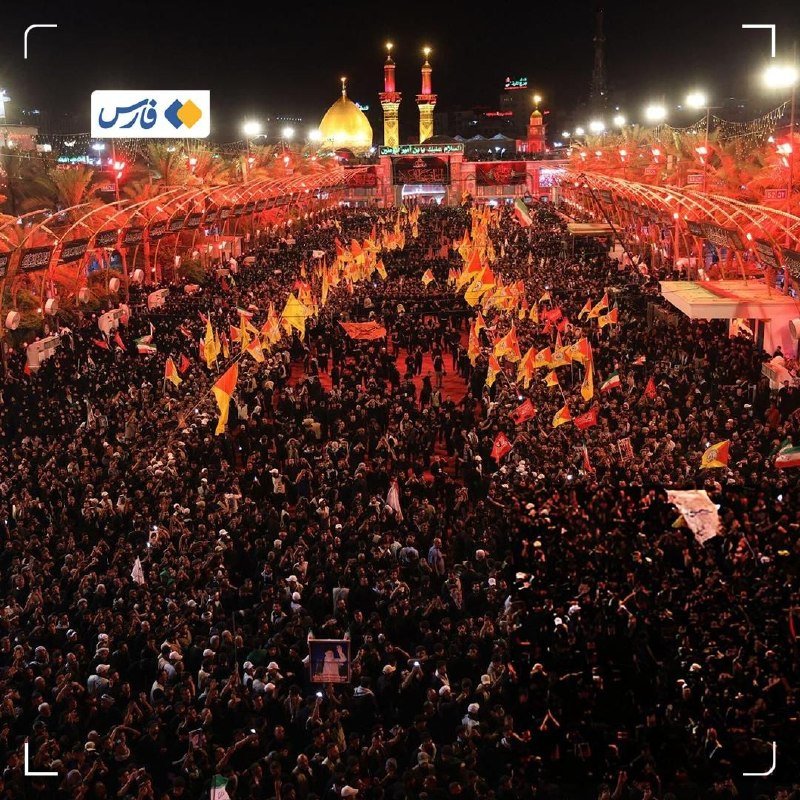
On 8 July 2026, the Telegram channel Middle East Spectator broadcast a sequence of images from Karbala, the central-Iraqi shrine city roughly 120 kilometres south of Baghdad. The first frame, posted at 22:41 UTC, claimed that approximately three million Iraqi mourners had gathered to receive the body of Ayatollah Ali Khamenei, the Iranian supreme leader. Two follow-ups at 22:43 UTC and 22:58 UTC amplified the figure; a fourth message at 23:08 UTC reframed the same footage as "the streets of Karbala risen for Ayatollah Khamenei." The cumulative effect is a single claim, repeated four times in twenty-seven minutes: a host city turning itself inside out for a dead foreign patron.
That is the kind of image that bends Middle East reporting by force of volume. Three million mourners, if real, would represent a near-quarter of Iraq's population standing in a single city at a single hour. The figure should be met with the same scepticism any other extraordinary round number receives, particularly when the channel repeating it has structural incentives to magnify the spectacle. The reading that follows respects that uncertainty without using it as an excuse to skip the question.
What the footage actually shows
The visual content is consistent across the four posts: dense, slow-moving crowds in Karbala's central corridors, banners bearing religious insignia, and what the channel describes as the arrival of the "martyred Imam." There is no independent verification in the source set of the three-million figure, no count of attendees by Iraqi civil authorities, and no corroborating wire reporting from Reuters, the Associated Press, the BBC, Al Jazeera, or AFP attached to the thread. The "approximately three million" line is sourced only to Middle East Spectator itself. The footage proves a procession; it does not prove a count.
Two concrete steps would ground the claim: an estimate from Karbala's governorate or the Iraqi Ministry of Interior, and shuttle-satellite imaging of the shrine district taken at the relevant hour. Without either, the number remains an assertion.
Why a Shiite shrine city hosts an Iranian leader's funeral
Khamenei held no Iraqi citizenship and no Iraqi public office. His religious authority rested on the title of marja, a senior source of emulation in Twelver Shiite jurisprudence, not on any Iraqi clerical appointment. Karbala, however, is one of the four holiest cities of Twelver Shiism — the site of the shrine of Imam Husayn, killed in 680 AD. Hosting a procession there reframes an Iranian state funeral as a pan-Islamic pilgrimage event. The city, the cleric, and the Iraqi Shiite shrines are bound by a shared sacred geography that pre-dates the modern Iranian state.
This is the structural fact the footage is engineered to illustrate: that the Iranian Republic's claims to regional religious primacy can find expression in concrete Iraqi space. It is, in effect, a foreign-policy tool staged as a devotional act.
The counter-reading the framing is designed to forestall
The procession also functions as a soft advertisement for Iraqi Shiite political alignment with Tehran. Iraqi Shiite parties — several of which were founded, financed, or trained in Iran or under Iranian tutelage — have spent the post-2003 period translating religious solidarity into political coalitions, parliamentary blocs, and at times militia formations. A Karbala crowd this size would be a powerful asset for those parties in any internal Iraqi debate about the depth of that alignment. Coverage that accepts the headline figure at face value performs a service for that coalition; coverage that pauses to verify performs a more useful one.
The plausible alternative read is that Karbala would have hosted large crowds anyway. The shrine city's annual Arbaeen pilgrimage — commemorating the fortieth day after Ashura — routinely draws millions, and Iraqi mourning culture is structurally generous with attendance. A procession arriving in that ecosystem would draw significant foot traffic without needing any stagecraft to inflate the number. The same crowd scenes could honestly read as a major but unremarkable devotional moment.
Stakes, and what remains unresolved
Who benefits from the claim? Most immediately, the Iranian state-aligned media ecosystem that produced the frames and the Iraqi political factions whose standing rises when foreign dignitaries are received in Iraqi holy cities. Quieter beneficiaries include Western analysts who treat the footage as evidence of Iraqi captivity to Tehran — a reading that flatters their priors but rests on a single uncorroborated number.
Three things remain genuinely uncertain on the available evidence: the size of the crowd; the proportion of attendees who came as deliberate mourners rather than pilgrims opportunistically joining a transit procession; and whether the figure of three million originates with Iraqi officials or with the channel's own editorial decision. The sources do not specify the answer to any of these. Until they do, the honest ledger treats the Karbala scenes as significant and the three-million figure as unverified.
This Monexus piece leads with an Iranian-aligned Telegram channel because that is where the claim originated; the editorial task was to hold the spectacle up to the source material rather than to the convention of repetition.
Wire provenance
This editorial synthesis draws on the following public wire/social posts:
- https://t.me/Middle_East_Spectator
- https://t.me/Middle_East_Spectator
- https://t.me/Middle_East_Spectator
- https://t.me/Middle_East_Spectator