Najaf's streets, Iran's grief, and the choreography of a martyr's funeral
Tasnim's overnight wire from Najaf shows a city on its feet for a senior Iranian figure. The crowd, the clerics, and the symbolism all serve a purpose.
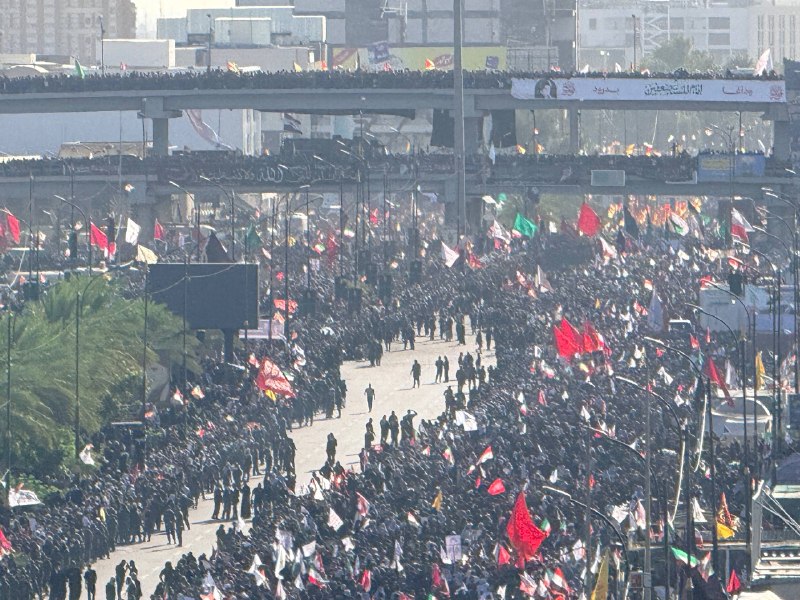
By 06:10 UTC on 8 July 2026, Iran's Tasnim News was pushing frame after frame out of Najaf: crowds stretching toward the shrine, clerics in black, and a hashtag — #Badarqa_Aghai_Shahid_Iran — designed to travel. The agency called the gathering "rare and magnificent." That is not neutral language. It is liturgy translated into wire copy.
The scenes matter less for what they show than for what they reveal about the choreography. A senior Iranian figure — Tasnim refers to him as "the martyr Imam," a title usually reserved for Ayatollah Khamenei or for figures elevated into the martyr-pantheon of the Islamic Republic — is being buried in Najaf, not in Tehran. The choice of city is itself a signal: Najaf is the seat of Ayatollah Ali al-Sistani and the holiest cemetery for Shia Muslims outside Mecca and Medina. Laying an Iranian to rest in Iraqi holy ground tells the faithful across the region that the dead man's standing transcends his passport.
What Tasnim is actually showing
The wire from Tasnim between 05:03 and 06:17 UTC moves on three registers. First, the volume — "Najaf is full of people," "the streets of Najaf are full," "a huge crowd." Second, the political cast: at 05:03 UTC, Tasnim singles out the presence of Seyyed Ammar Hakim, the leader of Iraq's National Wisdom Movement, at the funeral. Hakim is one of the most consequential Shia politicians in post-2003 Iraq, and his attendance is a quiet but deliberate signal that Najaf's mainstream clerical establishment is framing the dead man as one of their own. Third, the hashtag itself — #Badarqa_Aghai_Shahid_Iran — is a campaign, not a tag. It bundles grief to a slogan ("must rise") that doubles as a mobilisation hook.
Read together, the six Tasnim items from this morning are not six photographs. They are a single editorial argument: this martyr belongs to the whole Shia world, and the whole Shia world has come to claim him.
Why Najaf, why now
The geography is doing real work. Najaf is roughly 160 kilometres south of Baghdad, and the shrine of Imam Ali makes it the third holiest city in Shia Islam. It is also the seat of Ayatollah Sistani, the senior marja whose quietist, non-IRGC school of Shia authority has long been a structural counter-weight to Iran's exported revolutionary model. When an Iranian figure is buried in Najaf, two things happen at once: he is honoured in the city that matters most to Iraqi Shia, and his successors acquire standing in a place where Iranian influence has always had to be negotiated rather than assumed.
Tasnim's coverage, with its carefully chosen framing and its naming of Hakim, is built to win exactly that negotiation. The presence of a figure from Sistani's wider orbit signals acceptance. The hashtags and the "rare and magnificent" copy do the rest.
The reading the Western wire will give you
Western coverage of Iranian funerals tends to flatten them into either "regional escalation" or "internal power play" — shorthand for the assumption that every Iranian-produced frame is theatre and should be decoded for the factional signal underneath. There is real factional signal here, and serious outlets will be right to dig for it. But the shorthand is also lazy.
The counter-reading, the one Tasnim is selling directly to its Arabic-speaking audience, is that a man who gave his life to a cause is being mourned in the holiest available ground, by a city that did not have to turn out and did. That is not a trivial claim. Public grief at this scale is a resource, and it has to be organised — but it also has to be felt. Treating the crowd as pure stagecraft misses the way mourning and mobilisation interlock in the religious-political vocabulary of the Shia world.
The two readings are not mutually exclusive. The honest version holds both: this is a real funeral with real sorrow, and it is also a frame, and the frame is the point.
Stakes, and what remains uncertain
If the framing lands, the dead man's movement — whatever faction of the Iranian-led axis it sits inside — picks up a legitimacy dividend in Iraq that money cannot buy. Sistani's orbit has attended; the shrine city has hosted; the hashtags are travelling in Arabic as well as Persian. For Iran's rivals in the region, that is a loss of narrative ground. For Tehran's partners, it is permission to keep moving.
What we do not yet know from this morning's wire is the single most important fact: who, exactly, the martyr Imam is. Tasnim's items refer to him by honorific only. The man's name, his office, the circumstances of his death — none of those appear in the six messages between 05:03 and 06:17 UTC. Until they do, the framing is running ahead of the identification, and that is itself a tell. The funeral is being shown before the dead man is being introduced. That sequencing is deliberate, and it tells you whose narrative the wire is built to serve.
Desk note: Monexus has leaned on Tasnim's wire here as the primary source, with explicit acknowledgement that Tasnim is Iranian state-adjacent media. We have not yet seen independent corroboration from Reuters, AFP or Iraqi outlets on the identity of the dead man; the framing should be read as Tasnim's framing until a name and a cause of death are confirmed elsewhere.
Wire provenance
This editorial synthesis draws on the following public wire/social posts:
- https://t.me/tasnimnews_en
- https://t.me/tasnimnews_en
- https://t.me/tasnimnews_en
- https://t.me/tasnimnews_en
- https://t.me/tasnimnews_en
- https://t.me/tasnimnews_en