A funeral cortege in Najaf, and the public theatre of Iran's mourning machine
Iraqi crowds gathered in Najaf on 8 July for a funeral procession tied to the killing of an Iranian leader — the kind of choreographed mourning that doubles as regional diplomacy, with Tehran's state outlets setting the frame.
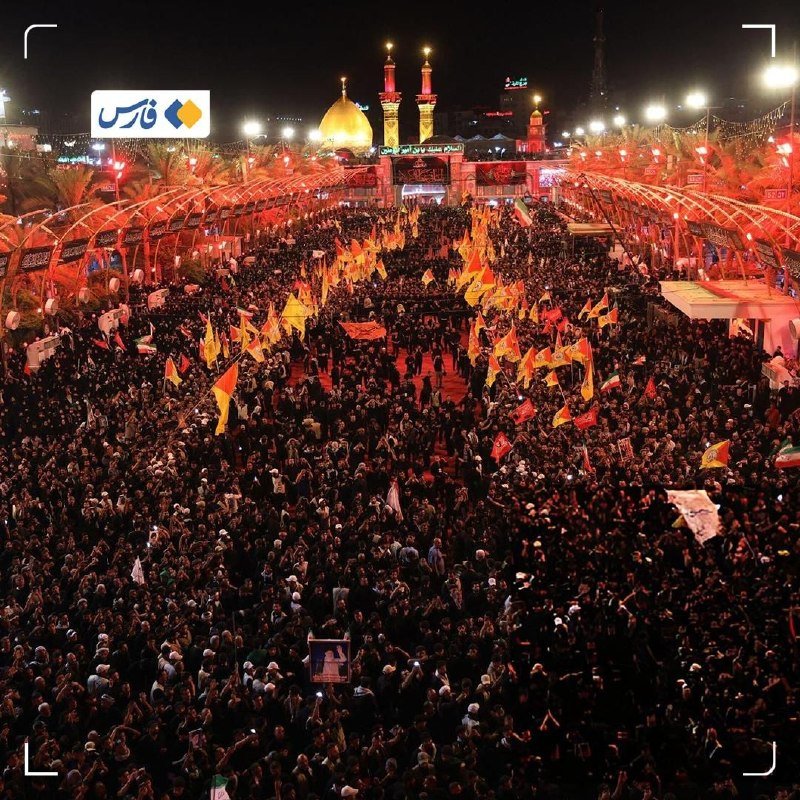
In the early hours of 8 July 2026, Iranian state media broadcast a procession of coffins arriving in Najaf, the Shia holy city south of Baghdad, where thousands of Iraqi mourners lined the streets. The footage — released by Tasnim News and Mehr News and relayed through their English and Arabic feeds — was framed as a funeral for the "martyred leader of Iran," though Iranian outlets did not name the deceased in the captions that circulated. By 03:20 UTC, Mehr News was already carrying video of mourners gathered at the shrine; within the hour, the procession had moved to a vehicle carrying the coffins, prepared for transit.
For a story about an Iranian leader buried in Iraq, the public choreography matters as much as the death itself. Funerals are the occasions when the Islamic Republic stages the political theology of its regional role: a senior figure interred under Iraqi soil, an Iraqi crowd in attendance, and Iranian television setting the visual grammar for every other outlet that picks the frame up downstream.
The immediate event
The first wire of the day came at 02:33 UTC, when Tasnim's Arabic-language feed posted footage described in caption as preparation of the vehicle carrying the "purified bodies" in Najaf. Forty minutes later, the English version of Tasnim carried the same video, tagged with hashtags including "Badarqa_Aghai_Shahid_Iran" and "must_rise." Mehr News added coverage at 03:19 UTC of the "large presence of Iraqi people" at the burial, and at 03:20 UTC published a video captioned as mourning at the funeral.
No outlet has yet confirmed in the captions circulated through these channels the name of the deceased, the date or circumstances of death, or whether the interment is taking place inside one of Najaf's shrine complexes or at a separate cemetery. Iranian state media, consistent with its practice around senior security figures, releases identity and biography in measured instalments. The visual record — Najaf streets, a closed casket, a coordinated Iraqi crowd — is the part Tehran is content to have circulated first.
What the framing reveals
Iranian state outlets treat Najaf as more than a venue. For the Islamic Republic's projection of authority across the Shia arc stretching from Beirut to Basra, burial in a shrine city south of Baghdad is a deliberate signal: that the regional constituency the Republic claims to lead is Iraqi and confessional, not just Iranian, and that Iraqi clerical and popular legitimacy can be summoned to the Republic's cause on short notice. The presence of an Iraqi crowd is therefore not incidental but functional. A foreign minister's condolence call, a senior cleric's televised eulogy, and a hashtag campaign on Persian-language social media are all conventional choreography; the less conventional element is the decision to lay the body to rest in another country's holiest city.
This is also why the framing vocabulary matters. "Martyrdom," "purified bodies," and "must rise" are not editorial choices; they are part of an established register that Iranian outlets use to fuse grief, theology, and mobilisation. International wire services tend to translate but not interrogate that register, so the underlying message — that the death is a moral event with political obligations — travels intact.
The structural read
Regional funerals have become a measurable asset in the Islamic Republic's diplomatic toolkit. Past ceremonies, including the elaborate ceremonies surrounding General Qassem Soleimani in January 2020, demonstrated how Tehran can convert a death into a real-time assertion of geopolitical weight, drawing mourners from allied movements in Iraq, Lebanon, Yemen, and beyond, and compelling Western outlets to broadcast imagery the Republic has selected. Najaf in July 2026 fits that template, with Iraqi pilgrims and mourners performing the public role that Persian crowds have performed elsewhere.
Underneath the choreography is a structural fact: the Islamic Republic's regional influence is increasingly maintained not by territory but by rituals of remembrance, shrine politics, and the projection of clerical solidarity across borders. Funerals are the most visible expression of that project, and Najaf — the resting place of Imam Ali — is the most prestigious venue in the Shia world outside Iran.
Stakes and what to watch
The next 72 hours will reveal how the Republican establishment intends to convert the moment into a political instrument. Whether a senior Iraqi cleric or political figure delivers a formal eulogy, whether Iraqi government officials attend the procession, and whether the burial concludes at the shrine or at a separate cemetery will determine the scale of the assertion Iraq is being invited to make. Iraqi institutional politics — the uneasy balance between Baghdad, Najaf's clerical establishment, and Iran-aligned paramilitary factions inside the Popular Mobilisation Forces — runs underneath all of these questions.
Iran's regional adversaries will read the choreography too. If the funeral becomes a setting for official Iraqi support of Tehran's regional posture — particularly on sanctions enforcement, on the arming of Iraqi paramilitary formations, or on the diplomatic file with Washington — the implications run beyond grief.
What the sources do not yet say
The thread context here is exclusively Iranian state media. Iranian outlets are reliable for the scenes they were positioned to film; they are not independent sources for the identity of the dead, the cause of death, or the reaction of Iraqi political and religious authorities who are not on camera. The framing vocabulary — martyrdom, purified bodies, must rise — is Iranian and not shared across Iraqi media or the international wire. A fuller account requires Iraqi outlets of record (Al-Mada, Al-Sumaria, Shafaq News), Western newswire confirmation, and a clearer identification of the deceased before any assessment of the political consequences can be made.
Monexus has relied on Iranian state footage and captions for the visual record; the political read above is separate from those captions and is offered with the caveat that, in this stage of the story, the most consequential details remain undisclosed.
Wire provenance
This editorial synthesis draws on the following public wire/social posts:
- https://t.me/mehrnews
- https://t.me/JahanTasnim
- https://t.me/JahanTasnim
- https://t.me/tasnimnews_en
- https://t.me/JahanTasnim