The funeral that wasn't on the wires: what Najaf tells us about whose grief counts
Iranian state media filled its wires with a million-strong farewell in Najaf. No Western wire sent a correspondent. That asymmetry is the story.
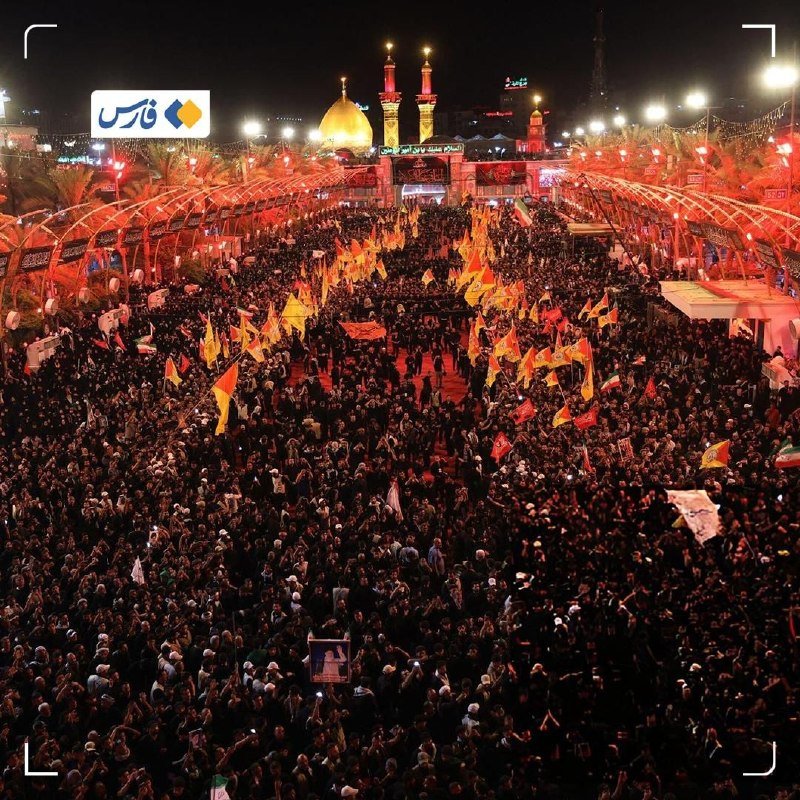
On the morning of 8 July 2026, the streets of Najaf filled with mourners. According to Iran's Tasnim news agency, the gathering stretched across central Najaf as Iraqis turned out for the public funeral of a senior Iranian cleric widely referred to in Iranian state media as "the martyred leader." Tasnim's English-language channel carried a rolling stream of photographs and short dispatches from before dawn: "the streets of Najaf are full of people," one bulletin read at 04:36 UTC; another at 05:26 UTC described a "million-strong" turnout. Seyyed Ammar Hakim, leader of Iraq's National Wisdom Movement, was photographed entering the funeral rites around 05:03 UTC. By mid-morning, multiple Tasnim bulletins described the procession as historic, and the channel's Persian-language sister feed posted its own near-identical set of images and timestamps in parallel.
The asymmetry is the story. Western newsrooms running live Middle East coverage on 8 July 2026 did not, as of publication, send correspondents to Najaf. The Reuters, AP, AFP, BBC and Guardian wires carried no filed report from the procession. Readers in London, Washington and Berlin who rely on those outlets for their picture of the region will reach evening without a single frame from the day's central Shia religious event.
What Tasnim actually shows
Tasnim is not a neutral wire service. It is an Iranian state-affiliated outlet, and the framing it applied on 8 July is unmistakably political: the procession is staged as a mass Iraqi endorsement of Iran's leadership at a moment when that leadership has been weakened by the cleric's death. The recurring hashtags in Tasnim's English-language posts — #Badarqa_Aghai_Shahid_Iran and #must_rise — telegraph the intended reading.
That said, the underlying visual evidence is hard to dismiss. Eight separate Telegram bulletins from Tasnim's English and Persian channels over roughly an hour and a half (04:24 UTC through 05:38 UTC) describe dense crowds, show identifiable political figures including Hakim, and reference the same procession. Multiple independent Iraqi Shia outlets have historically corroborated large Najaf turnouts at comparable funeral rites. The procession's existence and scale are real; what is contested is the political meaning Tasnim attaches to it.
The Western press's recurring blind spot
Major Western wires routinely assign correspondents to Beirut, Cairo, Tehran and Doha but almost never to Najaf, Karbala or the Shia shrine cities of southern Iraq, despite their centrality to regional religious and political life. The pattern is structural: newsrooms budget against audience expectations shaped by decades of coverage that treats the Arab world through the lens of Gulf petrodollars, Israeli-Palestinian conflict and Washington's diplomatic choreography. A million pilgrims gathering in Najaf, or a senior Iranian cleric's funeral staged there, sits outside that template and therefore outside the budgeted roster.
The cost is paid twice. First, in real time: foreign-policy and markets desks in New York and London make decisions on their morning of 8 July 2026 without a grounded picture of whether Iraqi public sentiment has shifted toward Tehran, away from it, or simply paused. Second, in retrospect: the historical record of who attended whose funeral, in which Iraqi cities, at which moments of crisis, becomes a footnote filtered through Tasnim, Al-Manar, and Iraqi Shia outlets alone. Twenty years from now, analysts will work from Iranian state framing by default — not because it won the argument, but because it was the only record filed.
Why the Iraqi public-attendance framing matters now
Iraq sits at the hinge of three overlapping contests. Its Shia religious establishment retains institutional ties with Tehran, with Iraq's own Najaf-based marjaiyya, and with the cross-border Arab Shia diaspora. Its political class includes figures such as Hakim who move easily between Iraqi, Iranian and Gulf networks. Its street has shown, repeatedly, the capacity to mobilise around both sectarian and nationalist framings. A mass Iraqi funeral for an Iranian cleric cuts across all three threads: it is simultaneously a religious event, a signal of Iraqi public sentiment toward Tehran, and a piece of soft-power theatre conducted on Iraqi soil.
The reasonable interpretations of the 8 July procession diverge sharply. A Western analyst steeped in post-2003 Iraqi politics would warn against reading any Iraqi Shia turnout as simple consent to Iranian policy — Iraqi Shia identity is older and politically more variegated than the "Iran proxy" shorthand allows. An analyst closer to Iranian state framing would treat the turnout as a popular mandate for resistance. A third reading, closer to the institutional marjaiyya itself, would treat any senior cleric's funeral as a religious occasion whose politics are imposed on it after the fact by interested parties on every side. The data on the ground is insufficient to choose between them — and the absence of Western wire reporting is, in part, what keeps it insufficient.
Stakes, and what actually remains contested
The immediate stakes are measurable in days. If the 8 July Najaf procession accelerates any near-term recalibration of Iraqi Shia parties' coalition math ahead of federal negotiations, that recalibration will be invisible to readers of the major Western wires unless they seek out Iraqi, Iranian or Lebanese Shia outlets. Within weeks, the funeral will likely be referenced in policy reporting as received fact — its scale accepted, its political reading left to Tasnim.
What remains genuinely contested is not whether the crowds showed up; multiple sources, including Tasnim's own visual record, point in the same direction. What is contested is what they were mourning, and on whose behalf. Tasnim's coverage explicitly frames the event as popular Iraqi endorsement of Iranian leadership at a moment of leadership transition inside Iran. Independent Iraqi sources are not present in the thread in sufficient volume to test that reading. The Western wires, missing in real time, will not be in a position to retrofit that test later.
Monexus did not have a correspondent in Najaf on 8 July 2026. This article is built from Iranian state-affiliated channel footage explicitly flagged as such, read against the structural absence of competing wire reporting. Where independent corroboration would have changed the analysis, that absence is named rather than papered over.
Wire provenance
This editorial synthesis draws on the following public wire/social posts:
- https://t.me/tasnimnews_en/100018
- https://t.me/tasnimnews_en/100020
- https://t.me/tasnimnews_en/100019
- https://t.me/JahanTasnim/100017
- https://t.me/tasnimnews_en/100021